


Areas We Cover
Categories

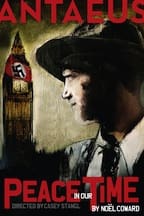
Los Angeles Theater Review: PEACE IN OUR TIME (Antaeus Company at Deaf West Theatre)
by Tony Frankel | October 27, 2011
in Los Angeles
A COWARD IN PEACETIME
[Undelivered letter to Noël Coward discovered in North Hollywood:]
My Darling Noël:
Sir Anthony here, writing to you from the palm-drenched regions of Los Angeles, where I am taking a much-needed holiday from the horrors of war. (Let me know, Dear Boy, if I could peddle some of your film scripts while I am here, would you?) How pleasant that Americans (Angelinos in particular) are loathe to discuss war in general, so my respite from la guerre was a fait accomplis until you, like an infiltrating spore of mold, brought World War II right back into my face. No sooner had I acquired an article about your role in the war, than I happened upon a darling company of professional actors who are reviving your rarely performed play Peace in Our Time. Your script is a stark reminder of the folly of war, but what could have been a preachy aide memoire of those nasty Germans turned into an uplifting, compelling, and completely transformative experience, thanks to both the ideas put forth in your play and the loving aesthetic of the Antaeus Company.
The article I read stated that you were acting on behalf of the Secret Service in France during the War, while we all thought that you were living up to your last name, sunning somewhere in the South Seas with some debauchery-ridden theatre company. Do please forgive me. I read that you began to suspect, while in France, that the physical effect of four years intermittent bombing was far less damaging to the intrinsic character of a nation than the spiritual effect of four years enemy occupation.
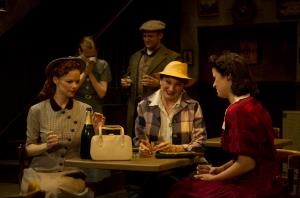
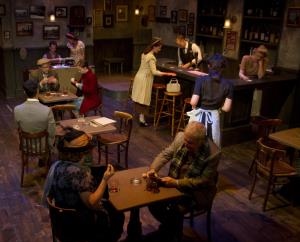
Quite right. The Americans lost a great deal of brave men, but the atmosphere here is much more triumphant and cocky than it is in the once-occupied, beleaguered nations of Europe. Ergo, Peace in Our Time is quite a brilliant premise: you envisage an England that lost The Battle of Britain, and is now under the enemy hands of the clutching Nazis. Instead of your usual cast of well-off sophisticates in some swanky salon, you place us in a saloon bar where class distinction is less an issue than the mettle of the denizens therein.
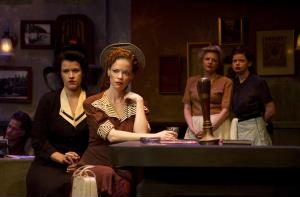
The opening diorama is as much a tribute to the shrewd direction of Casey Stangl as it is to the expertise of the design talent on hand: A torch singer named Lyia, played by the entrancing and distinctive-voiced Rebecca Mozo, sings one of your tunes, “London Pride,” as the lights are dim on a tableau vivant of the stationary patrons. Soon, Jeremy Pivnick’s lights slowly come up on a public house called The Shy Gazelle (very clever name, Noël), and as soon as they reach their peak, the song ends and the action begins. This powerful opening tells me that Antaeus is up to something much larger than are most companies in the States. The enthralling atmosphere is as important as the storytelling.
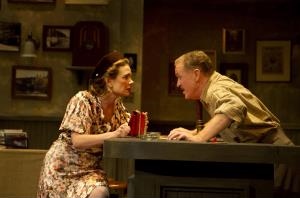
I tell you, it was as if I were home in London again: Tom Buderwitz’s rustic pub was so rife with the sumptuously brilliant décor of Heather Ho that I found myself searching among the British bottles and artifacts for some Spotted Dick. Jessica Olson’s wartime costumes were lovely, confirming that even while on the brink of doomsday, we Brits could still put an outfit together. Although you and I would much prefer sipping scotch and soda at the Savoy, I was infinitely titillated by John Allee’s tinkling on the tinny piano and John Zalewski’s directional sound. This design team, if you’ll pardon the pun, definitely hit a toad-in-the-hole-in-one.
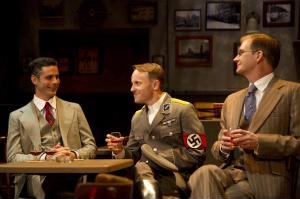
Now before you drop your cocktail, Old Thing, you should know that company member Barry Creyton adapted your original work, deleting some characters and adding 11 of your songs. The songs themselves do not heighten the drama, yet they certainly aid in crafting a distinct atmosphere. And without having seen your play before, I can attest that your script is all the better for it (22 characters are quite enough, thank you). Master Creyton has been most faithful to your script, ensuring that each character – the P.O.W., the barkeep, the trollop – has a reason for being there. Leave it to you, dear fellow, to write a play that is saturated with your trademark witticisms, even as it may lean towards the melodramatic and somewhat overly patriotic.
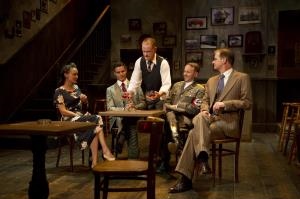
The more actors I list, the less time I have to hang about by the pool, but a few certainly deserve a mention: First, only you would have the role of an Englishman who is an informer to the Germans be a stuffy editor named Chorley Bannister! (Nobody likes an editor, except those with a published novel, n’est-ce pas?) Bill Brochtrup played the role like a petulant little prep-school brat; he is quite adorable and smarmy at the same time. Rob Nagle simply triumphs as the SS Man who patrols the neighborhood: this is an actor to watch, for his every glance and movement is positively organic. (Knowing that you love criticism just so long as it’s unqualified praise, I must add that I wish that you would have crafted an immensely likeable German character: we really should empathize with the poor bloke.)

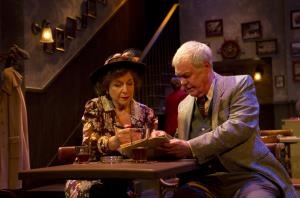
Ann Noble is not only beautiful but sympathetically vulnerable as patron Alma Boughton. As you know, Alma’s mother, Mrs. Massiter, has a cameo towards the end of the play; all I can say is bravo to Melinda Peterson, whose comedy is grounded in reality. (I really must write to this actress; if she is as good offstage as on, than the Singapore Sling is on me.) Equally dazzling is Rebekah Tripp as the Dorothy Parker-esque writer, Janet Braid – that’s a spectacular cat fight you wrote between her and Bannister. My favorite thespian of the evening is the estimable Josh Clark as the publican Fred Shattock; this is a professional who actively listens to other actors and reacts accordingly. As the man most responsible for keeping the peace in his surroundings, Master Clark is a spectacular realization of grace under pressure.
 While I truly cannot, in good conscience, call this an important play, it is a compelling work that addresses the shocking attempts of one nation to overthrow other nations (a most timely subject for Americans). The most fascinating aspect is watching the many ways people deal with such a homeland intrusion, from complicity to feats of derring-do.
Not all is perfect across The Pond: Antaeus double casts their plays, as many of their performers get paying work at a moment’s notice. But, Good Heavens, that means Ms. Stangl must deal with 46 actors, 23 in each cast, and the one on display (known as the “Stubbs Special”) needed a bit more rehearsal to become a fully-integrated team. There was a part of me that felt as if some understudies had suddenly joined a cast that was already quite familiar with the show. Plus, the dialects ran the gamut, from mostly spot-on to awkward.
Yet I must say that when the publican and his clients celebrate good news about a successful allied attack, the stellar company comes together in a way that is sensational. My appetite to see the other cast is more than whetted, since this estimable company has actors who are talented enough to make, as you would say, an Albanian phonebook come to life.
Now I must return to some liquid refreshment, darling Noël. Do be an angel and write about some tawdry affair on an ocean liner or whatnot. This is not a criticism, but Peace in Our Time had me thinking far too much about war, and not peace.
Yours most sincerely,
Sir Anthony
* * * * * * * * * * * * * * * * * * * * * * * * * * *
photos by Steven Brand
Peace in Our Time (“Stubbs Special” cast)
Antaeus Company
Deaf West Theatre, 5112 Lankershim Blvd in North Hollywood
Thurs and Fri at 8; Sat and Sun at 2 & 8
ends on December 11, 2011
for tickets, call 818.506.1983 or visit Antaeus
