


Areas We Cover
Categories

LA Theater Reviews, Commentaries, Rants, etc: THE 2ND ANNUAL HOLLYWOOD FRINGE FESTIVAL 2011

by Tony Frankel | July 17, 2011
in Los Angeles
HOLLYWOOD FRINGE FESTIVAL REVIEWS 2011
[Editor’s Note: Our (either) amazing or insane (you decide) theater correspondent Tony Frankel saw somewhere in the area of 40 Fringe shows during its ten-day festival; we’re pretty sure no one else exceeded that. Although the Fringe is now over, some of the shows that were featured have kept going past the festival’s end; those shows are reviewed elsewhere with their own individual reviews. What follows here are individual reviews of the shows that were contained within the festival. They are all on a single long web page. To see a specific review, click on a title below and you will jump to it.]
A MESS OF THINGS: A NEW DOCUMENTARY MUSICPLAY
ANOTHER EFFING FAMILY DRAMA
BE CAREFUL! THE SHARKS WILL EAT YOU!
COWBOY MOUTH
DEITY CLUTCH
EVOLUTION OF A KISS
FIVE UNEASY PIECES
FREAKSHOW DELUXE
GIRL BAND IN THE MEN’S ROOM
GROUP
LOST MOON RADIO
MAIZY: A FABLE
MARTINI AND OLIVE: TORN BETWEEN TWO LOVE HANDLES
MY MOBSTER
PORTER’S MACBETH
SMOKE AND MIRRORS
SPRING AWAKENING
STEAL AWAY: THE LIVING HISTORY OF HARRIET TUBMAN
THE BARKING PIG
THE DUMB WAITER
THE MILFORD PROJECT
THE NEXT BEST THING
THE SEX LIFE OF ACHILLES
 A Mess of Things: A New Documentary Musicplay
TRUE INVENTION
Adam Tinkle’s solo intermedia performance piece is about his peculiar father, Ben, who is forced to move out of his house of fifty years; the problem is that Ben has tinkered on more inventions than Thomas Edison, hoarding bits of every project in the basement. After the detritus is tossed into storage units, Mr. Tinkle recorded his family members and their feelings regarding this accrual of rubbish:or is it a treasure?
The influence of Ira Glass’ This American Life are evident in these audios, wherein splices of family dialogue reveal more about the American way of consumerism and storage than any commentator could. The influence of The Books is also evident when Mr. Tinkle stands before a microphone and accompanies his own folk-like, sometimes chaotically structured songs and text with guitar and saxophone (The Books and their “collage music” are nearly indescribable – they are an American duo who perform acoustic folk melodies with vocals and digitally processed sound).
 In A Mess of Things, sound artist Tinkle’s poetic creations (along with an occasional wry comment) are effectively sparse, counterbalancing the subject of stockpiling that we hear on the interspersed family recordings. The influence of “multimedia opera pioneer” Laurie Anderson is equally evident as Tinkle combines all of these elements with a television set that transmits scenes from nature. His show is self-admittedly a bit like all of these artists, and while Tinkle is still tinkering with the invention of his own wholly unique style, the gentle simplicity of what he calls a “videographically illuminated radio opera” and “a looping folk fable of memory, repetition and hoarding” sheds a cathartic light on a complex issue.
The show is more of a meditation than an entertainment – those who need a barrage of stylistic brouhaha in order to pay attention may have a tough time understanding this most fascinating artist. But if you actively listen, you will be rewarded with a keen understanding of the addiction to consumerism and the inability to dissociate from material possessions – a uniquely American disease. Tinker’s show was a welcome respite from the manic tomfoolery and assault of so many Fringe entries.
 Another Effing Family Drama
THE DEATH OF A DEATH OF A SALESMAN PARODY
In Another Effing Family Drama, playwright Catherine Pelonero had the idea to spoof the kitchen sink variety of family dramas, but instead of concocting a compelling story in which her stock characters are blatantly aware of their dysfunctions, she merely presents a repetitive drone of a piece that is silly and sophomoric. Even if you are familiar with the plays that she pokes fun at, the thinly drawn characters merely comment on their situation – making for poor satire (the joke where a delivery man actually delivers a kitchen sink falls flat because the sink serves no other purpose; it’s a punch line with no set-up). This structure leaves the actors floundering in an attempt to flesh out characters; the most successful being Monica Martin as a trashy, trumpet-blowing alcoholic. Pelonero is advised to re-visit O’Neill, Williams, Miller, et al, and create a strong story first, and then craft the satire around that. This is why satire is extremely difficult to manifest – you have to be as serious with your subject matter as the plays which are being parodied. Unfortunately, not a recommended show.
 Be Careful! The Sharks Will Eat You!
A ONE MAN CUBAN REVOLUTION
Just when I thought I was burnt out on autobiographical solo shows, Jay Alvarez comes along and, slowly at first, manages to capture the experience of his family’s perilous escape from Castro’s 1964 Cuba with such heartrending power that  we are amazed at what lengths some people will go to for freedom and, most importantly, how Americans take our freedom for granted. It is masterful storytelling, too, as Alvarez interweaves the history of Cuba, interviews with his father, immigration issues, and a thesis on self-identification. The visuals Alvarez conjures up with his insightful writing saw Non-Cuban members of the audience openly weeping throughout the play, alongside empathetic laughter. My concern is that Alvarez’ fascinating show may get lost in the morass of one-person plays – this story needs to be seen by huge audiences.
 Cowboy Mouth
DOWN IN THE MOUTH
As impressed as I am with the commitment, passion and vision of the UC San Diego grads involved with the production of Sam Shepard’s existential one-acter Cowboy Mouth, I found myself distracted – and ultimately exhausted – by the over-enthusiastic acting and direction. Shepard’s 1971 play is an autobiographical account of the brief and torrid affair he had with singer Patti Smith, who not only co-wrote the piece, but starred in the original production with Shepard himself. The play hit so close to home for Shepard that he bolted after one performance to reunite with his wife.
Cowboy Mouth is a brutal examination of an affair – an affair that may not have occurred as a love connection, but as a tool to fill life’s eternal voids. The glaringly self-indulgent script vacillates between naturalism and poetry; it is filled with metaphors and symbols (such as a dead crow for a pet) which are generated from insider info that would go over the head of most audiences: One character is a Lobster Man, who is based on French Poet Gerard de Nerval’s pet lobster, one that he took for daily walks (Smith claims that she was born on the day that Nerval hung himself). Also, the title Cowboy Mouth is taken from a Bob Dylan song, and Dylan lived at the Chelsea Hotel where the incendiary affair took place.
 For the play to resonate as a theatrical experience, the actors – in this case, Justin O’Neill as Slim and Claire Kaplan as Cavale – need to do some seriously layered work. But the manic direction by Samuel Hunter kept the hard-working actors so busy that internalized choices of character came off as an afterthought. As such, the vocal deliveries were often shrill: screaming does not intensify the language, it only serves to distance us from the absurdist/poetic dialogue. I’m shocked to see the word “nuance” used in some of the reviews on the Fringe Site, for the production, as a whole, had about as much nuance as a stampede. In fact, a violent and frenetic dance piece opens the show, leaving both actors nowhere to go – they’re out of breath and distractingly sweaty from the get-go. If such a “dance” is added, why not stylize it in, say, Kabuki?
The most interesting moments came when the dust settled and the actors caught their breath; both lead actors clearly have the ability to tap into their internal life, but their technique is way too raw, forced and unpolished, as is the direction of Samuel Hunter. Certainly, there was some good work (especially Ms. Kaplan and the quiet intensity of Spencer Howard as the Lobster Man), but a violent production of a violent play in a tiny space only substantiates the notion of many an acting teacher: Keep it Simple.
 Deity Clutch
TALK ABOUT THE TROUBLE WITH WORDS!
While playwright Gus Kreiger may be having a lexicological field-day with his new script Deity Clutch, his thesaurus-consulting word-play becomes the undoing of his post-apocalyptic tale – for although we are smitten with how much fun he is having with the English language, the verbosity trumps story and character development.
Interestingly enough, I entered the theatre one minute after the show began and spent the entire first act wondering how the author had managed to disseminate all of his exposition in that first minute. The style, at first, is decidedly theatre of the absurd (both Beckett and Stoppard come to mind); Kreiger is at his best with the creation of existential repartee. The style than jarringly shifts to a mock Elizabethan with some sci-fi George Lucas thrown in, and it soon becomes apparent that the script is a labyrinthine journey down a rabbit hole of ideas, leaving his audience in the dizzying dark. The basic structure of a story lies buried beneath the explosion of words – that of a group of people who have holed themselves up in a mansion to protect themselves from “The Outsiders” (whoever they are), but members of the group begin to disappear and no one knows who to trust. It’s a terrific idea, but really, we walked out of the theatre feeling slimed by vowels and consonants.
 I suspect that some theatregoers may be so impressed with Kreiger’s assemblage of three-syllable words that they may not notice how challenged the actors are with the complicated language. The acting, by the way, ranges from glorious to flat, largely due to the stylistic discrepancies in the script.
I love the Porters of Hellsgate, but why choose a huge undertaking such as this to showcase at the Fringe? Yes, Kreiger is the Associate Artistic Director and Head of New Works, but someone should have said, “Gee, Gus, maybe you spent too much time playing Dungeons and Dragons, because much of the dialogue sounds like a video game.” This Fringe outing was a repeat engagement for The Porters of Hellsgate and they may yet do it again (hell, very few of the young companies are listening to critics, anyway). If that happens, I recommend it to any young practitioner of the theatre: you may feel alienated but never bored, and you will see a perfect example of a playwright who is too clever by half. Hopefully, budding playwrights will learn that the story must be crafted first, and then you can have all the fun you want tweaking the language.
 Evolution of a Kiss
BÉSAME MUCHO
Cynthia Brinkman is an extremely engaging and endearing actress who successfully manages to create 3 generations of Latina women and their rite-of-passage involving a first kiss. Brinkman also wrote the piece, which is based on authentic entries in journals from her mother and grandmother. The scenes work particularly well, and Brinkman’s expressions are priceless. Her comedy is most organic and never forced.
However, I am not a huge fan of solo shows with characters that break the fourth wall and speak to the audience. I believe the show would be even stronger if Brinkman did not ask us if we know what certain words are in Spanish, but rather let the words speak for themselves in the scenes. She is adept enough at creating characters and deftly moving from one to the other, so what is the purpose of talking to the crowd?  It feels like Ms. Brinkman is asking us, “Do you like me? Do you really like me?” Yes, we do. As it stands, however, Evolution of a Kiss is entertaining and fun; it even conjured up memories of my own awkward teenage years (are there any other kind?)
I must state that there is genuineness about Brinkman – an openness and goodness – that shines through in her performance. She appears to be a lovely and gracious lady – you will not be sorry to have spent time with her.
 Five Uneasy Pieces
HE MAKES IT LOOK UNEASY
Had I not been supremely entertained and enthused by Todd Waring’s Five Uneasy Pieces, I would have been consumed with jealousy over the consummate acting skills he employs. Doubly remarkable is that Waring writes monologues with such authenticity that his six distinct characters seem to be speaking off-the-cuff. With just a button of a shirt or the addition of a vest, Waring adroitly melts from an old southern woman to an Australian art teacher; a has-been English theatre critic to a gangbanger grappling with internalized homophobia; and a Heart of Darkness-like special ops leader in Afghanistan. Each monologue may have shock value, but Waring deserves each seat-squirming moment because his expertise in character development makes them well-earned. The acting is rich and focused, utilizing incredible space work, complex mannerisms, and master dialects. The play shows off Waring’s talents, but he’s not showing off; instead, he relishes moments and allows his creations to breath. This is a classically-trained actor with a fascinating internal engine; you would have to search well to find better acting in the entire Hollywood Fringe Festival.
 The anxiety that these mini-plays may create is smoothed out by swing bassist Edwin Livingston, who makes the minimalist settings come alive. After the titular monologues, we are treated to the astounding mimicry of some Jacques Brel wannabe – Waring’s Robert Clary-esque vibrato alone is worth the visit and the mini-concert was hilarious (my French-speaking companion surprised me with the news that Mr. French was not actually speaking French, they were nonsense syllables).
Because this play obviously showcases Waring’s insanely good talent, some may label this enterprise a “showcase.” But unlike other showcases that serve no other purpose than to parade people who would have been better left at home, Five Uneasy Pieces is a celebration of the craft of acting. And what’s wrong with that?
 Freakshow Deluxe
DON’T TRY THIS AT HOME (OR IN A THEATRE, FOR THAT MATTER)
OK, who doesn’t love a freak show? There is no denying the thrill of watching folks walk on glass, pierce their bodies, lie down on a bed of nails or swallow sharp objects. For a break in the department of self-mutilation, why not throw in a card trick or two?
The reason that I attended this entertainment oddity was its status as Winner of the 2010 Hollywood Fringe Festival’s Award for Best Cabaret/Circus (a category that was changed to The Fringe Award for Cabaret & Variety this year – which is a shame because the Best Circus award at the Fringe would have gone to the way that the awards were handed out:but that’s another story).
 This “Carnival-Style Sideshow” is based on the “Ten-in-One” sideshow, a sequence of acts that include Born Freaks (people with physical deformities, such as The Elephant Man), Made Freaks (such as tattooed or extremely obese people), and a variety of stunts and magic. In the Dustbowl of 1920’s Oklahoma, with no TV or movie theatres, this shit must have been killer. But this is 2011, and all we have to do is turn on the internet for a display of thousands of freaks, from David Blaine to Tom Green to Sarah Palin.
Perhaps it’s because I am sitting in a theatre, but this oddity of a diversion has about as much theatricality as a Little Rascals backyard entertainment. Any great act, magician or freak is all about the build-up. Because Freakshow Deluxe changes artists with any given performance, there is no way for them to construct a solid, steady show, even though most of these folks are the real thing. Apparently, the ringleader who normally introduces acts was off freaking somewhere else, so the replacement, a little person, inadequately delivered poorly written introductions.
 Except for the astoundingly fabulous piano player (the deadpan Brother Daniel the Demented, who also composed and recorded the fun theme song), this show was freaky boring: the audience had to be constantly reminded to applaud for the acts, and the entire proceeding lacked an air of suspense, mystery and creepiness. The audience members are the ones who must go from pain to resistance to extraordinary flexibility to buy this as a theatrical entertainment.
 Girl Band in the Men’s Room
STRAIGHT FLUSH
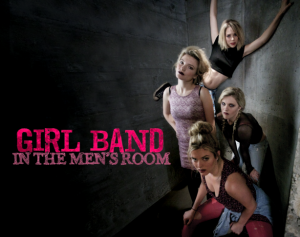
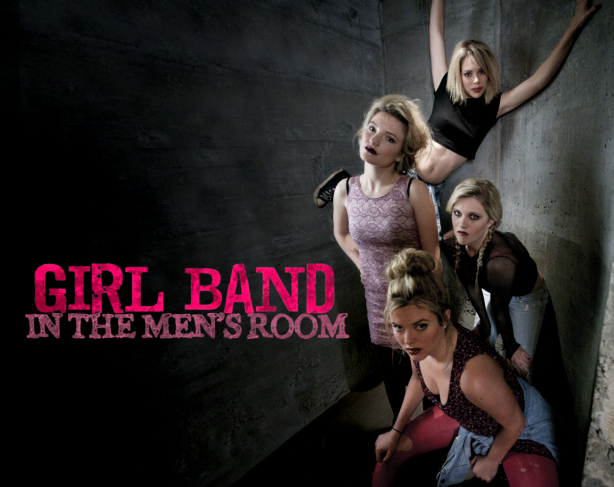
On the precipice of what may be a lucrative recording contract, four female musicians, in a backstage men’s bathroom, get ready for a gig. In Robert Ford’s very promising short play, these girls are about to discover the communion and friction inherent in a musical group.
Whether or not Girl Band in the Men’s Room can be developed into a grown-up play remains to be seen, but Ford’s script is rife with playful, pitch-perfect patois, evoking the 90s alternative rock/grunge scene without romanticizing it. Updating this piece to modern times would be a mistake, as part of its appeal is the clash of ideals at a time when polarized politics became the norm. Clinton represented  possibilities for the future (especially to the younger set), but the chains of 1980s American Family Values kept America shackled to the past. Therefore, Kurt Cobain’s 1994 demise, which casts a shadow over the Girl Band, is a perfect metaphor for the times: his death spoke to fame, rebellion, religion, drug use, and following one’s vision – all of which are motifs in the play. The experience is also nostalgic, largely because we don’t have to think about piracy, bootleg downloads, and American Idol. As such, the story is a universal voyage of discovery which ruminates on timely and universal themes: women seeking influence in a man’s world; disparate actions and motivations toward a common goal; and the balancing act between self-expression, art and business. Each character shines with diversity (not the skin color, but personality – these chicks (as cast) are white and blond),
  but it is the actresses (Erin Boyes, Kat Primeau, Katherine Skelton and Lisa Summerscales) who bring this play to life under the surehanded direction of Michael Kortlander.
However, there are some problems: there is the opening monologue where a bandmember talks to herself like a character out of One Flew Over The Cuckoo’s Nest; the too-easy interaction with a guy who comes in for a pee, and the lack of discovery – these chicks seem to know themselves and each other a little too well. Maybe some shocking revelations? I’m rooting for this show and the newly formed producers, Dirtie Blonde Productions.
 Group: A Musical
YOU’LL NEED GROUP THERAPY AFTER SEEING THIS MUSICAL
Here’s what I don’t understand: A musical premieres in Los Angeles, the reviews are encouraging BUT but loaded with caveats. Instead of tweaking the material, the creators settle with what they’ve got, blatantly disregarding the advice of the critics, and present the same troubled work about a troubled college professor who encourages his 6 troubled clients to sing their confessions, aided by a three-piece band that was hired by the professor. Miraculously, the patients and musicians come up with songs on the spot.
Here are snippets of the reviews:
– “Admittedly, each of the seven characters is someone whose story we’ve seen before, whether on stage or on the big screen or on a day-or-nighttime soap;”
– “A bit on the underdeveloped, overly familiar side;”
– “Feels precisely like a season of ‘Glee’ jammed into a two-hour play;”
– “An uneven and intellectually ambitious musical about group therapy. Sadly, director Richard Tatum’s lackluster production is marred by flat acting and indifferent music:The generic-therapy conflicts strain to engender our sympathy, while the songs are a collection of slight melodies and unexceptional lyrics along the lines of, ’You’ve got your issues. Here, take a tissue;’” and
– “Appealing if unfinished experiment:needs a tighter story line, more surprise, and a bit of diversity to give this production the dramatic engine it needs to carry an audience through seven catharses.”
 The most telling quote of all: “Here’s hoping “Group” will keep working on its issues. A breakthrough is imminent.”
Instead of working on the issues, the creators decided to stage it again, publicizing the Hollywood Fringe run with deceptively positive snippets from the same reviews. But to what end? Are the creators looking for an angel before they re-work the piece? Are they hoping that this outing will garner more and better reviews so that they will win Best-of-Fringe and stage it yet again?
I suspect that the creators listened to feedback that they wanted to hear from friends, family and not-too-discerning audiences who elevate really mediocre shows into the category of brilliant (clearly because they have nothing brilliant to compare them to).
 Here’s the bottom line: while I agree with a majority of the reviews cited above, Group: A Musical is a predictable, sophomoric show that wears its heart on its sleeves and strains credibility with each passing revelation. The first problem is that we’re never really on board with the concept. Next is the use of stock characters: the closeted gay guy, the cancer patient, the sexaholic, etc. The acting, although showing signs of authentic emotion, is basically overwrought. Plus, it’s only the second time in a year that I had to be talked out of bolting from a show at intermission (my theatregoing companion hated it, too, but thought that surely there must be a pay-off in Act Two – there wasn’t).
Some teary-eyed moments at the end do not justify the means, and the so-called improvised songs in Group don’t hold a candle to the truly improvised musicals of Impro Theatre or The Groundlings, to name a few.
These are exciting but scary times for the theatre: young writers and directors are loaded with talent and promise, but sorely lack guidance and mentors (which is exactly why they should listen to critics!). Audiences, like the one that jumped to its collective feet for Group, are cheating our future visionaries by making them believe that their work is great (indeed, two other friends who also rose to their feet acknowledged how misguided this show was).
My suggestion to Adam Emperor Southard, who wrote the book, music and lyrics: before you attempt to re-envision musical theatre, go back and study the works of those who did so successfully (from Hammerstein to Sondheim) and then go about deconstructing their theories. It just feels as if your work, like your characters’ songs, is being made up on the spot. I know you want to be a part of something greater. I know you’re passionate. I know you see theatre as a place for ideals and inspiration. Now, it is time for you to get really tough on yourself as an artist – writing a musical is 5% inspiration and 95% sweat.
 Lost Moon Radio
LOST’S NEW HORIZONS
It’s going to be difficult to top the excitement that was generated with Lost Moon Radio’s performance at the Hollywood Fringe. In fact, their 10th episode (entitled “Travel”) was one of the most theatrically satisfying and stimulating events of the year. To know more about the troupe, see my review of Episode 8. As promised, this turned out to be one of the most talked-about events at the Fringe. Fortunately, they’ll be performing at Best of the Fringe, so you still have a chance to see the most thrilling
