


Areas We Cover
Categories

Los Angeles Theater Review: LONG DAY’S JOURNEY INTO NIGHT (Actors Co-op in Hollywood)
by Jason Rohrer | April 20, 2012
in Los Angeles
LONG DAY’S JOURNEY INTO NATURALISM
Much has been written about Eugene O’Neill’s decision to trade first names with his own dead brother Edmund when naming the younger Tyrone brothers in Long Day’s Journey into Night. The autobiographical play about the family of a fading actor was after all so personal to the writer that he sealed it in an envelope and gave instructions that it not be opened until twenty five years after his death. Those instructions’ being ignored resulted in a posthumous Pulitzer Prize (O’Neill’s fourth) and Tony award, and indirectly the current revival by director Marianne Savell with Actors Co-Op.
Like O’Neill’s father James, James Tyrone (Bruce Ladd) is an Irish actor with a convent-raised, drug-addicted wife named Mary (Nan McNamara) and two surviving sons, the older an alcoholic called Jamie (David Scales). Like Edmund Tyrone (Daniel J. Roberts), at the age of 23 Eugene O’Neill had returned from stints at sea with incipient tuberculosis and was just beginning his writing career before a trip to the sanatorium. So much of the play has been lifted directly from life, in particular the family’s retreat to a country house in the summer of 1912 (exactly the time specified in the text), that speculation has run rampant regarding that one inconsistency. Why did Eugene take his brother’s name, and give his own to a dead infant? Did he wish to give his short-lived brother a chance at immortality? As the survivor of a deadly disease, did he identify with the dead – or did he wish to? Would a part of him have preferred to die rather than put up with one more day in the company of this spectacularly awful family? You couldn’t blame him if he did.
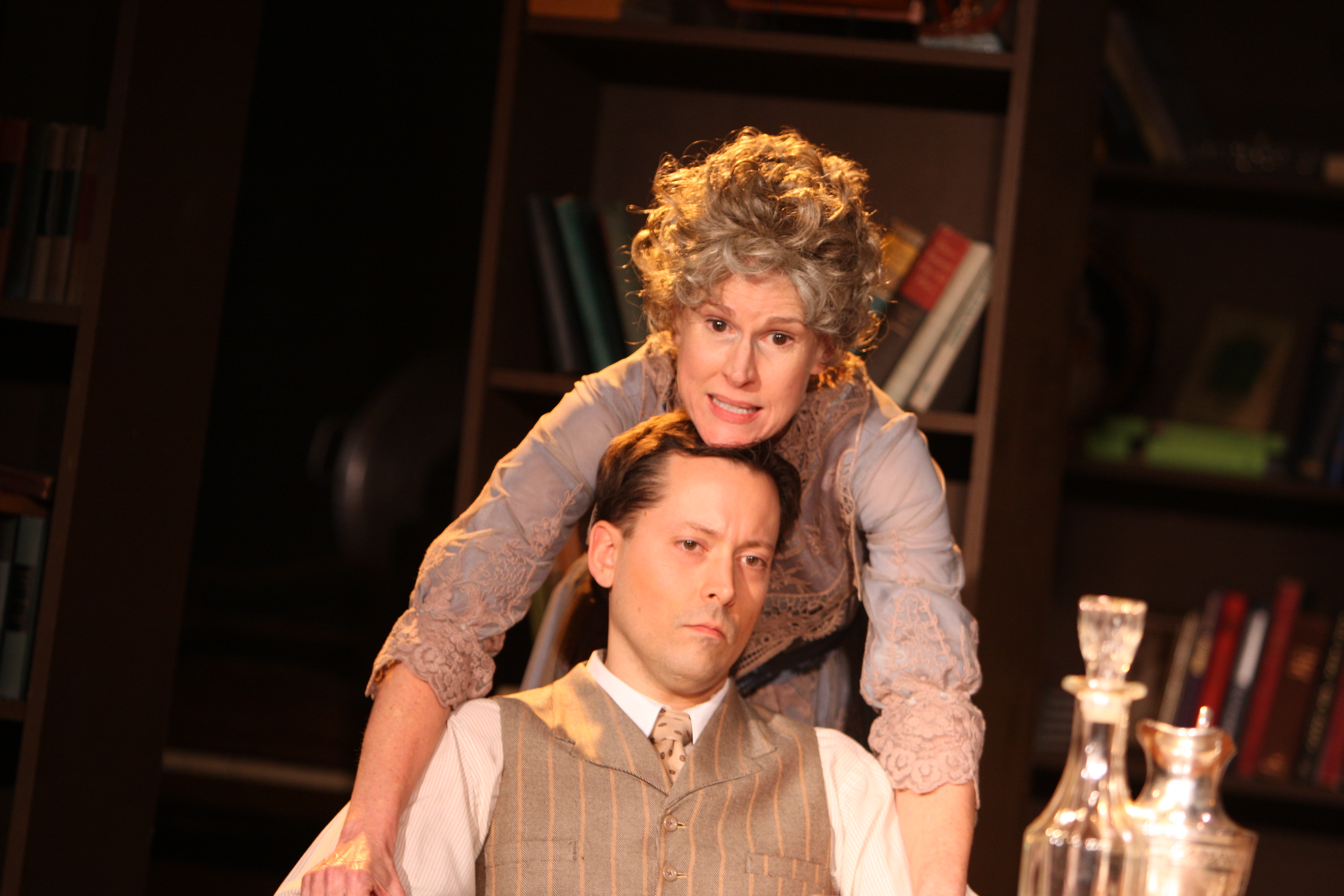
James is a domineering drunk with a tendency to pinch a dollar at the expense of his family’s health; Mary sneaks upstairs several times a day to shoot morphine into her arm, or bribes the maid (Selah Victor) to keep her company; Jamie mopes spitefully, sponging off his parents and watering his father’s whiskey after pilfering from it. Edmund coughs and tries to make the best of one miserable day, attempting to reconcile the estranged members of his family, but from a bickering breakfast to a midnight exchange of revelations there is little happiness in this house and, given the play’s 56 years on most people’s lists of great American texts, surprisingly little drama. That’s a great part of the joke of the piece, even though it’s not very funny.
Seventy years after its writing, this hallowed play remains a magnificent showcase for actors, with its four long acts full of character development, and each of the four Co-op principals does very good work. But, though structurally irreproachable, this play has never offered much in the way of story, plot, or action; it’s tedious, intentionally so, as dull, repetitive and depressing as a day spent with relatives to whom you have not completely reconciled, to whom you are bound by more than love: by parasitism, by co-dependence, by the unnameable sticky mess of DNA that we do not discuss but learn by slow degrees to tolerate until death releases us from etiquette and responsibility. It is a maddening play, to be endured, not enjoyed; at least, in its traditional form.
 But to directors unfettered by tradition, Long Day’s Journey into Night offers a smorgasbord of options for staging. Designers unfettered by tradition-bound directors can go to town on the many levels of reality in this terrible house: opium, alcohol, fever, and disillusionment might be given visual and aural life here. But they almost never are, because O’Neill took American naturalism to its logical conclusion, and a lot of theater thinking ends there. A growing number of theater people see no further than staging that imitates life, no matter what the material; and when they think of O’Neill, no other idea could possibly come to mind. It’s an unfortunate comment on modern tastes, or educations, or ingenuity, especially given the variety of styles and forms O’Neill himself embraced in his long career. I doubt that this play has more to say, in 2012, when presented in its usual naturalistic trappings of an uncomfortable cottage than it would were the audience to see the Tyrones on a sinking ship (Edmund’s a sailor), or a mining camp (O’Neill had gold fever in his youth), or that favorite of limited theatrical imaginations, a stage, since the Tyrones’ lives have always revolved around the theater. And no, you don’t need a budget to sink a ship onstage, nor even water. All you need is creative intent.
The depressing American habit of canonizing the playwright, and so holding sacred his words and ostensible intent, has done as much to limit theatrical imagination as any other single factor of the last fifty years. But there’s another question, beyond how to stage a play, that doesn’t always get asked: why to stage it: what has this production to say with and about this piece that needs to be said today? Both these questions, why and how, are answered in the case of the Actors Co-op by a single moment at the very end of the play – a moment that, except for a couple of subtle lighting cues by Bill E. Kickbush and Gary Lee Reed’s set, stands as the production’s only theatrical gesture: just before the final curtain, the fog Mary’s been talking about since breakfast begins to fill up the parlor, a metaphor given tangible shape. I got a little thrill when I noticed it, the excitement of recognizing a designed intention. But three and a half hours in is a little late to start directing, no?

That’s not entirely fair; Marianne Savell kept the pacing up, and again, these are good actors doing their consistent best. She got Mr Reed to design a handsome set. But that set, come to mention it, was an opportunity to do some real directing: bookcases cut off various rooms, making the floor into a maze of alcoves and cubbyholes for actors to hide in, to pop out of, in which to be cut off from one another. Doesn’t happen, though. Virtually all the action takes place in a circle about ten feet square downstage center, with all that pretty space around the actors wasted like so much trimmed lace.
So what did Marianne Savell have to say about this play? Nothing at all. She, like many directors, apparently felt it sufficient to put this play on its feet, to (in filmmaking parlance) “shoot the script.” She left the play to speak for itself, which is also to say that she abdicated directorial responsibility for the show and may as well have handed out copies of the book instead of selling tickets. This play about the difficulty of communication says something else today, in the Information Age, than it did during the Cold War. But this production doesn’t help to say it, any more than O’Neill’s taking his brother’s name gave his brother a voice.
photos by Lindsay Schnebly
Long Day’s Journey into Night
Actors Co-op in Hollywood
ends on April 29, 2012
for tickets, visit Actors Co-op
