


Areas We Cover
Categories

Theater Review: RENT (American Theater Company)
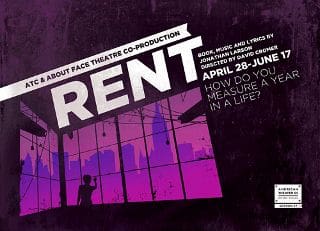
RENT GETS A NEW LEASE ON LIFE,
EVEN AS THE INTRINSIC PROBLEMS REMAIN
As soon as David Cromer was announced as the director, the revival of Rent became one of the buzz productions of the season, Cromer being one of the hottest directors in the country. His reputation soared with a revelatory revival of Our Town in Chicago and later in New York City and Los Angeles. Would he serve up the same magic with Rent? Absolutely. Fans of the show will be delighted by the drama and theatricality of Cromer’s vision of the play as he weaves a young and enthusiastic company of 15 players into a credible East Village subculture; this revival is also a fine introduction for first time audiences. Yet, while I have nothing but admiration for Cromer and his committed and versatile cast, the satisfying production of this iconic musical still has inherent problems. Also, Rent is very much a product of its time, and if not dated, its urgency has faded, at least the AIDS element. I respect Rent, but I still don’t love it.

Rent has a romantic history: Jonathan Larson, its author and composer, died suddenly of an aortic aneurism on Jan. 25, 1996, 10 days before his 36th birthday and the day before the musical’s first preview performance Off-Off-Broadway. In a matter of months the show had transferred to Broadway where it won the Pulitzer Prize for drama and ran for more than 12 years.
The musical is based on Puccini’s opera La Boheme, shifting the time and scene from nineteenth century Paris to New York City’s dilapidated East Village circa 1990. Like the Puccini opera, it portrays a group of young people living a bohemian life as society’s outsiders. The major characters are variously homosexuals, lesbians, and drug addicts, some of whom are afflicted with AIDS or HIV. They exist in squalor and poverty, but they have bonded into a community, though often a contentious one.
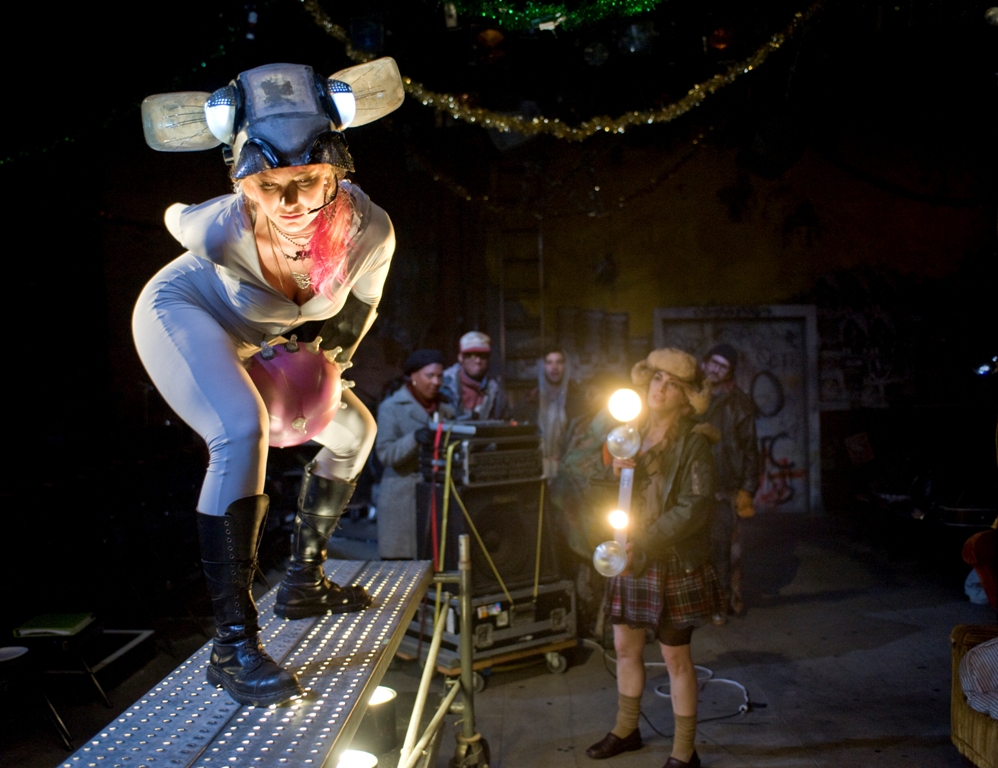
The narrator is an independent filmmaker named Mark Cohen. The chief characters are Mimi, a druggie dancer, and Mark’s roommate Roger, a composer who expects to die of AIDS and desperately wants to write one great song as his legacy. They are joined by Tom Collins, a gay anarchist professor and his lover, a drag queen named Angel, and the lesbian lovers Joanne and Maureen. The central characters are joined by a swirl of other men and women, mostly denizens of the East Village scene.
Larson’s score is a mix of rock, rap, and gospel, the best-known number being the recurring “Seasons of Love.” The storyline lurches from one short scene to another, more a portrait of marginalized young people as a class than a coherent narrative. Larson may have revised the show had he lived, but we’ll never know. The opening scenes are slow and the show doesn’t really hit its stride until the middle of the first act.
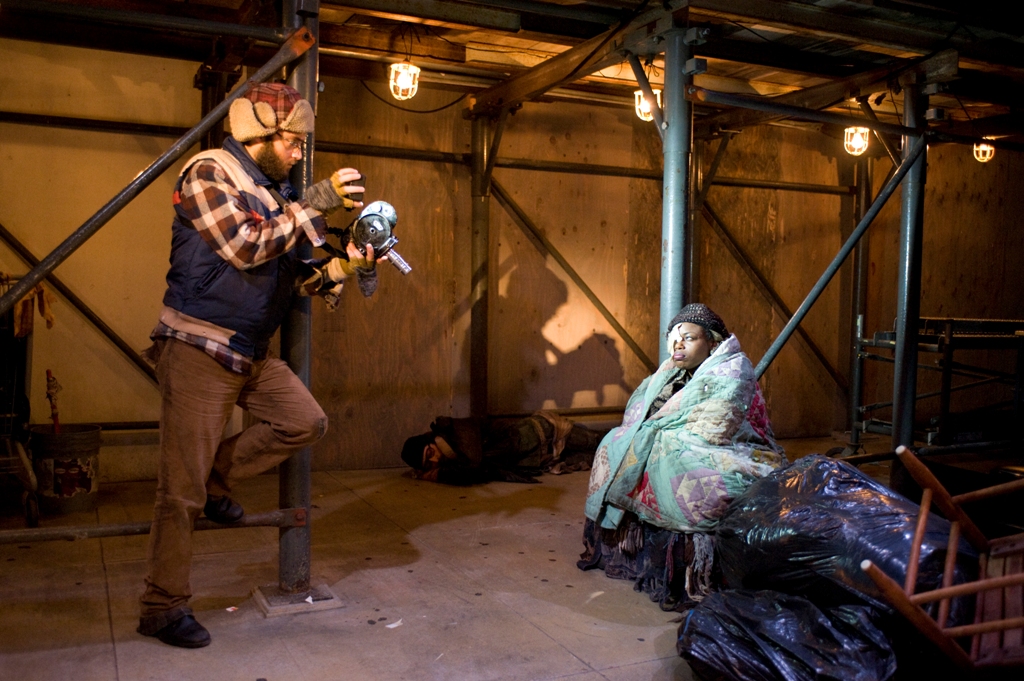
Cromer remains faithful to Rent’s spirit, but he has also illuminated individual scenes to emphasize their emotional impact and sometimes their comedy. He’s freshened up the musical numbers, assisted by Jessica Redish’s lively and distinctive choreography. The crowd scenes are especially vibrant, topped by the long “La Vie Boheme” scene that ends the first act.
Yet even the inventive Cromer cannot fix the show’s glitches: there is a smugness about the grubby lifestyle of Mimi, Roger, Mark, and their cohorts; the outside world is treated with condescension, with easy jokes about areas like the Hamptons, Westport, and Scarsdale, the bastions of the scorned middle- and upper-class; if a character has money, he/she is mocked; and when the middle-class parents of several of the characters telephone their offspring, their calls are treated as comedy, as if parental concern for children enduring the disease and poverty of the East Village is a topic for ridicule.
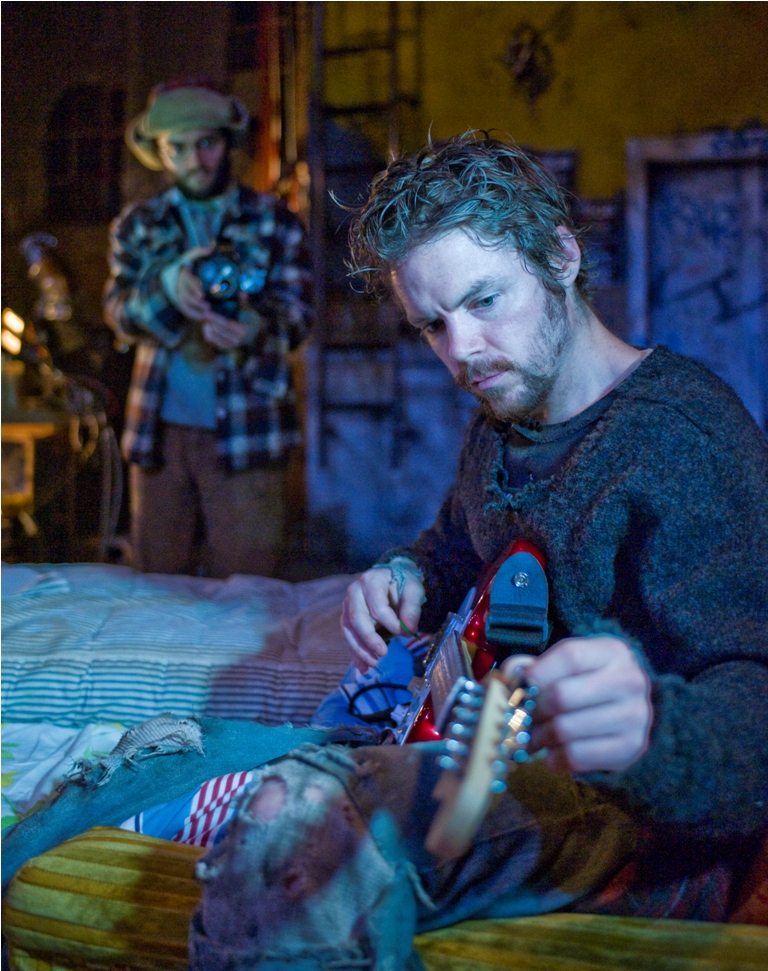 Derrick Trumbly is superb as the anguished Roger, trying to leave some mark behind him as he faces AIDS. Grace Gealey has a strong voice as Mimi but I have always found the character unsympathetic and underqualified for Roger’s love, and Gealey’s performance didn’t change my mind. Alan Schmuckler is fine as Mark Cohen and Alex Agard is the most three-dimensional Tom Collins I’ve ever seen – indeed, at a funeral (beautifully staged by Cromer) Agard’s grief is the most moving moment in the show. Esteban Andres Cruz is suitably swishy and flamboyant as the drag queen, and Lili-Anne Brown and Aileen May are good as the quarreling lovers Maureen and Joanne. Tony Santiago does what he can with the thankless role of Benny, who married money and is thus rejected as a sell-out by his grungy friends. The seven all-purpose performers who make up the chorus are superior in creating the panorama of East Village characters.
The production is being co-sponsored by the American Theater Company and the About Face Theatre, with ATC providing the performance space, which has been reduced to an intimate open area with the audience placed on two parallel sides. Patrons sitting in the first row are often within easy touching distance of the actors. High praise must go to the small band conducted by Timothy Splain. The four musicians sit in a loft above and behind the stage and perform Larson’s multifaceted score with a commendable absence of raucous decibels. Collette Pollard designed the minimalist set, Heather Gilbert the lighting, Victoria Delorio the sound, and David Hyman the thrift shop chic costumes.
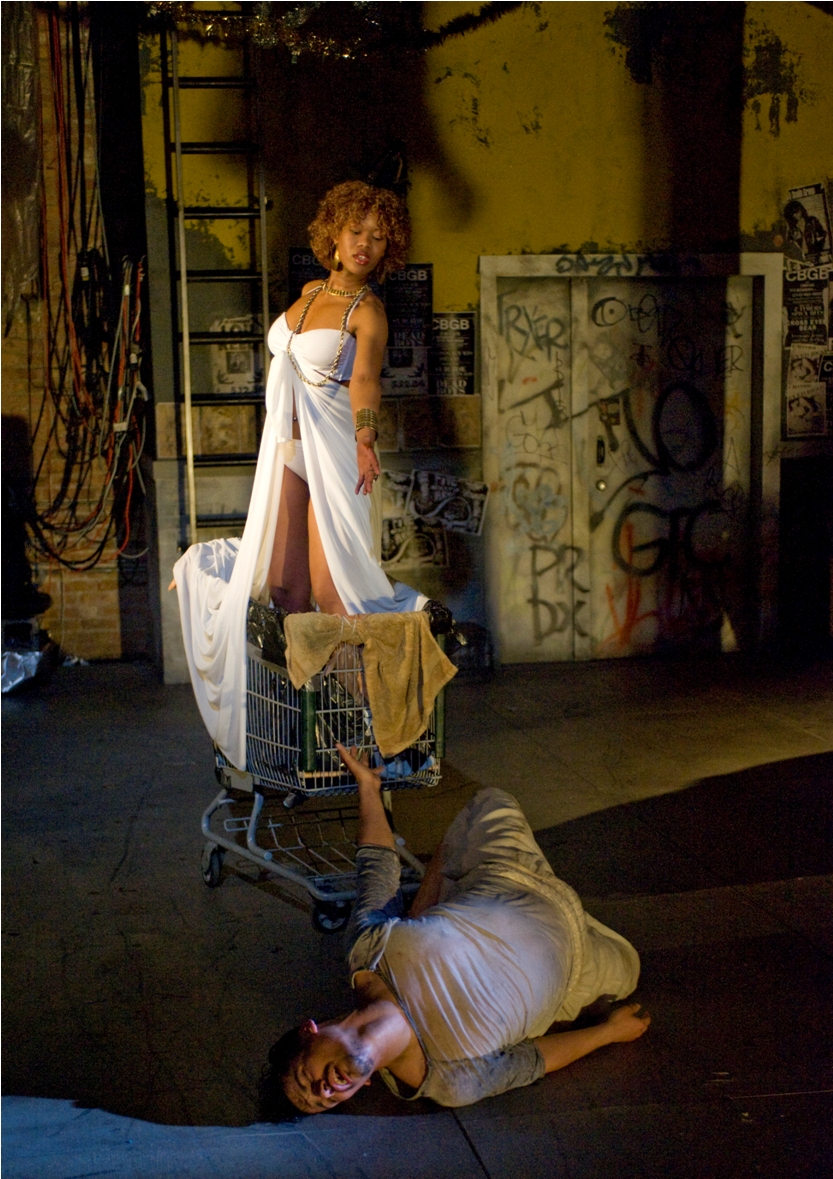 Rent has been called the Hair of the Nineties, an unfortunate comparison: Rent deals with a narrow group of characters locked into a small area of New York City, while Hair encompasses the entire country during the Vietnam War years; plus, Hair’s music is more varied, and its characters better-rounded and more entertaining. But it’s easy to understand why Rent attracted such a youthful audience. All those characters living free of humdrum responsibilities must look enticing to youthful patrons leading earthbound middle-class lives, even as the characters have gotten themselves into a bad scene with their sexual promiscuity and drugs. Youthful audiences might romanticize the lives of those East Village free spirits, but I doubt that many of them would really want to change places with Roger, Mimi, Angel, Tom, and their colleagues.
photos by Michael Brosilow
Rent
American Theater Company
ends on June 17 EXTENDED to July 1, 2012
[on March 4, 2018, American Theater Company
ceased operations; more on this story at Chicago Tribune]
