


Areas We Cover
Categories

Music Obituary: SIR ROGER NORRINGTON
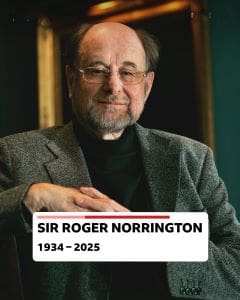
by Michael M. Landman-Karny | July 19, 2025
in Music
THE METRONOME
REVOLUTIONARY
Sir Roger Norrington, who died on July 15th at the age of 90, spent his career making enemies of the right sort. Traditionalists loathed his brisk Beethoven. Period purists found his scholarship insufficiently dogmatic. Modern orchestras discovered, to their dismay, that he expected them to actually read what composers had written in their scores.
This was precisely as Norrington intended. The son of a headmaster, he had learned early that the most interesting discoveries come from questioning received wisdom. At Cambridge in the 1960s, while his contemporaries were content to conduct standard repertoire in standard ways, he was haunting libraries, digging through 18th-century treatises on violin technique and horn construction. The music world was still treating Mozart like a powdered aristocrat. Norrington suspected something more dangerous lurked beneath.
His hunch proved correct. When he founded the London Classical Players in 1978, the sounds that emerged were shocking in their immediacy. Beethoven’s Eroica, stripped of a century’s worth of interpretive sediment, suddenly sounded like what it was: music written by a revolutionary for revolutionaries. The finale of Mozart’s Prague Symphony, taken at the composer’s own metronome marking, became a controlled explosion rather than a dignified march.
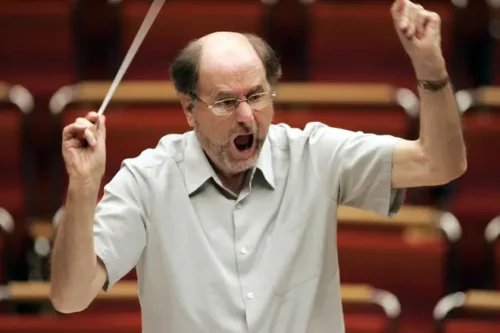
Sir Roger Norrington (© Getty – Robbie Jack)
Critics initially treated him as a curiosity, then as a threat. His recordings of the Beethoven symphonies in the 1980s sold surprisingly well, introducing thousands of listeners to the radical proposition that composers might have known what they wanted. Traditional conductors muttered about “sewing machine Beethoven” and “archaeological pedantry.” Norrington seemed to enjoy their irritation.
He was not, despite accusations, a fundamentalist. His research was meticulous but his instincts remained musical. When he discovered that Schumann’s orchestration worked beautifully once you stopped drowning it in modern string sections, he didn’t trumpet his superiority over previous generations. He simply let the music speak. When his Stuttgart Radio Symphony began applying historical techniques to romantic repertoire, the results were revelatory rather than doctrinaire.
The most telling criticism came from musicians who worked with him. They described a conductor obsessed with details that seemed peripheral until you heard the difference they made. Why did Norrington insist on those particular bowings? Because that was how you got the articulation that made Mozart’s wit audible. Why the seemingly pedantic attention to vibrato? Because Brahms’s harmonies emerged differently when the strings weren’t all wobbling in different directions.
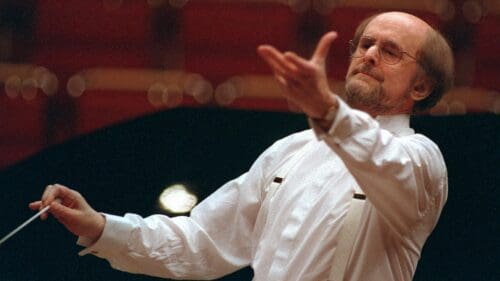
Sir Roger Norrington with the Kölner Philharmonie, 1999 (Hermann Wöstmann)
His evangelical period lasted roughly two decades. By the 1990s, his ideas had begun seeping into mainstream practice, often without acknowledgment. Young musicians started learning baroque technique alongside modern. Major orchestras began programming “historically informed” performances. The revolution had become evolution, then absorption.
Norrington himself seemed oddly detached from his victory. In later interviews, he spoke more about unfinished research projects than past triumphs. There were still scores to examine, recordings to make, assumptions to overturn. He had always been more interested in the next discovery than the last argument won.
His final years brought a certain vindication. Musicians who had initially resisted his methods now took them for granted. The idea that a composer’s written instructions might matter no longer seemed radical. Concert programs routinely mentioned “period practices” without explanation.
Sir Roger Norrington proved that scholarship and showmanship need not be enemies. He rescued classical music from its own respectability, reminding audiences that great compositions were once dangerous new music made by dangerous people. In trying to recover how Beethoven actually sounded, he gave us back the shock that Beethoven’s first audiences felt. The dead composers, one suspects, would have approved.
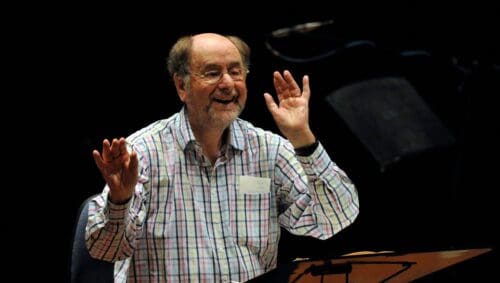
Roger Norrington © Getty – Robbie Jack
FIVE ESSENTIAL RECORDINGS:
1. Beethoven: The Nine Symphonies (London Classical Players, 1986-1988)
This cycle changed everything. Norrington’s Eroica clocks in at under 45 minutes, revealing a work of brutal urgency rather than monumental grandeur. The finale of the Ninth becomes a genuine celebration instead of a pompous march. Critics initially balked at the breakneck speeds, but audiences heard Beethoven as his contemporaries did: music that grabbed you by the throat.
2. Mozart: Symphonies Nos. 35-41 (London Classical Players, 1991)
Mozart emerges here as a subversive wit rather than a court composer. The Prague Symphony fizzes with dangerous energy. Jupiter’s finale transforms into a display of compositional showing off that borders on the unseemly. Norrington takes Mozart’s own tempo markings seriously, producing performances that sound improvised despite their scholarly foundation.
3. Schumann: The Four Symphonies (Stuttgart Radio Symphony Orchestra, 1997)
These recordings proved that historical practices could illuminate romantic repertoire just as effectively as classical. Schumann’s notoriously thick orchestration suddenly becomes transparent. The brass sections bite rather than blare. The string writing, so often buried under layers of vibrato, emerges with startling clarity. Even hardened Schumann skeptics found themselves converted.
4. Berlioz: Symphonie Fantastique (London Classical Players, 1989)
Norrington’s Berlioz crackles with the revolutionary fervor the composer intended. The March to the Scaffold genuinely frightens. The Witches’ Sabbath descends into genuine chaos rather than orchestrated pandemonium. Using period brass instruments, Norrington recovers the raw edge that modern orchestras tend to polish away. This is Berlioz as dangerous young radical, not establishment master.
5. Brahms: Symphony No. 1 (Stuttgart Radio Symphony Orchestra, 1998)
Perhaps Norrington’s most controversial achievement. His lean, swift approach strips away decades of interpretive tradition to reveal Brahms’s actual orchestration. The finale emerges as structural tour de force rather than emotional catharsis. Purists howled, but Norrington had proven his point: even the most “romantic” composers benefited from historically informed practice.
