


Areas We Cover
Categories

Film Reviews: AVANT QUEER (Shorts Program, NewFest)

by Rob Lester | October 13, 2025
in Film
SHORT, NOT ALWAYS SWEET:
SOMETHING FOR ALMOST EVERYONE
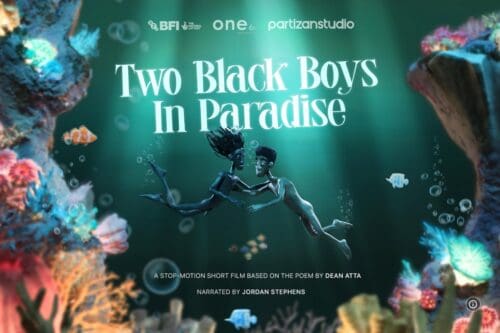
Two Black Boys in Paradise starts with its titular twosome in a boat, going gently down the stream, merrily. They’re naked; it’s full-frontal nudity for these thin fellows and later in the film there is a sweet, discreet but definite moment when they get into positions for sex (and although the sensibility is gentle, the F-word is used for the action). Prudes may possibly be peeved or put off, but this is neither prurient nor pornographic; the people are puppets! Well, they’re called “puppets” in the credits, but they’re not hand puppets or wooden marionettes or Muppet-like. The creations are more like a variation of Claymation. When nude, the looks of the loving lads might recall resemble Ken dolls (Barbie’s beau, you know) except they’re anatomically correct and their faces are more distinctive and can change expressions from looking blissful to looking stressful, unlike the possibly over-Botoxed Ken whose face is never animated. But this charming nine-minute film is animated and the movements are in that quaint stop-motion style. With the presence of Paradise, two lovers alone, apples, a tree, shaming, and suddenly being clothed all in evidence visually and in the spoken lines, the comparison to the Adam and Eve story is plain. Add the elements of racial prejudice and police pat-downs and put-downs, post-Paradise, and things get scary and sad in the middle.

Jordan Stephens, with warmth and pointedness, speaks the tender text taken from Dean Atta‘s poem of the same name; the poet is one of the executive producers. Ben Jackson is the producer. It’s directed by Baz Sells with apparent love and definite sensitivity, with subtly effective mood-enhancing background music (composers: Jasper Dent, Lanre Diko, and Adam Grigg) with smart decisions of when and where to pause for tension and for words to sink in. Beyond the look of the protagonists, attention to detail in the characters, settings, and physical items invites close inspection and a second viewing — note the intimidating Caucasian policeman’s flatter head, his moving hands, the multi-racial crowd, the bushels of fruit, the simple boat, the eyes that move, the late cameos by a glorious giant bird, a pair of lesbians, and reflections in the water. Speaking of reflections, the text that attacks the attitudes of dismissiveness and diminishment of Black males and affirms gay love (emotional and physical) is thoughtful and thought-provoking.
# # # # # # # # # #

Strawberry Shortcake, a new short, is certainly not to be confused with the smiley little mega-cute character named Strawberry Shortcake, a red-haired imp wearing a bonnet, with decades of incarnations (cards, cartoons, TV, movies, merchandise). This not-for-children film begins innocuously with a mother (Jou Min-Huang) and teen-aged daughter (Heme Liao) at the breakfast table, and dancing to the Billie Holiday recording of “All of Me,” but shortly thereafter a strawberry shortcake is presented, smashed, spread over two naked female body parts, is licked off, and lowered panties reveal a dildo, toes are bitten, and that red liquid we see next is not strawberry icing, but blood. What’s going on? Is it happening? Is it a dream? Is it a flashback? Is it a fetish-fueled fantasy? A bit later, there’s another disturbing scene involving the daughter, the mother and the house both in alarming conditions — and a new strawberry-topped cake with birthday candles and another morning meal.
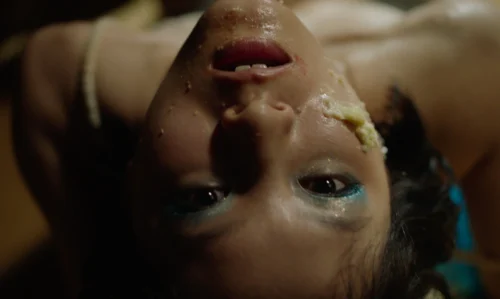
In a word, YIKES! Unusual and unsettling, mysterious and seemingly sadistic, Strawberry Shortcake is not the recipe for all tastes, but it has its mercurial and intriguing moments (what did the third person in the photo, probably the mom’s husband, do to motivate the cutting-out of his face?; tears coming on suddenly at breakfast; a flood from an overflowing sink; slow camera pans). While this short featuring a shortcake may seem half-baked to some, and turn out to be a turn-off for many, others have found artistic merits in its treatment of taboo-breaking and psychological suggestiveness, worthy of an award at the Vancouver Festival, netting $5000 for the effort. Deborah Devyn Chuang is the director, writer, co-producer, and editor. The film clocks in at 21 minutes, and it is in Mandarin with English subtitles, although there is only a little dialogue.
# # # # # # # # # #
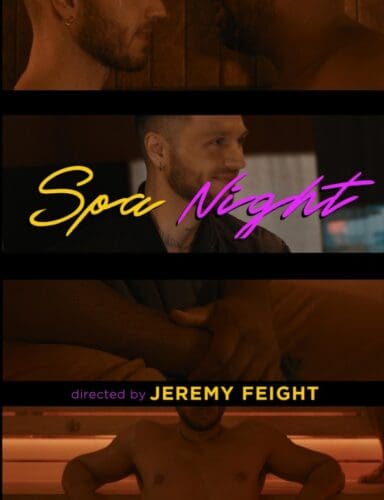
Spa Night takes place, as you might guess, one night at a spa. A guy waiting to go into a fancy NYC spa looks distracted and/or dismayed by text messages with, apparently, a significant other who won’t reply. A mention among the messages is that one of them had sex with the brother of the other. Once in the spa, our peeved protagonist exchanges looks with a few other men there (withering looks; flirtatious looks; disinterested looks from staff members). Stressed, he strips, stops at the steam room, stays for a while hitting the showers and seems to be ready to hit the guy who’s caught his eye and is rinsing off next to him. There’s virtually no dialogue and, one might say, virtually no point — except maybe to be a reflection of lonely frustration, expectation, stimulation, and nonverbal communication.
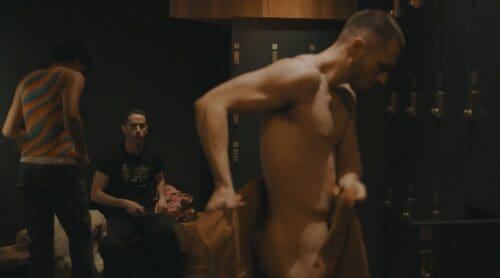
The end implies surprise, but it’s all over in less time than it might typically take you to take a shower yourself. And if the expanse of above-the-waist male skin (one bare rear does appear for a moment), soaking, sweating, and suspicion of sex-to-follow turns you on, you might need a cold shower. Whether it seems like more of a “Why?” or a diverting “Wow!,” it’s due in part to the contributions of Jeremy Feight who is credited for the “story,” co-writing the screenplay, and is also the protagonist, one of three co-producers, and one of the two executive producers. Oh, and he’s also the director. All those credits are on screen during a song. He didn’t write or sing that, but you will hear the voice of Alex Newell, who won a Tony Award for Shucked and is back on the New York stage in the cast of Bat Boy.
# # # # # # # # # #
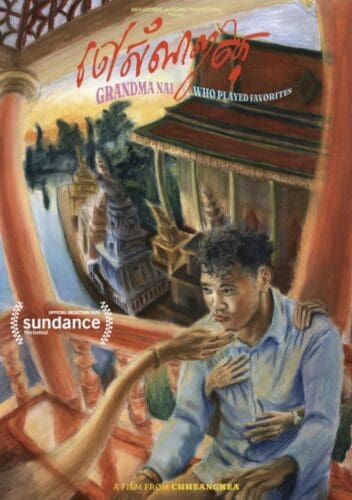
Grandma Nai Who Played Favorites, a Cambodian film with English subtitles, doesn’t let the pesky fact that its title character is dead get in the way of having her become a center of attention as she (Saroeun Nay, nicely nailing the role of a crotchety, but selectively caring, elder) devotes her attention to watching over Meng, her 29-year-old single grandson (Bonrotanak Rith, with relaxed charisma). Not suffering fools gladly nor suffering from what we’d expect as the restrictions of being deceased, she simply materializes from the afterlife to check up on his life. She prances around with the cloak of presumed discreet invisibility. An annual tradition is sprucing up the gravesite of deceased relatives, so generations of her family gather there to catch up, take selfies, argue, eat, play, offer advice, and nag Meng about getting married.
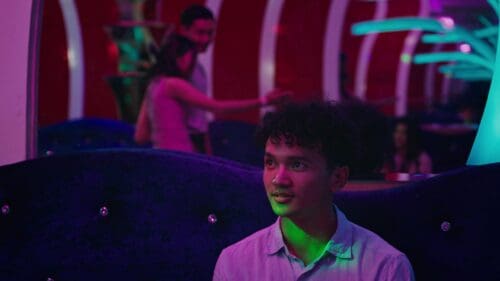
In her grandmotherly metaphysical manner, Nai knows this pressure and plans with a young woman pegged as Meng’s prospective bride need to be stopped. Guess why. Well, since the film is in a queer festival, we pick up the hints that Meng is gay, and in the closet or in denial or in over his head, despite his smiles and small talk and a gift. Nai keeps an eye on a get-together of the families of the potential bride and groom at a karaoke club and, amusingly, controls a moment in the musical goings-on not with anything as mystical as coming back from the dead, or by magic, but by controlling the karaoke machine with a remote control device! It’s kind of an easygoing adventure, sweetly endearing with believable acting, as we ignore and yet focus on the metaphorical “elephant in the room” presence. Director/writer Chheangkea fills much of the 19 minutes with the cacophony of a bustling, negative nagging family and amateur singing in karaoke competing with conversation, which can be irritating, but seems appropriate for the situations where peace and peace of mind would be M.I.A. And if things are resolved in the plot, Grandma can return to her burial plot and rest in peace.
# # # # # # # # # #
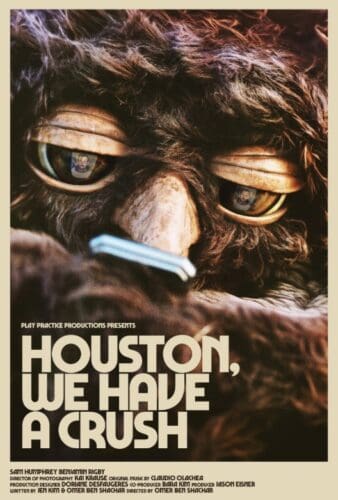
Houston, We Have a Crush is an inspired and adorable little treat of particular and peculiar interest, taking place on a visually arresting planet, with an endearing rotund alien wobbling around. The creature comes upon a foreign object that is baffling and intriguing. Assuming that viewers of this sweet scenario in the 10-minute American film cooked up by director Omer Ben Shachar are earthlings, we have no trouble identifying it: It’s a cell phone. The curious and cute alien pecks the screen with his pointed beak, and — EUREKA! — things happen: It plays music, and, with a tiny tap or two, a series of videos and photos appear, with an omnipresent smiling, bearded human man (Benjamin Rigby) doing various things, sometimes speaking.

It’s interspecies interplanetary love at first sight. (Underneath the terrific furry round costume and headpiece is Sam Humphrey, the 4’2″ actor who played Tom Thumb in the movie The Greatest Showman.) What will happen if and when the astronaut, who might still be on site, is sighted in the flesh, looking for his valuable lost item? A more immediate concern: Watching the object of his affection and hoped-for-connection on screen can only go on as long as the battery’s power will last, which isn’t long enough. Enchanted movie audiences will likewise wish there were more minutes in this entertaining film.
# # # # # # # # # #
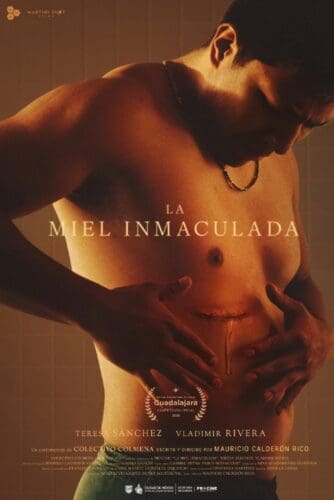
The Immaculate Honey (La Miel Inmaculada) brings us a chapter in the relationship of a mother and her grown son, Chucho. It’s prompted by the concerned mom coming to stay with the man in his small apartment as he rests to let his body heal from an attack. Teresa Sánchez and Vladimir Rivera act and interact with warmth and real-feel familial affection in these roles, although there is neither much conflict in the conversations (in Spanish, with English subtitles) nor any major discovery in the “rest and recovery” period. A scene where they dance together is darling.
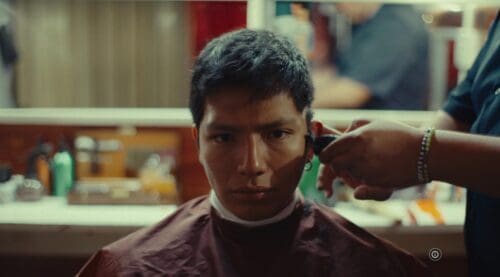
Mother knows best, and she’s brought jars of honey to apply to the large scar on his torso. Their feelings for each other are ostensibly as sweet as the honey, but he’s evasive about his private life and what he does at the bar where he was stabbed. When, on a couple of late-night occasions during the stay, a man outside his window hollers “I love you!” Chucho says to ignore it because it must be some crazy or drunk guy. Astute audiences (and maybe Mama) may not be convinced. (Hint: This is, again, in a gay-themed film festival.) Writer/Director Mauricio Calderon Rico‘s 18-minute portrait feels authentic without a pushy agenda and a viewer can feel like a fly on the wall, observing the kindness and the kind of closeness that lucky kinfolk don’t quite “age out” of as they age.
# # # # # # # # # #
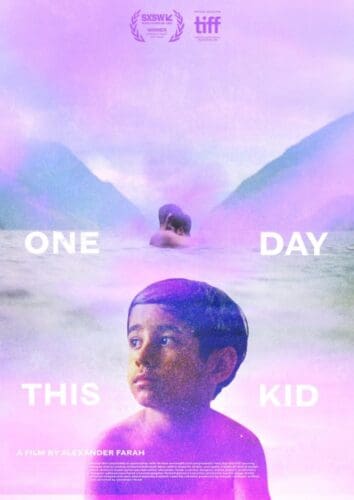
One Day This Kid follows the maturing of Hamed, from an Afghan family, growing up in Canada, but growing apart from that family. The role is played by three actors of different ages, so that we see him first as a young child. He seems then to be the apple of his father’s eye, but when Hamed’s own big brown eyes, from that young age and onward, linger on handsome men in various settings, trouble is also in view. There is no grand “coming out” scene, nor any “Get out of the house!” / “Get out of my life!” tirades or displays of discussions with the disapproving parents. However, the tension hovers and the tenderness that was present is missed when it’s gone. Flash forward and we see the adult version of Hamed (still youngish), played by Massey Ahmar, with his “chosen family” of gay friends and a partner, seemingly content and coping. Just as Hamed’s gaze stays locked on someone or something so we know he’s curious, confused, or conflicted, the camera occasionally keeps its gaze firmly for extra seconds to make sure we don’t miss something. For example, when adult Hamed sees a father and son cavorting in the water outdoors or is filling up his car’s gas tank, it’s pretty clear we’re supposed to note that memories of his childhood with his father are being triggered.
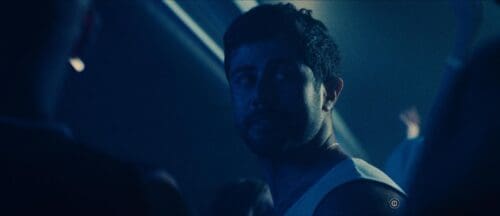
Just when we think Dad is out of the picture in director/writer Alexander Farah‘s well-made motion picture, there’s one climactic, emotional phone call made that might mend fences, better late than never, but the audience doesn’t get the satisfaction of being able to do more than guess before the credits roll. 17-minutes, in English and Dari/Farsi with English subtitles.
# # # # # # # # # #
Avant Queer Shorts Program
NewFest37
October 15, 2025, at 7:30: BAM Rose Cinemas
virtual streaming through October 21, 2025
for all films in NewFest37, visit Newfest
