


Areas We Cover
Categories

Film Reviews: IF YOU WANNA BE MY LOVERBOY (Shorts Program at NewFest)

by Rob Lester | October 17, 2025
in Film
LOTS O’ LOVERBOYS
Eight – count ‘em – eight short films are grouped together for If You Wanna Be My Loverboy, one of several packages in the NewFest offerings of themed sets. Each set will be screened only once, with virtual showings through October 21. This collection, at NYC’s School for Visual Arts on October 18, has all kinds of plots concerning gay men. If you miss it at NewFest, worry not; these shorts will live forever.
ORION’S QUEST
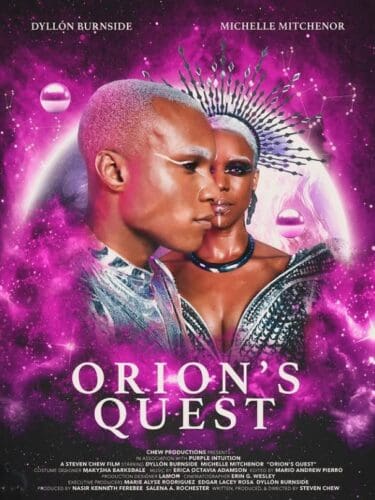
AND THE QUEST, AS THEY SAY, IS HISTORY
Orion’s Quest is an extra-earnest Afro-Futurism tale with an extraterrestrial title character seeking permission to go on an extra-special mission. His chosen task is almost as challenging as it might be for audiences to take seriously the opening scene’s stilted dialogue, when Orion (Dyllón Burnside) formally pitches his plan to his planet’s Queen (Michelle Mitchenor).
But things are played straight in this gay film—no irony or humor in writer/director/co-producer Steven Chew’s 15-minute fantasy. Orion has a limited time to conduct his research: to go on dates and have conversations with Black gay earthlings, posing as one himself, to find the single reason why they are so often single.
Dyllón Burnside in Orion’s Quest
The later scenes are more grounded—perhaps too recognizably realistic for viewers who’ve suffered through the grind of serial dating. (It’s no coincidence that, in mythology, Orion is known as “The Hunter.” This film is not subtle.)
Orion scrolls through apps, swipes and texts, and is repeatedly rebuffed, reviled, and rejected—for lacking instant sexual chemistry; for not wanting to have sex on the first date (with a man whose ad insists he’s “old-fashioned” and looking for something serious); or for simply being the “wrong” age.
Scene from Orion's Quest
Still, Orion keeps plugging away in the name of research—psychological, anthropological, and sociological—to see what makes such people tick, and tick each other off. Some insight is finally in sight when a more sensitive man shares what he’s learned about the ability to love.
Orion’s Quest stands out in the way it observes human defensiveness and desire from an outsider’s perspective—someone alien enough to see people as they truly are, and perhaps even see through them.
FAN LETTER
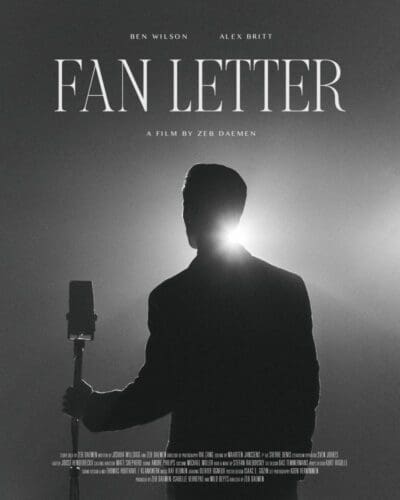
A SHORT WORTH WRITING ABOUT
Fan Letter takes place in the 1950s—intriguingly filmed in dramatic, nostalgic black and white, with an arty film-noir look full of shadows, close-ups, and moody mystique, beautifully shot by cinematographer Rik Zang. The 16-minute film opens when successful crooner Ricky (Ben Williams) unexpectedly receives a note from Alfie, the man who was once the love of his life but whom he hasn’t seen in years. On impulse, Ricky calls him.

We hear both sides of the conversation but never see Alex Britt as the much more reticent Alfie, speaking from his home. It’s frank but fraught. Their talk stirs up regrets, rue, and memories (cue the fuzzy flashback of idyllic romantic romping). The conversation is filled with pained pauses—many… many… many… pauses… of… almost… equal… length. Williams delivers his lines in halting phrasing and an almost numbed monotone, despite occasional smiles and melodramatic declarations: “We’ll always have the stars.” “I see you, Alf… I always see you. I try to sing over it… write… but I end up writing about you.”
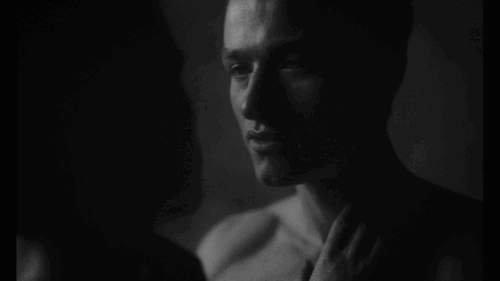
As we watch and wait, we wonder if there will be a reconnection beyond the one provided by the wire-and-dial invention of Alexander Graham Bell. Of course, given the time period and his career ambitions, Ricky is closeted. Living openly as a couple could only ever be a dream for Alfie and for a singer whose swoon-worthy ballads were marketed to women.
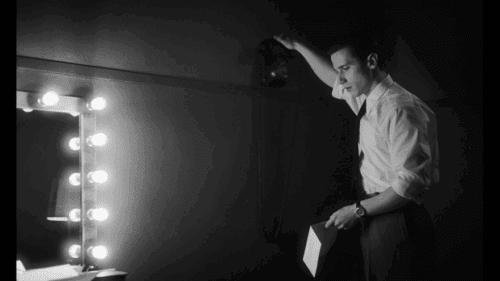
The film includes an on-target performance from Ben Williams, crooning an era-perfect pastiche number onstage. Zeb Daemen directed and produced, co-wrote the screenplay (with Joshua Willdigg), and even collaborated on the song with composer .
Evoking its era and provoking both tears and thought, the admirable Fan Letter earns fans of its own.
PINING
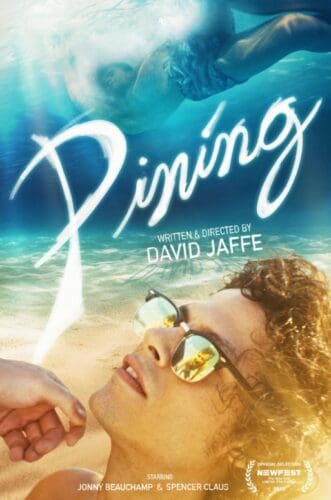
PINING AT THE PINES
Pining, with its one-word/double duty title referencing: (1) The somewhat quaint synonym meaning the state of yearning for / desiring something / someone possibly unattainable / missed AND (2) Spending time in the section of Fire Island called The Pines, a gay mecca. Written and directed by David Jaffe, Pining presents people who are — variously — pining, dining, opining, combining, or reclining by the pool. There are drinks and twinks, and hunks who have hook-ups and hangups. Jonny Beauchamp plays Island regular Andrew — occasionally hostile, sometimes happy, always horny.
Spencer Claus and Jonny Beauchamp
A few minutes after the story starts, he’s met 24-year-old Island first-timer Kit (Spencer Claus). Initially excited, Kit has followed Andrew to the beach, seemingly more concerned with his many social media followers, and hasn’t followed up on Andrew’s sexually suggestive suggestions or looks. Therein lies the pining, perhaps, but Andrew has seemed ambivalent and Kit has acted distracted, distant, and resistant (to swimming, to relaxing, and to Andrew).
Jonny Beauchamp and Christopher F. Costa
The film is filled with colorful Fire Island scenery and colorful Fire Island partyers, some underwhelming dialogue, underdeveloped characters, underwater shots, shirtless guys, shameless lust, and loose plot lines, but some drama bubbles under and up. Like many vacations, it has visual diversions, a variety of people passing through, some relaxed moments, and a nice stroll along the beach and may be worth your time if you have time off from the workaday world. It’s a pretty trip and a pretty quick one at 14 minutes.
THE UPPER ROOM

THE QUARTER MILE HIGH CLUB
The Upper Room might be thought of as the gay male cousin of the play and film called Same Time, Next Year. Its story was about a man and a woman who have an affair – or, rather, a series of annual meet-ups, although both are in heterosexual marriages.

“See you next year” says one of the men when it comes to the part when the male bed partners must part, having dressed and retrieved his wedding ring from the nightstand. The other says, simply, “Yeah. Next year.” They apparently meet annually at a convention for those who work in the same field. (“Your choir gets better and better every year” is one line of “shop talk,” post-shtup talk.) Adding to the one-more-time testosterone tryst taboo temptation total for the twosome is that they are both youth pastors in pentecostal churches. It’s a religion that doesn’t smile on gayness or adultery – certainly not for its clergy. At one point, they pray for forgiveness for sinning and not winning the battle against temptation (until next year?).

Other moments let actors Robin de Jesús and Daniel K. Isaac emphasize the tender and sweet aspects of the brief encounter in this brief (12 minutes) offering by director/writer Joel Perez. Its title has more than one meaning: the “upper room” references the Bible’s account of the disciples receiving the Holy Spirit in the upper room in Acts 2, specific churches or ministries that take the name, or the location where the men are staying, on a high floor.
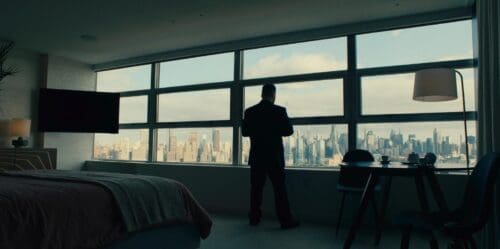
There are huge windows that offer a beautiful city view, and they discuss drawing the blinds in case someone might be able to see them, undressed together, from across the way. They must go their separate ways, but, like the swallows who fly back home to Capistrano, when spring comes, there’s always next year.
LISBON
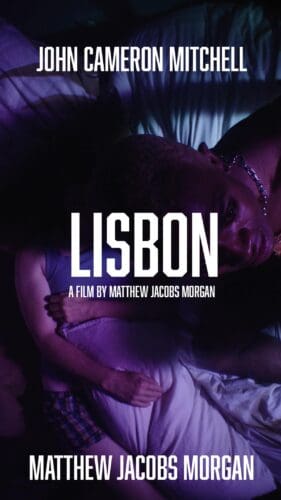
DEATH BE NOT PROUD
Lisbon, a compelling, intense 13-minute change-of-pace short, does not short-change the viewer in terms of suspense, surprise, and dark subject matter. It’s a matter of life and death. Imagine being cash-strapped Jason, arriving at a man’s apartment expecting to have sex with him (an arrangement with a stranger, for money, but we’ll get to that) and finding him in bed, in pain, intravenous medication dripping into his veins. He’s terminally ill and is ready to die. The online sex-for-a-fee request was a ruse, a means to an end – to end his life. Chemical injection, by needle, will do the deed. It’s a shocking thing to ask. (It’s one of two requests – the other one was quite a bit simpler: Take off your shoes when you come into the apartment.)
Matthew Jacobs Morgan and John Cameron Mitchell
A moral dilemma is on the table – as is the standard sex worker’s fee. Can Jason be convinced it’s an act of mercy to end the man’s misery? Will he be horrified enough to flee? Either way, will he accept the fee? The perspectives and soul-searching in this very human drama command attention and there’s impressively convincing acting by John Cameron Mitchell as the man at peace with his demise and decision and, as the man wrestling with a new decision to make, Matthew Jacobs Morgan, who also wrote, directed and produced.
A GARDEN UNDER THE EARTH

GOING DOWN UNDER
A Garden Under the Earth, taking just six minutes of your time, depicts what’s heard and seen “under moons” — still poses of nude figures, often dwarfed by their surroundings and bathed in blood-red light.


It’s all accompanied by a somber, deep voice intoning descriptions of a garden bordered by mushrooms, a male body, humid air, smells, sex, death, rebirth, and instrumental music that grows increasingly spooky. Pedro Lavin’s piece is described as “a series of dreamlike digital vignettes, two wild fairies engage in an increasingly intense erotic ritual.” That about sums it up.
WITHIN A QUIET BODY
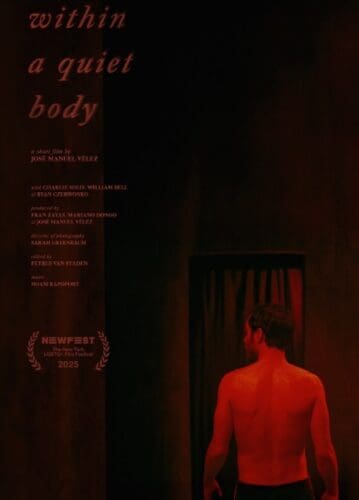
LOOKING FOR MISTER BADBAR
Within a Quiet Body from director/writer José Manuel Vélez takes place mostly at a sex club populated with men who are hunky, horny, hirsute, heaving, and — oh yes — homosexual. Haunting and ominous is the music (composer: Noam Rapoport) that accompanies some sections of the 14 minutes that includes scenes of rough sex acts and requests for them by central character Alex (Charlie Solis), the building’s cleaning man. (It’s a dirty job, but someone’s gotta do it.)

He seeks sex and pain (“I like it rough”), pushing his lit cigarette into his skin, asking another guy to burn him to turn him on, but the man turns that request down. Another encounter turns dangerous. Those who are voyeuristic, curious, or intrigued by S&M, like Alex, may find some interest; others are sure to find it depressing or distressing — as unfulfilling as a couple of the thwarted and aborted sexual overtures portrayed. Proceed with caution.
BRIEF SOMEBODIES
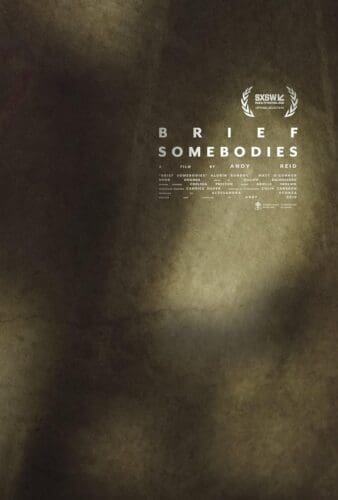
ALL TOO BRIEF
Brief Somebodies is an enjoyable movie about making a movie. In the story, Joel (the appealing, resourceful actor Aldrin Bundoc) is a young man who’s written a film script that includes a scene with a sexual assault, based on his own experience as the victim, and he’s playing that role himself with his own casting choice for the co-starring part. He picks Calvin (Matt O’Connor), and they get to know each other—somewhat shyly and cautiously—during rehearsal, filming, and breaks.
Aldrin Bundoc, Noor Dhanda and Matt O’Connor
The early rehearsal of the assault scene has them fully clothed, with an object between their prone bodies to prevent any awkwardness or excessive contact that would make things physically or emotionally uncomfortable. The two, along with a diligent, thorough woman who has the job of Intimacy Coordinator (Noor Dhanda), discuss and dissect the characters’ inner thoughts and psychological motivations in detail, as well as their own feelings about it.
Matt O’Connor
This action, choreographed to an inch of its life and repeated “at half-speed,” has the potential to be quite funny if the movie (now a breezy 15 minutes) is expanded, with additional incidents and by making some of Brief Somebodies’ scenes not so brief. It’s one of those shorts that has the potential to engage audiences for the longer time of a full-length feature, as it features characters worth knowing more about, and the story can be mined for more drama and fun. There could be satire of overly serious and solipsistic artists, things going wrong, personality conflicts, off-camera personal relationships, etc.
Aldrin Bundoc and Matt O’Connor
In its current state, the conversation creating connection between the two actors—getting acquainted with mutual respect and likely attraction—could lead to any number of follow-ups. (At one point, we’re not sure if the two are acting, with lines from Joel’s script, or interacting as themselves, flirting and more.) Director/writer Andy Reid also appears in the film in a small role. Art imitates life.
Aldrin Bundoc and Matt O’Connor
# # # # # # # # # #
If You Wanna Be My Loverboy
NewFest37
screens October 18, 2025, at 7:30: School for Visual Arts, 215 East 23 Street
virtual streaming through October 21, 2025
for all films in NewFest37, visit Newfest
