


Areas We Cover
Categories

Theater Review: CYMBELINE (Antaeus Theatre Company in Glendale)

by Ernest Kearney | October 24, 2025
in Los Angeles, Theater
THANKS TO ANTAEUS, CYMBELINE RIDES AGAIN
Who knew Cymbeline could gallop? Director Nike Doukas’s new staging at Antaeus Theatre Company turns one of Shakespeare’s most notoriously unwieldy plays into something brisk, lucid, and surprisingly delightful. Though often dismissed as a late-period jumble, this Cymbeline proves that with intelligence and judicious trimming, even Shakespeare’s strangest hybrids can ride like the wind. Cymbeline is not only seldom produced, but very seldom produced this well. That should be reason enough for you to bound onto your trusty steed, and ride hell bent for the Antaeus Theatre Company, shouting, “Hi’yo, Silver, away!” all the way to Glendale.
Cymbeline is a grab bag of literary concepts and conceits that places it nearly outside the possibility of any precise classification: historical, mythical, farcical, romance, tragedy, pastoral. Of Shakespeare’s later plays, Cymbeline and The Tempest share a common trait: they both reverberate with echoes of the Bard’s earlier works. Cymbeline evokes, in its tumbling of styles, a hodgepodge of Shakespeare’s more heralded efforts – The Rape of Lucrece, King Lear, Romeo and Juliet, Macbeth, by way of frolicking plot scheme, The Comedy of Errors, and even Coriolanus in the complexity of the mother-son relationship which fuels the villainous motivation at its core.
Although sometimes labeled Shakespeare’s last Roman play, it is Othello that Cymbeline most precisely holds the mirror up to, and the reflection of that most tragic of tragedies is, as it should be, a complete reversal of the original. Othello, despite the nobleness, virtuousness, and trustworthiness of the preponderance of its dramatis personae, is doomed to be a tragedy. And despite the pettiness, sexual depravity, wicked hypocrisy, and self-serving deceitfulness of all its ruling class characters—child abduction, decapitated cadaver, and a closing scene that drops the final curtain on a corpse-spattered battlefield—Cymbeline leaves them laughing.

The plot line is full of Shakespeare’s favorite dramatic devices: Cymbeline (Bernard K. Addison) is enraged that his daughter Imogen (Elinor Gunn) has married Posthumus (Peter Mendoza), a man of noble spirit if not an aristocratic pedigree. Imogen is Cymbeline’s only child, his two infant sons having mysteriously vanished from his castle decades earlier, never to be seen again. Cymbeline banishes Posthumus, partly due to the maneuvering of his new queen (Eve Gordon), who feigns love for her stepdaughter Imogen while scheming to arrange her marriage to Cloten (Randolph Thompsom), her brutish son, all part of her plot to dispose of Cymbeline and usurp his throne. And if things needed to get worse, Cymbeline is faced with war against his kingdom’s Roman occupiers, who are demanding the payment of tribute.

Meanwhile, Posthumus languishes in his Italian exile, where he meets the caddish Iachimo (Gerard Joseph), who, hearing Posthumus praise Imogen’s virtue, wagers he can seduce her. Arriving in Cymbeline’s kingdom, Iachimo goes right to work in his efforts to woo Imogen, only to be slapped down vigorously by our virtuous heroine. The nimble-tongued Iachimo lives up to his name, which means “little Iago,” and begs for her pardon, convincing her that his attempt was a mere ruse to validate Posthumus’ confidence in her fidelity. Receiving her forgiveness, Iachimo requests to be allowed to move a large trunk containing great “sums to buy a present for the Emperor” into her bedroom for safekeeping.
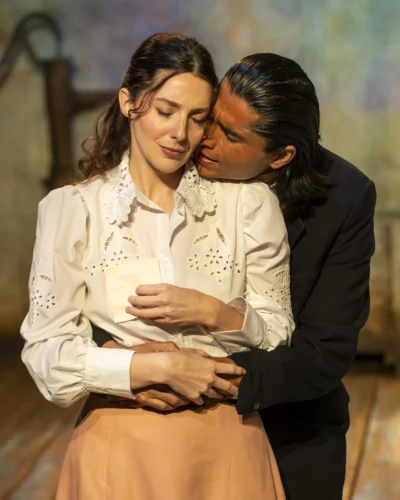
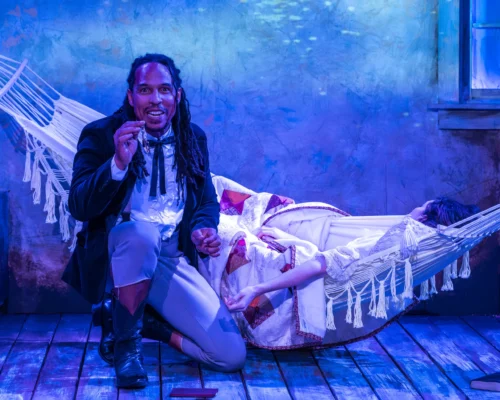
That night, as Imogen sleeps, the lid of the trunk opens to reveal Iachimo concealed inside. Emerging from the trunk, he quickly moves about the room, making notes of her sleeping quarters’ décor, and even putting down that on her left breast, she has a “crimson” mole. Returning to Rome, Iachimo uses these details and presents a bracelet he has stolen from Imogen’s wrist as she slept, to convince Posthumus that he has had his way with his wife.
Driven to madness by the thought of Imogen’s unfaithfulness, Posthumus sends two letters back to his servant Pisania (Desirèe Mee Jung), one to be given to his wife telling her to join him in Wales, the other for Pisania’s eyes only, ordering his servant to kill Imogen for her betrayal.
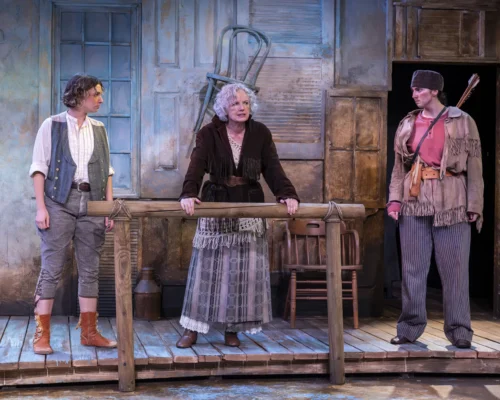
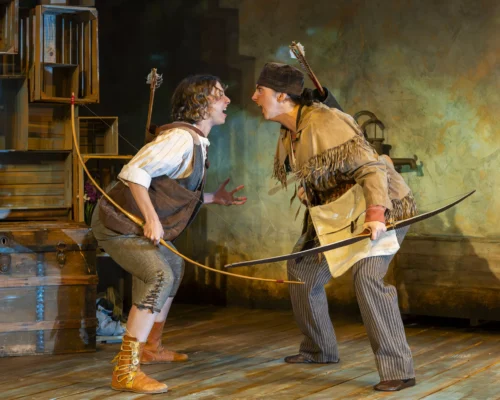
From here, Shakespeare uses some of his favorite devices. Learning of Posthumus’ order to kill her, Imogen disguises herself as a boy and sets off to find him. In her journey, she comes upon Bellaria (Eve Gordon), who lives an anchorite existence in a mountain’s cave with his two sons Guiderius (Teodora Avramovic) and Arviragus (Anja Racić), who are in fact Cymbeline’s long-lost sons! (C’mon, you knew they were going to show up.)
From here, the Bard takes his audience over familiar ground, such as a young lover drinking a potion that causes them to be mistaken for dead, to scenes bordering on the Grand-Guignol sexual violence of Titus Andronicus, and even those that cross into a macabre black comedy distinct from anything that ever flowed from Shakespeare’s quill—a love lament with a headless corpse.

The Cymbeline that director Nike Doukas has placed on the Antaeus stage is a much-altered play from the original, and this is not necessarily a bad thing. Uncut, with 3,753 lines, Cymbeline is the Bard’s third lengthiest play behind Hamlet (4,024) and Coriolanus (3,824).
It has been said there is “little profundity” in Cymbeline. AllGreatQuotes lists 397 “important quotations” from Hamlet. Cymbeline has one “famous” quote: “The game is up” (Belarius, Act 3 Scene 3). If there are any other famous quotations from Cymbeline, nobody knows them.
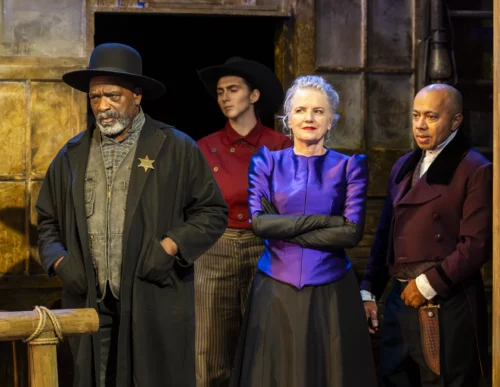
Doukas’ streamlining of the script spurs the show at a steady pace, conveying the richness of Shakespeare’s language while never enmeshing the audience in a bog of “arbitrament,” “Ods pittikins,” or “runagates.”
The original cast list of some 37 speaking parts has been trimmed down to eighteen, with assorted “gentlemen” and Roman tribunes wholly exorcised, in addition to Posthumus’s deceased parents and brothers who appear for a musical invocation to the gods to aid their pitiable son—and the god Jupiter, who descends on the back of an eagle, lobbing thunderbolts while assuring them all will end well. All these reductions are accomplished with intelligence and such adroitness that their removal leaves not even a trace in the fabric of the drama.

A company of ten meets the production’s demands, with Avramovic, Racić, and Gordon doing double duty in paired performances, while the multi-talented JD Cullum portrays a cast of thousands—well, five—including a troubadour who stitches the various scenes and segues seamlessly together with original songs by composer, musical director, and sound designer John Ballinger. Doukas has layered a “Wild West” motif atop her staging that is a bit too casually applied. Cymbeline wears a sheriff’s badge instead of a crown, and that’s about the extent of it. Ann Sheffield’s set is right out of Ruggles of Red Gap, and you wouldn’t be surprised to spy “a poor cowboy all wrapped in white linen as cold as the clay” walking through it. With the Antaeus Theatre Company, stagecraft cannot be faulted.
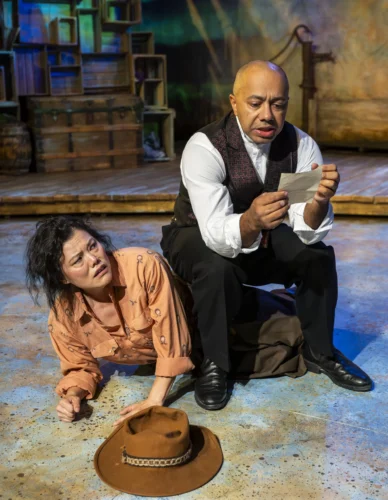
The primary benefit of the Western conceit, of course, was allowing costume designer Julie Keen to sidestep putting the cast in either togas and bronze-feathered galea helmets, or in kilts, with everybody’s face colored blue from woad. Western attire is far less demanding on a budget, but the motif called for more playfulness.
Cymbeline is stuffed with outstanding performances. As mentioned, JD Cullum is a major presence in this show. Randolph Thompsom does excellent work as Cloten, revealing not only is he a sexual psychopath, but a pain in the ass too. Desirèe Mee Jung, as the faithful Pisania, displays the cost of striving to do what’s right in a world determined to facilitate the wrong. Addison has the kingly presence for his kingly role.
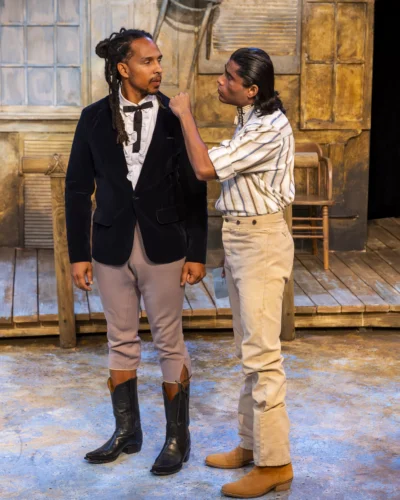
Gerard Joseph’s Iachimo was puzzling. In past stagings I’ve seen of Cymbeline, one of the challenges facing the director was preventing Iachimo from running off with the show. The glib-tongued conniver extraordinaire looms large at the play’s outset as the instigator who ignites the fuse of the central conflict. Then he vanishes, not reappearing until very near the drama’s end. Had he resurfaced any later, he would have missed the curtain call. Shakespeare’s plays often have very minor characters who are there to hoist the banner of “Author’s Viewpoint”: Williams in Henry V, Adam from As You Like It, and Measure for Measure’s Barnardine. Iachimo, however, is a rarity in Shakespeare’s writings—a minor character with a major role.

Iago in Othello never questions his actions, and when his villainy is finally exposed, he refuses to confess his crimes. Iachimo, even as he is in Imogen’s bedroom carrying out his scheme, expresses his qualms, and at the play’s conclusion, he confesses his wrongdoings and is forgiven. That perhaps explains why audiences take to Iachimo: because he is not innately evil as Iago is; he simply enjoys playing “evil.” And because he enjoys it, his audiences are allowed to as well. Whether the actor’s choice or director’s call, there is no “trickster” in Joseph’s Iachimo, and I think the show suffers for it.
Cymbeline is perhaps Shakespeare’s most underpraised play. George Bernard Shaw scorned it as “stagy trash.” However, the character of Imogen has had her admirers over the centuries, to the point where some have declared her, after Hamlet, the Bard’s most completely realized character. And Elinor Gunn provides her performance with everything that is required to substantiate that opinion.
So saddle up, theatergoers. This is one Cymbeline worth chasing down.
photos by Craig Schwartz Photography
Cymbeline
Antaeus Theatre Company
Gindler Performing Arts Center, 110 East Broadway in Glendale
Fri at 8; Sat at 2 & 8; Sun at 2; Mon at 8
ends on November 17, 2025
for tickets, call 818.506.1983 or visit Antaeus
for more shows, visit Theatre in LA

I agree with Bernard Shaw: “Stagy trash”!