


Areas We Cover
Categories

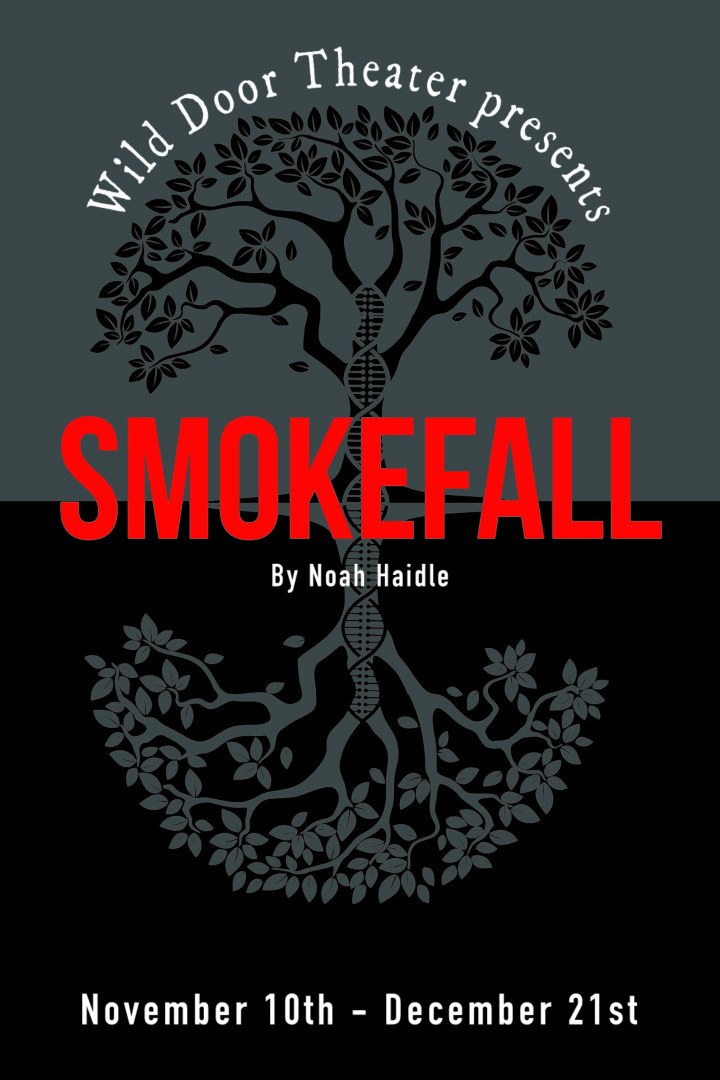
Theater Review: SMOKEFALL (Wild Door Theater)
by Mitchell Oldham | November 23, 2025
in Chicago, Theater
A FAMILY IN FLUX, A PLAY IN FREEFALL
Wild Door’s debut digs deep into love and legacy,
even when Haidle’s sprawling story gets in its own way
Chicago’s robust theater community got even stronger several days ago when Wild Door Theater made its debut in the Lincoln Park neighborhood. By “embracing bold theatrical storytelling to create transformative experiences for Chicago audiences,” the fledgling company hopes to add a valued layer of texture to the city’s already lush theatrical topography.
Choosing Noah Haidle’s Smokefall as its inaugural production leans into Wild Door’s desire to present daring works that deviate from convention to broaden how people view themselves and the world they live in.
Lucky Star (Fetus Two) and Andrew Gallant (Fetus One)
Since its initial staging nearly a decade ago, Haidle’s generation-spanning, family-centered story has garnered the full spectrum of critical responses. Both Smokefall’s unorthodox approach to storytelling and the playwright’s method of shaping themes require an initial adaptation — a willingness to travel down a different type of road to reap the anticipated reward.
The play takes place in the Midwest, in Grand Rapids, Michigan, where a family that at first glance looks perfectly normal soon proves quite otherwise. The very pregnant wife of the house, Violet, is putting together breakfast for the family, and her demeanor couldn’t be more pleasantly appealing. She’s living in the house she grew up in with her husband, Daniel, her daughter, Beauty, and her father, the Colonel. A narrator, Footnote (Lucky Star), briefs us on the specifics of their backgrounds and lives.
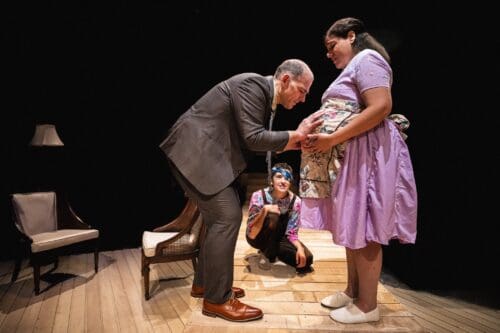 Andrew Gallant (Daniel), Isabella Isherwood (Beauty) and Vilmarie Rosario (Violet)
The first clue that something’s amiss is Beauty’s (Isabella Isherwood) eating habits. She exists on the bark of trees and dirt — or, as they refer to it in the play, earth. She’s also conditioned herself to drink paint, making it her preferred dietary liquid. Beauty’s family has come to accept this change in her eating habits, just as they’ve resigned themselves to her no longer speaking.
Smokefall deals heavily in the theatrical technique of magical realism, where the fantastical and implausible run parallel with reality. Here, director Andrew Gallant orchestrates the approach well. In Beauty’s case, her behavior becomes more comprehensible as we learn more about this family. Violet (Vilmarie Rosario) and Daniel’s marriage creaks with instability. The play’s director, Mr. Gallant, also performs the role of Daniel. Their private arguments are overheard by the rest of the family, and Beauty’s retreat into herself may be a response to that tension. Daniel resents living in his father-in-law’s house. And Violet’s father, the Colonel (Richard Schumacher), cognitively destabilized by dementia but ever the wellspring of the play’s comic relief, does little to make Daniel feel valued. Schumacher, a former trial lawyer making his debut stage appearance in this meaty role, gives it genuine luster. Part of the stress in the couple’s marriage stems from the twins Violet will soon bear. She’s enthralled at their impending arrival; Daniel doesn’t want them. Unhappy and detached, it’s clear he wants out.
Lucky Star (Fetus Two) and Richard Schumacher (The Colonel)
As we watch this disintegration, aphorisms and beliefs the Colonel has been expressing begin to resonate with more meaning. A widower who was rapturously married for decades, he’s a staunch champion of love. In addition to admonishing those in his family to “remember God exists,” he often shares with them his most sincerely held creed: “the greatest act of courage is to love.”
Lucky Star (Footnote), Vilmarie Rosario (Violet), Andrew Gallant (Daniel),
Isabella Isherwood (Beauty) and Richard Schumacher (The Colonel)
The implications of those words linger when Daniel finally does leave. It’s on the anniversary of his first date with Violet. The act scars the family by leaving a persistent stain on their psyches. It also sets up one of the most interesting and well-executed parts of the performance: the sequence where we’re taken inside Violet’s womb and meet the highly vocal and — in one of their cases — incredibly cerebral twin fetuses, John and Samuel, who are debating whether they want to be born.
Richard Schumacher (The Colonel) and Isabella Isherwood (Beauty)
Opposites who squabble fiercely but with a sweet, affectionate regard for one another, they’re feisty, precocious, very funny, and know a lot about the world they’re about to enter — including that their father didn’t want them. Which reinforces why one of them, Samuel (played by Gallant), is so vehemently opposed to leaving the security of his watery home. He’s also inordinately predisposed to worrying about original sin and, as his twin brother refers to it, “genetic determinism.” Lucky Star as John is a high-spirited sizzler who can’t wait to blast into the world. And when he does, he does so alone.
Enhanced by Spencer Donovan’s ingenious scenic design and the amplification of intimacy created by Josiah Croegaert’s lighting, it’s an exceptional scene where both Star and Gallant shine.
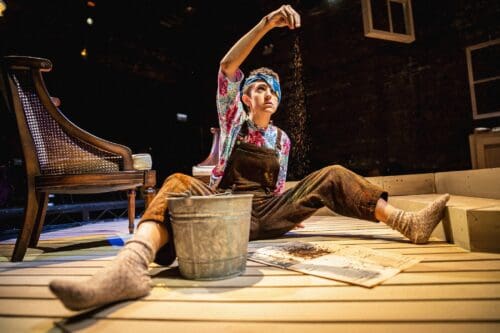 Isabella Isherwood (Beauty)
Progressions in the play can happen in great leaps. Beauty left home long, long ago in search of herself and her father. By the time we encounter the surviving twin John again, he’s an old man — not yet caustically bitter, but close. Living alone, he’s enduring the aftermath of a failed marriage and an equally dismal fatherhood. Still, his son has traveled a great distance — 25 hours of flight — to be with him on his birthday. Calling his son a failure just like him, John is a long way from that lightning bolt so anxious to be a part of the world. His son, who’s been given the name of the twin who chose not to be born, handles his father with philosophic fortitude. When his aunt, John’s sister Beauty, shows up out of the blue — now 94, speaking again, and spewing wisdom — it’s quite a reach to reconcile the timing of this reunion and the way it unfolds. As it sometimes does, Smokefall’s language slips into a distracting poetic density. And in this scene, the symbolism too is overwrought. But what the play ultimately burnishes is the belief of John’s grandfather, the Colonel, who preached how courageous it is to love — a lesson this family seems finally to take to heart.
Admirably performed and encased in a central story that many will be able to recognize and connect with, Smokefall holds valuable insights. Its terrain may be challenging, but it can also be exciting as it makes its observations about who we are and what we should value.
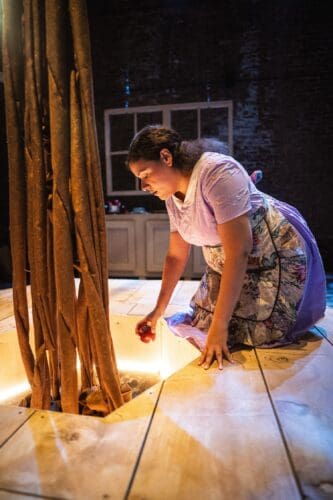 Vilmarie Rosario (Violet)
✦ ✦ ✦ ✦ ✦ ✦ ✦ ✦ ✦ ✦
photos by Joe Mazza/brave lux
Smokefall
Wild Door Theater
Theater Wit, 1229 W. Belmont Ave
Thurs-Sat at 7:30; Sun at 2:30; Wed at 7:30 (Nov 26); dark Nov. 27
two hours with intermission
ends on December 21, 2025
for tickets ($25–$39), visit Wild Door Theater
for more shows, visit Theatre in Chicago
✦ ✦ ✦ ✦ ✦ ✦ ✦ ✦ ✦ ✦
