


Areas We Cover
Categories

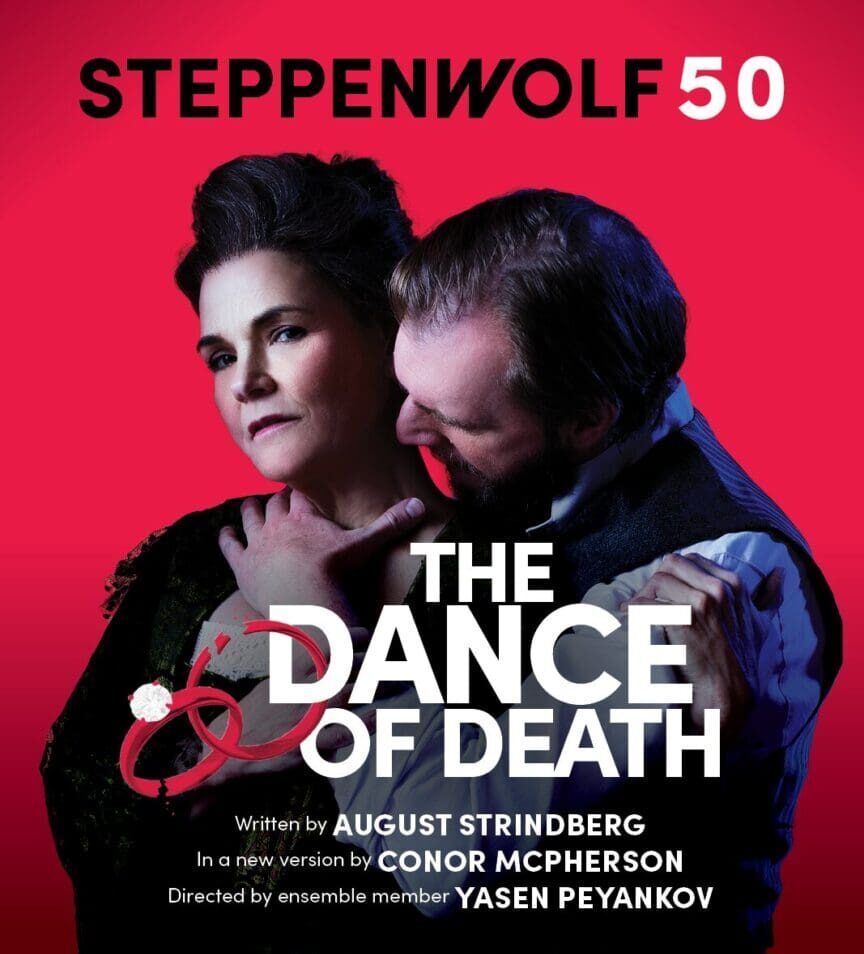
Theater Review: THE DANCE OF DEATH (Steppenwolf)
by C.J. Fernandes | February 10, 2026
in Chicago, Theater
It’s the little ways you try together; cry together; lie together—that make perfect relationships
– Stephen Sondheim, Company
Once upon a time, in a land far, far away, in a high stone tower, there lived a beautiful woman who hated her husband of twenty-five years and waited every day for him to die.
That is about as succinct a summary of August Strindberg’s The Dance of Death as can be written. Now being mounted in a handsome new production at Steppenwolf, I suspect your opinion of this lively new-ish adaptation by Conor McPherson of one of the classics of the theatrical canon will depend on whether you view the source material as a drama with comic elements, or a scabrous black comedy.

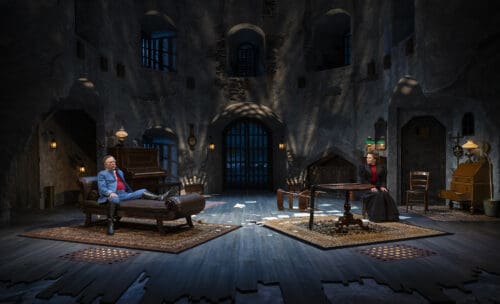
Scenic designer Colleen Pollard’s set is a three-story high tower room in cold grey stone. High barred windows and double doors that open onto a wintry landscape add to the chill in the atmosphere. Lee Fiskness’s lighting design emphasizes these elements, throwing shadows of bars onto the walls with harsh light streaming through grates in the stone floor. This is not merely a tower in a fortress but a turret prison, refitted as living quarters for a military captain Edgar, and his much younger wife Alice, a former actress. The date of their 25th wedding anniversary is near, but there’s also an unexpected visitor, Kurt, a distant cousin of Alice and more crucially a former lover.
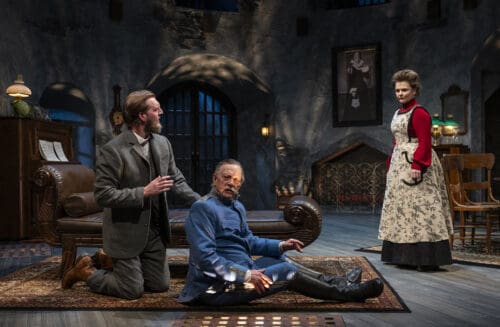
Edgar and Alice have long been considered one of the most toxic couples in theatre; there are times when they make George and Martha seem almost cuddly. There doesn’t seem to have been a time when they were happy, and it seems like the sourness of the marriage has tainted even the memories of their courtship, although there’s a quiet moment when Alice admits that—at least at the beginning—the homely Edgar was handsome and charming to her. But the thing about these two people is that we can never know when they tell the truth and when they lie, and I suspect that the characters themselves do not know. It is not for nothing that actors rush to play these parts.
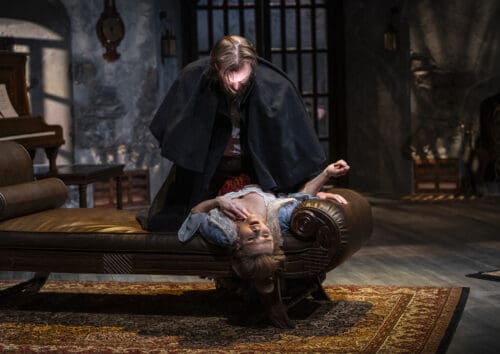
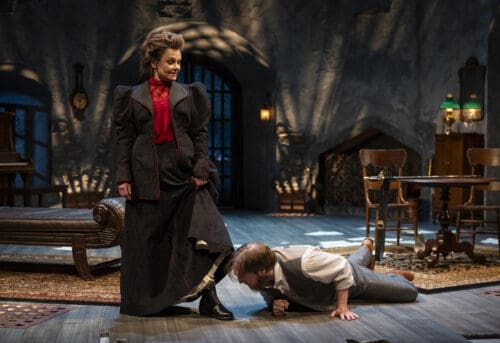
McPherson’s adaptation ratchets up the comedy—at the expense of the drama, some might argue—but rather than diminishing the complexity of the relationship and the characters, it enhances it. As the two snipe and fight with each other, Yasen Peyankov directs his cast to emphasize the up tones of the dialogue; the barbs are delivered with the timing of a screwball comedy, and the stage movements occasionally approach slapstick. But when the characters are left to their own devices, the facades drop away and the isolation on their faces is revelatory.
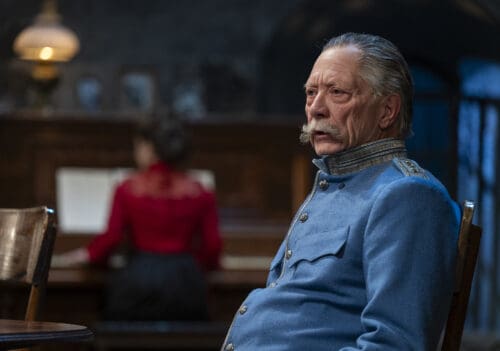
If not for Edgar’s cartoonish pomposity and overbearingness in the first act, his coming to terms with his mortality would not be as powerfully moving. Ominous shadows and flashes of lightning fill the room while ghostly whispers fill the air. Peyankov directs the scene as a horror movie. It works because to Edgar, played by a marvelously theatrical Jeff Perry, the prospect of slowly encroaching death is more horrifying than any ghost story could ever be.
Alice is played by Kathryn Erbe who returns to the Steppenwolf after almost thirty years spent on television, including a decade-long run in the popular Law & Order franchise, Criminal Intent (“Dun dun!”). Alice is a classic narcissist, somehow shackled to a much older man for 25 years. Erbe is deft at the comedic pieces, but what I like most about her performance was how cool and calculating her Alice is. Alice is always observing, assessing, and planning her next move. She is at war with Edgar and every battle is planned as if it were to be fought to the death. And if the death is literal then so much the better. Poor Kurt never stood a chance.
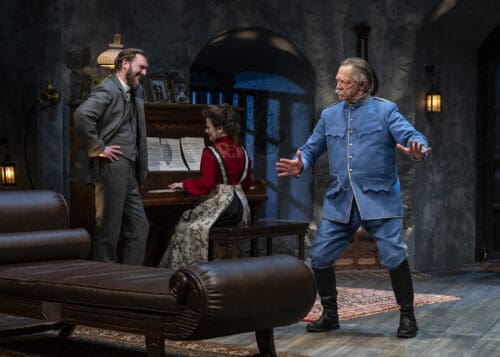
Cliff Chamberlain gave my favorite performance in last season’s You Will Get Sick and I am happy to report that it was clearly not a one-off. As the thoroughly decent Kurt, he brings an air of sweetness that is crucial to the play’s success. Thrust in the middle of these two monstrous people he is manipulated by each in turn repeatedly until he doesn’t know which side is up. And yet, his good nature persists. His watching over Edgar while he sleeps is a rare moment of decency and tenderness in a play that desperately needs it. But even Kurt has his limits and when he thrusts Alice at Edgar and flees the fortress to save himself, our enemy combatants are once again left alone with each other.
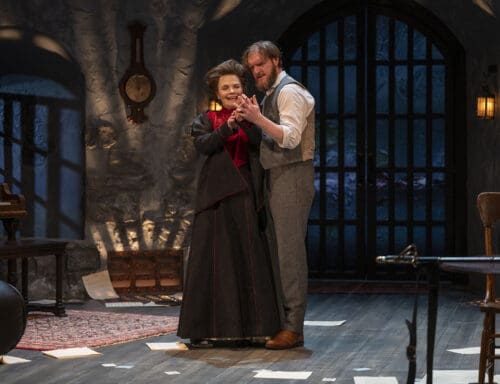
Alice and Edgar loathe each other. This much is established. But they also loathe everyone else even more (Sondheim: “It’s people that you hate together”) and towards the end of this production I started to wonder what would happen if one of them actually dropped dead. I suspect the other would wither away shortly after. Without a sworn enemy, someone to plot against, someone to torment, what would either one of them do? Has their decades-long hate for each other connected them in a way that love or affection could never have done? Alice and Edgar despise each other, but they also feed off each other, and console and protect each other from the indignities of the world. There’s a powerfully strong bond between them and as much as they try to break it, I wonder if there’s a part of them that’s relieved every time they fail.
Or maybe Alice will find a handsome young doctor and run away with him and live happily ever after.
What the hell do I know?
✦ ✦ ✦ ✦ ✦ ✦ ✦ ✦ ✦ ✦
photos by Michael Brosilow
The Dance of Death
Steppenwolf Theatre Company
Downstairs Theatre, 1650 N. Halsted St.
2, hours 15 minutes, with intermission
ends on March 22, 2026
Tues-Fri at 7:30; Sat at 3 & 7:30; Sun at 3; Wed at 2 (March 11)
(check for performance variances)
for tickets ($20–$148.50), call 312.335.1650 or visit Steppenwolf
for more shows, visit Theatre in Chicago
✦ ✦ ✦ ✦ ✦ ✦ ✦ ✦ ✦ ✦
