


Areas We Cover
Categories hhhh

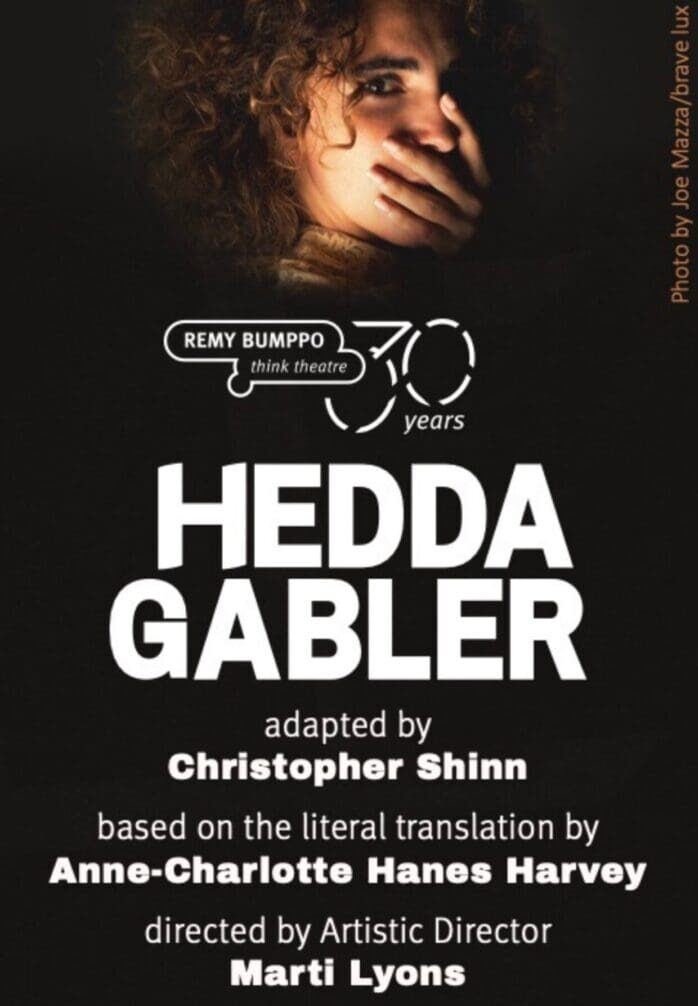
Theater Review: HEDDA GABLER (Remy Bumppo)
by C.J. Fernandes | February 16, 2026
in Chicago, Theater
IBSEN’S ICONIC ANTIHEROINE STILL
MAKES A MESS OF POLITE SOCIETY
A sleek, sharply acted production
driven by a magnetic central
performance, even at a lightning pace
Redtwist Theatre may have “Defiant Femmes” as its seasonal theme, but headstrong, prickly, and complicated women are commanding stages all over Chicago at present. For its first production of 2026, Remy Bumppo brings the ur-antiheroine Hedda Gabler back to the stage at Theater Wit in Lakeview. To be fair, Hedda isn’t the first antiheroine in theater, but she may be the first explicitly written as one—and certainly the first to be recognized as such when Henrik Ibsen’s masterpiece premiered in 1891.
Gloria Imseih Petrelli, Greg Matthew Anderson, Eduardo Curley, Aurora Real de Asua, Annabel Armour, Linda Gillum, Felipe Carrasco
Annabel Armour and Eduardo Curley
Hedda Gabler opens on a handsome living room and study set that seems lifted out of The Gilded Age TV series; Joe Schermoly’s design is all mauves and purples, paneled walls and embroidered upholstery; pure old world elegance. But there is an anomaly: a spinet upstage adds a discordant note (pun intended), and a nervous maid frets about a newly delivered bouquet of flowers that are a startling, intrusive red; They clash with everything in the room and are eventually banished to the top of the piano. A pair of newlyweds, just returned from a six-month honeymoon, sleep upstairs, and the new mistress there is adamant that everything be in place by the time she wakes. Yes, the symbolism is pointed—but come on, it’s Ibsen.
Aurora Real de Asua and Eduardo Curley
Soon Tesman (Eduardo Curley) is downstairs amiably chatting with his aunt about his wedding trip. Everything is genteel and proper until his new wife Hedda (Aurora Real de Asua) storms in like a dervish, half-dressed and unkempt, upending the room’s careful equilibrium before she even speaks.
Felipe Carrasco, Greg Matthew Anderson, Eduardo Curley, Aurora Real
There are few plays that depend on the talent of a single actor as much as Hedda Gabler. An actor friend once joked that the rest of the cast could be played by automatons and the play would still work if the lead were strong enough. Not entirely true—but not entirely wrong either. This is one of the great roles ever written for a woman (another, Irina Arkadina, is being performed further north at The Edge Off Broadway by Red Theatre, and a third, Miss Julie, at Court in Hyde Park. See? All over the city). So the real question is never how good the play is, but how good the Hedda is.
Aurora Real de Asua
And Aurora Real de Asua is very good—indeed, she’s fantastic. Her portrayal feels strikingly modern in speech, affect, and movement, which only heightens her separation from the more restrained world around her. Hedda is deeply dissatisfied—with society, her circumstances, even herself—and the reasons are never fully articulated, which allows for a fascinating range of interpretations. Real de Asua leans into that ambiguity: her Hedda is a taut bundle of nerves, constantly exerting control over whatever—or whoever—is within reach. Real de Asua’s Hedda is a bundle of angst and nerves, constantly trying to control life; it doesn’t matter whose. Like a malevolent Emma Woodhouse, she manipulates others for her own amusement. and then dismisses them with cavalier disregard when she’s bored with them.
Eduardo Curley, Felipe Carrasco and Aurora Real de Asua
The only other character she seems to meet as an equal is Judge Brack, a family friend who is as restrained in his demeanor as Hedda is wild. Greg Matthew Anderson, excellent in the role, offers a sly, insinuating performance that draws out Hedda’s most dangerous impulses. Their scenes crackle. In one especially telling moment, a flicker of excitement crosses Hedda’s face as Brack hints at his own depravity; she leans toward him almost involuntarily. Is it the thrill of finally encountering a worthy adversary? A subconscious recognition of the power he holds over her fate? Or something else entirely? Real de Asua keeps her cards very close to her chest, thus forcing us to lean in ourselves.
Greg Matthew Anderson and Aurora Real de Asua
The rest of the cast is solid. Felipe Carrasco, as Hedda’s former lover Eilert Lövborg, could use a bit more nuance, though the role itself offers limited shading—he need only remain convincingly under Hedda’s spell. And that’s the key: everything returns to Hedda. The strongest testament to Real de Asua’s performance is that, despite Hedda’s cruelty, it never seems implausible that everyone around her remains captivated. She is, quite simply, enchanting.
Aurora Real de Asua
Director Marti Lyons stages the production with flair and a welcome sense of wit. Even the transitions have a kind of balletic precision, enhanced by Christopher Kriz’s finely tuned score. The more one reflects on the production, the more its clever touches reveal themselves: the vivid red of the flowers later echoed in Hedda’s scarf and Eilert’s tie; staging choices that heighten the play’s underlying sexual danger (Hedda’s seduction of Eilert visible to her husband and the Judge, but unheard); and an overall pacing that gives the piece the momentum of a psychological thriller.
Aurora Real de Asua and Gloria Imseih Petrelli
And that’s the one reservation. The pacing is perhaps too brisk. At just under 100 minutes, the production moves swiftly—impressively so—but at the cost of some deeper excavation. A touch more space might allow the audience to linger over the characters’ motivations and the play’s more elusive themes.
Then again, audiences and actors have been trying to decode Hedda Tesman, née Gabler, for more than 135 years, so maybe it’s not that big of a deal.
May she remain an enigma forever.
Felipe Carrasco and Aurora Real de Asua
✦ ✦ ✦ ✦ ✦ ✦ ✦ ✦ ✦ ✦
photos by Michael Brosilow
Hedda Gabler
Remy Bumppo
Theater Wit, 1229 W. Belmont Ave.
100 minutes, no intermission
Thurs-Sat at 7:30; Sun at 2:30; Wed at 7:30 (Feb. 25 & March 4)
ends on March 8, 2026
for tickets ($36–$55), visit Remy Bumppo
for more shows, visit Theatre in Chicago
✦ ✦ ✦ ✦ ✦ ✦ ✦ ✦ ✦ ✦
Linda Gillum and Annabel Armour
