


Areas We Cover
Categories

Opera Review: AKHNATEN (LA Opera)
by Michael M. Landman-Karny | March 1, 2026
in Los Angeles, Music, Theater
STILL THE PHARAOH-EST OF THEM
ALL, AKHNATEN STUNS AT LA OPERA
An intellectually rigorous, visually arresting production that
embraces the opera’s challenges rather than disguising them
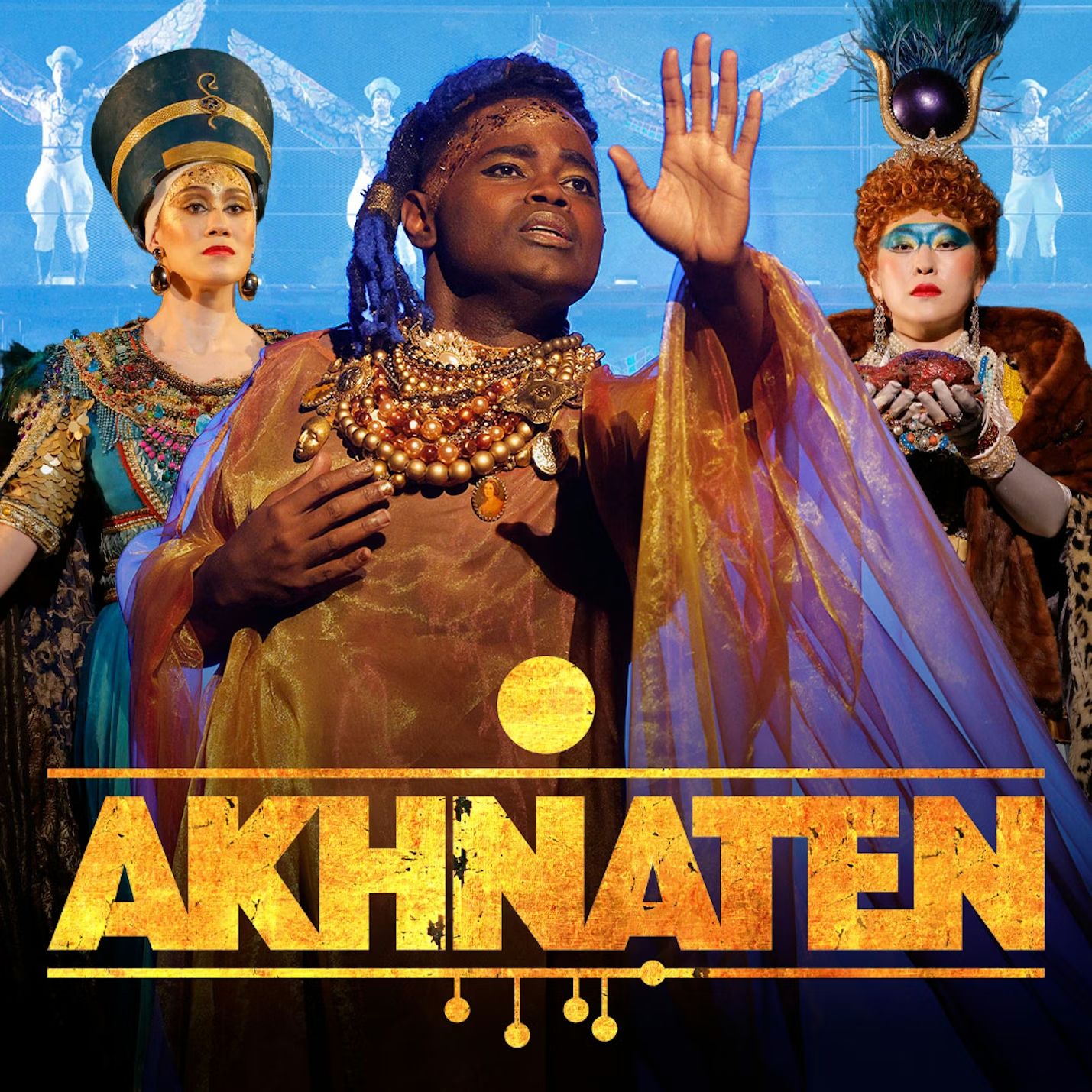
John Holiday as Akhnaten
There is a structural difficulty at the heart of Akhnaten that admiration alone cannot resolve—although admiration at last night’s opening at The Chandler is never in doubt. The opera is not dramatic in any familiar sense. Philip Glass’s 1984 score, the final installment of his portrait trilogy following Einstein on the Beach and Satyagraha, does not attempt to shape its subject into conventional theater. Akhnaten, the monotheist pharaoh who overturns Egyptian polytheism and is later erased from official memory, moves through a sequence of formal rites: birth, coronation, devotion, collapse. The music gathers around these events in repeating cells and expanding cycles rather than pushing them forward. The libretto, drawn from Egyptian religious texts, the Amarna letters, and Psalm 104, is sung in ancient Egyptian, Akkadian, and Hebrew, Glass has stipulated that no surtitles be used, and so the vocal lines hover in a state of radiant unintelligibility, their meaning dissolving into pure sound. The opera asks its audience to set aside narrative propulsion and psychological immediacy and to accept something closer to immersion in historical vastness. It is a lot to ask. But forty years on, the score keeps justifying the demand: this remains one of the great operatic works of the twentieth century.
Jugglers and Choristers
Phelim McDermott’s production, revived by LA Opera after its celebrated 2016 run, addresses this challenge with unusual clarity. The answer is spectacle—but spectacle applied with intelligence and restraint. When the curtain rises on a stage crowded with jugglers and acrobats tracing patterns that mirror the score’s internal logic, the proposition is unmistakable. If the ear requires time to adjust to Glass’s idiom, the eye remains active enough to sustain attention. The juggling is not ornamental. It operates as a visible analogue to the music, rhythmic figures embodied in space. When a cascade aligns precisely with the orchestral pulse, the repeating figures register as structure, not stasis. What might feel static in a bare staging acquires momentum through movement.
Julia Maria Johnson as Meretaten, Emily Damasco as Bekhetaten,
and Erin Alford as Neferneferuaten
Tom Pye’s sets and Kevin Pollard’s costumes resist archaeological literalism. The Egypt presented here feels hieroglyphic instead of documentary, composed of sculptural groupings, metallic surfaces, and images that seem summoned from some collective unconscious of antiquity. Bruno Poet’s lighting washes the stage in a glow more suggestive of memory than geography. The visual language parallels the score’s stance toward the ancient world. Glass does not attempt historical reconstruction in sound; he applies his own vocabulary of arpeggiated harmonies, elongated vocal lines, and gradual expansions of color to ancient material. The production meets him on those terms, answering invention with invention.
Zachary James as Amenhotep
In the pit, Dalia Stasevska gives a reading alert to instrumental detail. The chamber quality of the orchestration emerges clearly, with woodwinds and basset horns threading through the texture and the organ pedal grounding the harmony in something elemental. She allows the larger spans to unfold patiently, trusting the cumulative force of repetition. This opera falters when a conductor attempts to hurry its pulse in search of conventional drama. Stasevska accepts the score’s slower metabolism, and—with a few exceptions on opening night—the orchestra meets her commitment with discipline and sheen.
John Holiday as Akhnaten and So Young Park as Queen Tye
John Holiday’s Akhnaten favors inward intensity over monumentality. His countertenor possesses clarity and delicacy of shading that suit the role’s long, arching lines. In the “Hymn to the Sun,” he sustains phrases with concentrated stillness that seems to quiet the hall. The silence afterward feels less like courtesy than suspension, as if breathing itself has been briefly forgotten. Holiday’s interpretation leans toward vulnerability. His Akhnaten appears visionary yet politically unguarded, convinced of divine purpose but blind to gathering resistance. The portrayal carries authority without chill—you see the man inside the icon. Those who remember Anthony Roth Costanzo in the earlier run may recall a more overt sexual charge. Holiday’s approach substitutes introspection, opening a different dramatic contour.
Sun-Ly Pierce as Nefertiti
Sun-Ly Pierce’s Nefertiti supplies warmth and steadiness at the center of the court. The voice is burnished and centered, carrying weight in the upper register without forcing the lower. In the extended love duet, where the two voices entwine in sustained arcs, her legato allows the music to expand without strain. In quieter passages, as her line settles beneath Holiday’s, the timbres fuse with quiet inevitability.
Sun-Ly Pierce as Nefertiti, John Holiday as Akhnaten, So Young Park as Queen Tye
So Young Park as Queen Tye
Queen Tye, Akhnaten’s mother, occupies a sharper vantage point—perhaps the only figure who grasps both the scale of her son’s ambition and the institutional machinery already gathering to dismantle it. So Young Park, whose instrument carries the high, silvery brilliance associated with The Magic Flute’s Queen of the Night, brings an unexpected edge. Where some interpreters warm the character from within, Park cuts through the ensemble textures with pointed clarity, the sound harder and more strategic than maternal lament.
(seated) Schroeder Shelby-Szyszko (Young Tutankhamun),
(back) Vinícius Costa (Aye), Sun-Ly Pierce (Nefertiti),
Yuntong Han (High Priest of Amon), and Hyungjin Son (Horemhab)
Vinícius Costa’s Aye never announces himself as the villain—and doesn’t need to. The voice has a bass-baritone density that settles into a room rather than filling it, suggesting power that operates through patience rather than display. When Akhnaten’s revolution finally collapses, you believe this is the man who has waited it out.
Zachary James as Amenhotep III
Zachary James, as the ghost of Amenhotep III, contributed the most commanding presence of the evening. The role is spoken, not sung, but James made that limitation irrelevant. Narrating his own soul’s ascension, threading poetic commentary through the coronation and the revolt, he held the stage with a vocal charisma and physical authority that few singing roles in the repertoire demand so nakedly. In the final scene he reappears as a university lecturer walking tourists through the ruins, a shift that could easily curdle into cleverness but instead lands with quiet force, preparing the ground for the vocal epilogue in which the spirits of Akhnaten, Nefertiti, and Queen Tye converge in something close to a literal haunting.
Vinícius Costa as Aye, Yuntong Han as the High Priest of Amon, Hyungjin Son as Horemhab
Much of the production’s vitality arises from continuous visual invention—new geometric formations, shifting tableaux, evolving images. The eye never rests. One could argue this compensates for the opera’s restrained dramatic engine. Glass builds through accumulation, not event. A barer staging would force a more austere confrontation with that fact. If movement grants the ear patience with repetition, assistance is being provided.
Yuntong Han (center) as the High Priest of Amon
Yet at its strongest moments, when singers, dancers, and orchestra settle into a unified pulse, the objection fades. The staging does not distract from ritual; it activates it. The underlying argument becomes clear. This story concerns political belief more than ancient Egypt. Faith radiates beauty and coercion in equal measure—and remains fragile before institutional resistance.
John Holiday as Akhnaten
In the final scene, tourists wander the ruins of Amarna as a guide recites from a travel book. Stone remains silent. Then the tourists leave, the stage empties, and the ghosts of Akhnaten, Nefertiti, and Queen Tye appear among the rubble, singing wordlessly, at first seeming not to know that their world has ended. Glass ends without flourish or consolation. The image persists in darkness, completing its work in silence. McDermott’s production stands as the definitive theatrical realization of this opera, and LA Opera’s revival emerges as a must-see event this season in Southern California.
So Young Park as Queen Tye, with Ensemble
✦ ✦ ✦ ✦ ✦ ✦ ✦ ✦ ✦ ✦

photos by Cory Weaver
Akhnaten
LA Opera
Dorothy Chandler Pavilion, 135 North Grand Ave.
3 hours with two intermissions
sung in ancient languages with English supertitles
libretto by Philip Glass in association with Shalom Goldman,
Robert Israel, Richard Riddell and Jerome Robbins
for tickets, call 213. 972.8001 or visit LA Opera
Wednesday, March 11
Thursday, March 19
Saturday, March 14
Sunday, March 8
just added: Saturday, March 21
Sunday, March 22, 2026
for more shows, visit Theatre in LA
✦ ✦ ✦ ✦ ✦ ✦ ✦ ✦ ✦ ✦

The juggling was tedious. The sets were ugly and non-supportive to the theme. The opening hieroglyphics were heavy-handed and disarming
This opera is the worst I ever attended. The music does not exist, and all that slow-motion music and crazy juggling. 3 hours of annoying time.
I agree. Dissapointed.
I am so amused that the other commenters hated this. I loved it. It was spectacular. Clearly avant garde is not everyone’s cup of tea! lol.
This is one of the most magical mystical mesmerizing theatrical experiences ever! I loved it 10 years ago and loved it even more last night… second only to Glass’s Einstein on the Beach, which remains the most unique operatic experience ever! If you are expecting La Bohème then you will probably race for your car at intermission. But if you give yourself over to the tenor and tone and go with the flow you will reap untold rewards and gratification.
Loved the music, the sets and costumes. Transported to a timeless reverie. Thank you LA Opera and the magicians on stage, in the pit and the composer Phillip Glass for taking me there.
If endurance were an art form, Akhnaten would be its crowning achievement—an unapologetically self-indulgent, almost narcissistic exercise in how far an audience can be pushed before surrendering.
What unfolds on stage feels less like storytelling and more like a composer utterly captivated by his own reflection. The production doesn’t invite you in; it assumes you’ll sit quietly and admire it, whether or not it gives you anything in return. And for long stretches, it doesn’t.
The score circles endlessly around the same few notes, repeating with such stubborn devotion that it begins to feel less like music and more like a test of psychological resilience. The orchestra plays beautifully, no doubt—but beauty without variation quickly curdles into monotony. Meanwhile, the vocalists—clearly gifted—are reduced to sustaining an eternal vowel. Not language, not narrative—just a ceaseless “Aaaaaaaaa…” stretched across what feels like entire epochs of time.
The staging doubles down on abstraction, opening with a baffling three-tier scaffolding set where performers drift about with no discernible purpose. Some shuffle slowly across levels, others juggle objects in moments that feel like they wandered in from a low-energy Cirque du Soleil rehearsal. These brief bursts of activity are almost a relief—not because they make sense, but because they introduce movement at a speed measurable by human standards.
Elsewhere, the pacing is so glacial it borders on parody. Performers move with such excruciating deliberation that a sloth would seem hyper-caffeinated by comparison. Each step is placed with ceremonial gravity, evoking Egyptian art—but draining the stage of any sense of life. It’s less a performance than a living diorama.
Occasionally, as if aware that the audience may have completely lost the thread (or consciousness), the music halts and someone steps in to explain what is supposedly happening. These interruptions feel less like artistic choices and more like emergency interventions.
Then there’s the moment that might have been memorable—had I been awake. The lead’s full-frontal entrance, intended as a bold, symbolic coronation of Akhnaten, instead serves as an accidental metaphor for the entire production: exposed, self-serious, and convinced of its own profundity. I missed it entirely, having drifted off somewhere in Act One—a decision I can’t honestly say I regret. I was later informed of the spectacle over a drink at intermission, which, like the second intermission, functioned primarily as an opportunity to reconnect with reality.
And that may be the most telling detail of all: the liveliest part of the evening happened at the bar.
By the end, applause feels less like appreciation and more like a collective acknowledgment of survival. The lingering echo of “Aaaaaaaaa…” doesn’t read as music—it feels like a warning, still reverberating days later.
Akhnaten is not something you watch. It’s something you endure—and perhaps, in its own peculiar way, something you recover from.
It was breathtaking. I attended the final performance on Sunday & was transported. An extraordinary experience.