


Areas We Cover
Categories

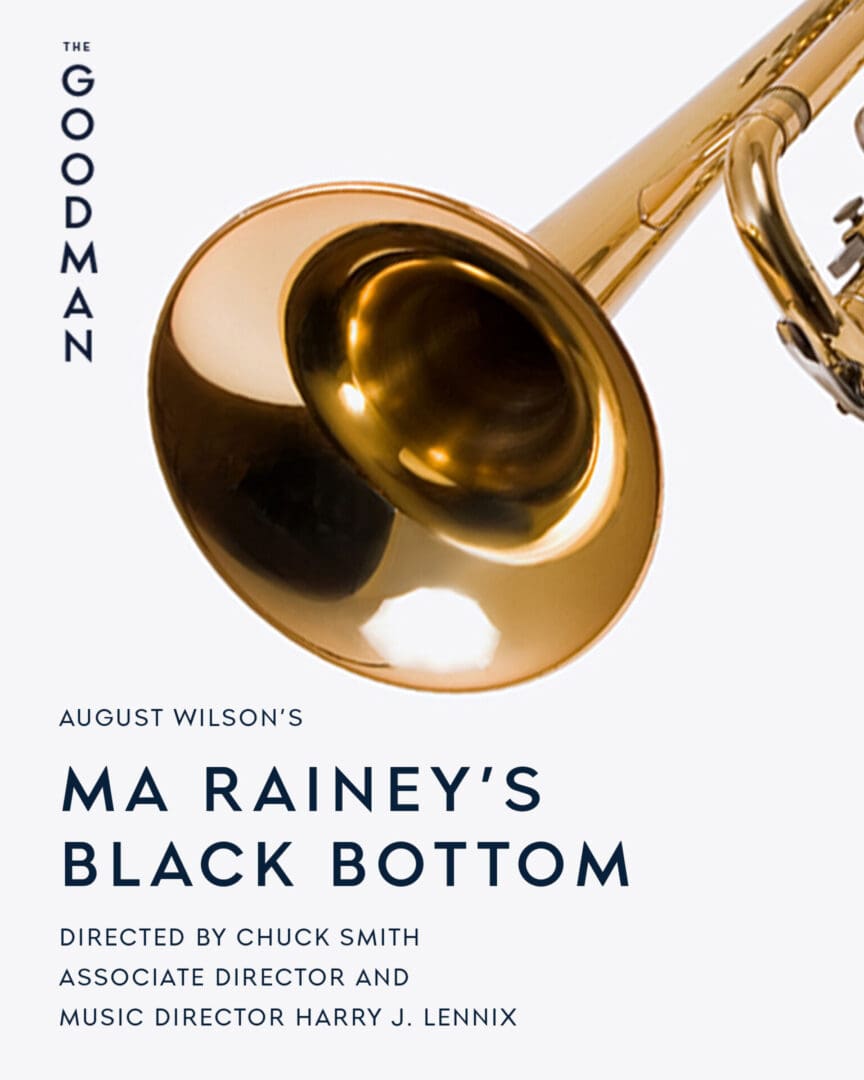
Theater Review: MA RAINEY’S BLACK BOTTOM (Goodman Theatre, Chicago)
by C.J. Fernandes | April 9, 2026
in Chicago, Theater
THE BLUES THAT BUILT AMERICA—
AND THE COST OF SINGING THEM
August Wilson’s masterpiece lands with
devastating force in a blazing Goodman revival
Four black musicians amble into a recording studio in Chicago in 1927. They are met by two nervous white men; one a manager, the other the owner of the studio. Both demand to know where Ma is, and why she isn’t there yet. The musicians shrug. They are members of the band. As long as they play what they’re told to play, the egos and demands of the stars have little to no bearing on their livelihood. They head straight down to the basement, outfitted with a piano and some benches. This is their band room. Their space. Ma will get here when she gets here.
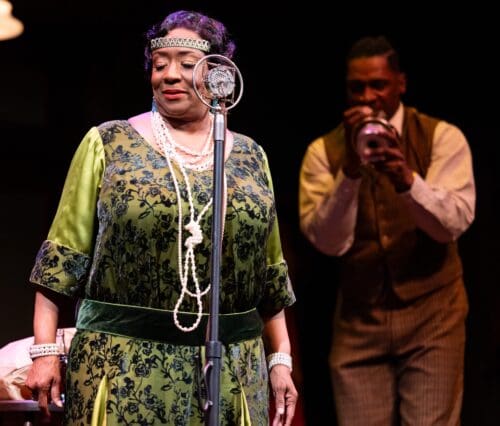
E. Faye Butler, A’Jaleel McGhee
Ma Rainey’s Black Bottom was written by legendary playwright August Wilson in 1982. It eventually made its way to Broadway two years later—his first play to do so—and its success there established him in the public eye. This near-flawless revival, directed by Chuck Smith with musical direction by Harry Lennix, is Goodman’s second go at the play—the first was a huge success in 1997—and one hopes it will be at least as successful.
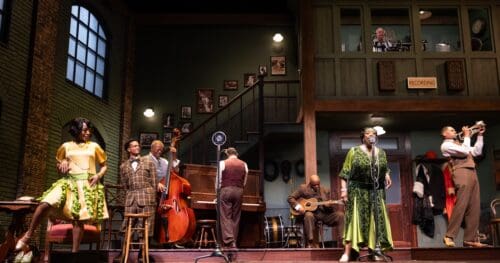
Tiffany Renee Johnson, Jabari Khaliq, Cedric Young, Kelvin Roston Jr., David Alan Anderson, E. Faye Butler, Matt DeCaro (above), Al’Jaleel McGhee
Most of Ma Rainey’s stage time is occupied by a bunch of folks sitting around, shooting the shit. While Cutler (David Alan Anderson), Toledo (Kelvin Roston Jr.), Slow Drag (Cedric Young) and Levee (Al ’Jaleel McGhee) wait in the band room, they exchange stories, catch up with each other, and affectionately rib the hot-headed, arrogant Levee about his new shoes. Even after Ma—the legendary E. Faye Butler, roaring up to the heavens, giving us glorious entitled diva goodness, and generally having the time of her life—shows up, there is very little incident. Recording is interrupted because there isn’t a bottle of Coca-Cola in the studio. A nephew has to learn to control his stutter to deliver the intro to the song. Ma’s comely girlfriend flirts with Levee—it would seem out of boredom more than anything else. All the while Ma’s manager Irvin (Marc Grapey) runs about frantically while the studio owner Sturdyvant (Matt DeCaro) develops an ulcer.
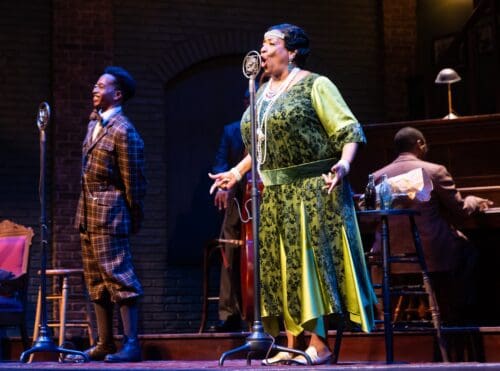
Jabari Khaliq, E. Faye Butler, Kelvin Roston Jr.
What’s remarkable is how subtly this chatter sets us up for the play’s two explosive set pieces—one at the end of each act. Rather than state his thesis out loud, Wilson buries it beneath quotidian conversation. Ma’s insistence on the studio owner calling her “Madame.” She is his most successful artist and he will address her as such. The musicians’ insistence on being paid in cash and not a check. Levee’s excitement over his new shoes. Toledo’s erudite philosophizing. And above all, Cutler’s and Slow Drag’s complacency. They are the oldest members of the band. They have learned their place. As Slow Drag says at one point, “I wanna get out of here. I don’t want to be around here all night. When it comes time to go up there and record them songs . . . I just wanna go up there and do it.” He’s a musician for hire, nothing else, and Levee’s ambition seems to annoy and amuse him in equal measure.
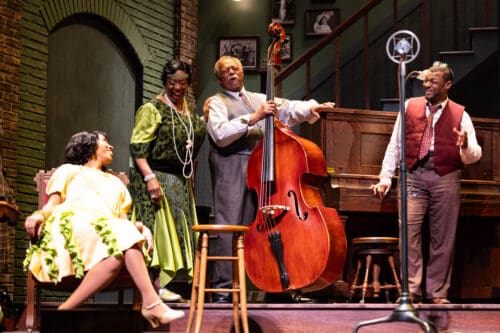
Tiffany Renee Johnson, E. Faye Butler, Cedric Young, Kelvin Roston Jr.
Because Ma Rainey’s Black Bottom is about systemic racism—how it slowly grinds you down and ultimately defeats you. The four musicians are in different stages in this process, with the naïve Levee at one end of the spectrum and Slow Drag at the other. Even Ma Rainey is well aware of her place in the system. She knows her worth to the studio and that once her magnificent voice is recorded and signed over, her value diminishes. She exploits her power not just because she can, but because she knows that it has an expiration date. Levee is the only character that gets a serious backstory, but the accumulation of life-long racist macro- and microaggressions comes through in all five performances. In what is a throwaway part, watch how subtly Matt DeCaro’s demeanor shifts when he talks to Levee (as opposed to Ma) about his new songs. It’s a small moment, but a chilling—and telling—one.

Al’Jaleel McGhee, David Alan Anderson, Cedric Young, Kelvin Roston Jr.
I cannot praise this cast enough. There’s not a bum line reading in the entire two-plus hours. The collegial chemistry between musicians is wonderful. The singing is terrific. Every joke lands—I will never not blush at the origin of Slow Drag’s nickname—but I must single out Al ’Jaleel McGhee, who was criminally underused in Revolution(s)—also at the Goodman—last winter, but in Levee has found a part worthy of his considerable talent. He is sublime.
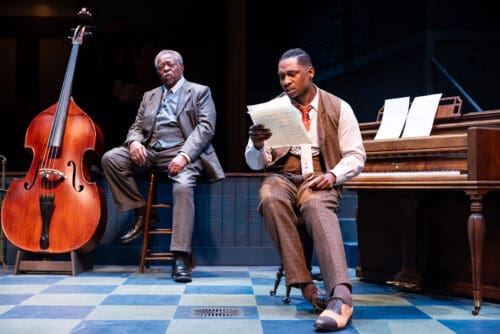
Cedric Young, Al’Jaleel McGhee
As with most productions at the Goodman, the technicals are flawless, from Evelyn Danner’s period-appropriate costumes to Linda Buchanan’s gorgeous set of a 1920s recording studio, all warm wood, painted brick, and shades of soothing sage green. Jared Gooding’s lighting design is unobtrusive but effective, and I quite liked the occasional projections of abstractions of El tracks accompanied by train sounds. It’s a clever touch.
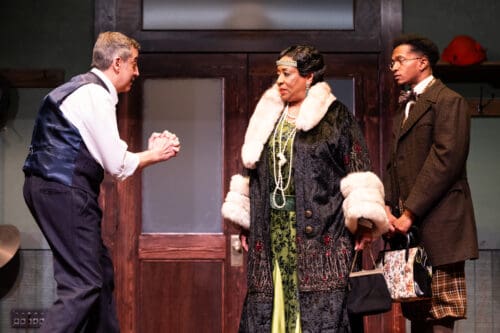
Marc Grapey, E. Faye Butler, Jabari Khaliq
Ma Rainey’s Black Bottom is a play set in the 1920s, written in the early 1980s. As weighty as its themes are, thanks to the distance provided by time, there will always be a tint of nostalgia laced through every production, helping its remarkably bitter pill go down. The incredible music helps too. But just like Top Girls—a play about systemic sexism—that debuted on the West End in the same year, watching it in 2026 is a sobering, and depressing experience. There really is no sugar-coating it.
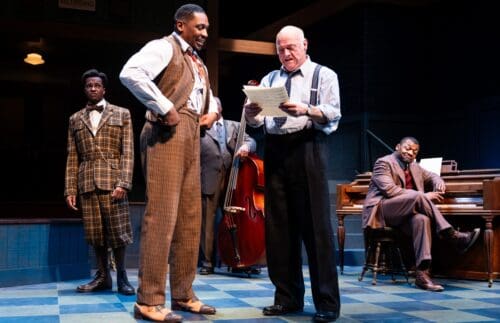
Jabari Khaliq, Al’Jaleel McGhee, Cedric Young, Matt DeCaro, Kelvin Roston Jr.
There’s a lovely line from a conversation between Ma and Toledo that is frequently quoted in the context of this play:
“The more music you got in the world, the fuller it is.”
What always sticks, though, is what she says after that:
“The blues help you get out of bed in the morning. You get up knowing you ain’t alone. There’s something else in the world. Something’s been added by that song. This be an empty world without the blues. I take that emptiness and try to fill it up with something.”
✦ ✦ ✦ ✦ ✦ ✦ ✦ ✦ ✦ ✦
photos by Justin Barbin
Ma Rainey’s Black Bottom
Goodman Theatre
Albert Theatre, Chicago
performances schedule varies; see website for details
ends on May 3, 2026
for tickets ($34–$109), call 312.443.3800 or visit Goodman Theatre
for more shows, visit Theatre in Chicago
✦ ✦ ✦ ✦ ✦ ✦ ✦ ✦ ✦ ✦
