


Areas We Cover
Categories hhhh

Concert Review: LISE DAVIDSEN & FREDDIE DE TOMMASO (BroadStage, Santa Monica)

by Michael M. Landman-Karny | April 13, 2026
in Concerts / Events, Los Angeles, Music, Tours
TWO VOICES, ONE VOLTAGE
An evening of operatic power finds
its charge in connection, not just scale
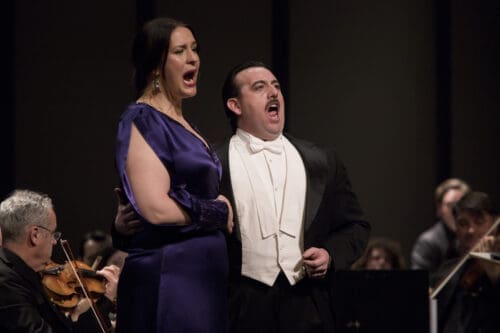
BroadStage does not often present evenings of this ambition. A sold-out house, a freelance orchestra under Iván López Reynoso, and two singers at or near the summit of their respective careers: Lise Davidsen, the Norwegian soprano who has owned the dramatic repertoire for the better part of a decade, and Freddie De Tommaso, the British-Italian tenor who has been making his case at the major houses with a forcefulness that is difficult to argue with. The program promised opera at full weight. For most of the evening, it delivered something rarer: two voices that actually wanted to be in the same room, and found each other there. The house was on its feet before the evening was half over.
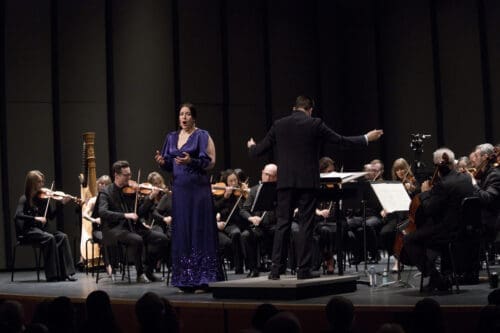
Davidsen opened the evening. She is, at present, one of the two or three most important voices in the world. The first phrase of “Dich teure Halle” settled the question. It was titanic, yet the diminuendi managed to mitigate sheer volume with the tentative melt of a mountain’s slipping sleet, the notes extinguished until they became precious tincts of sound rather than demonstrations of lung capacity. This is the central miracle of what she does: the power is always there, and she has learned to govern it without losing an ounce of it.
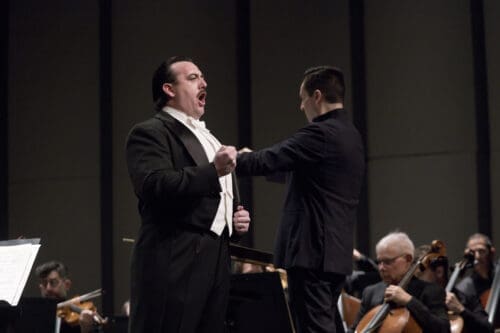
De Tommaso’s first solo entry was Cilea’s “Lamento di Federico” from L’arlesiana. It is a choice that tests a tenor’s capacity for sustained inwardness before he has warmed the room, and De Tommaso did not flinch. What he gave Cilea was devotion rather than display, an earnestness that never curdled into solemnity, and the technique underneath it was formidable from the first phrase: a powerful lyric instrument held in genuine reserve, the tone golden rather than bright, dynamics shaded with a sensitivity that a singer twice his age might envy. There is a particular kind of young tenor who mistakes volume for conviction. De Tommaso is not that tenor, and at this stage the distinction is everything.
None of this is to say the evening was flawless. In the Cilea, his handling of “scordar” was pushed to near-silence in a way that undid rather than deepened the sombreness he was reaching for; and in “Teco io sto,” certain successive notes carried a slightly choked quality, swallowed passion of the kind that mid-century Italian tenors deployed as a matter of style and that lands uneasily in a modern hall when it is not precisely controlled. A voice of this quality will iron out such roughness with time and mileage. It was in that same Cilea, paradoxically, that the evening’s most staggering singing arrived: impassioned, razor-sharp at the top, the kind of phrase that resets your expectations mid-breath.
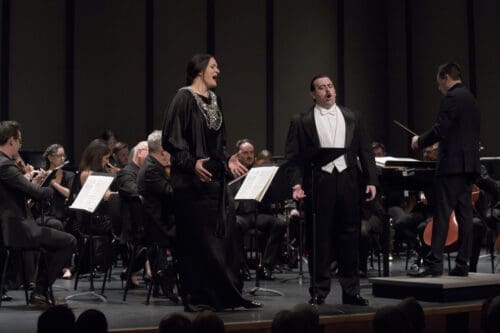
The Mascagni scenes that followed — Davidsen’s “Voi lo sapete, o mamma” and then the “Tu qui, Santuzza?” duet — had the density of people who have been wronging each other for years. Santuzza sits inside Davidsen’s instrument the way a hand sits inside a glove: the grief is already in the sound before she shapes a word. De Tommaso’s Turiddu pushed back with enough heat to make the scene crackle.
Davidsen closed Part I with Verdi’s “Come dal ciel precipita” from Macbeth: dark, focused, Lady Macbeth’s sleepwalking aria carrying the specific weight of a voice that does not need to manufacture dread. Then “Teco io sto” from Un ballo in maschera brought both singers back together, pulling away from grandeur and toward something murkier and more private, as though the characters were thinking aloud rather than declaiming.
Puccini’s “Ch’ella mi creda” from La fanciulla del West opened Part II. Johnson’s farewell aria is not a display piece; it asks for conviction without ornament, and De Tommaso gave it exactly that. He has recorded the Neapolitan repertoire on his album Passione, and that frankness carried here too: a willingness to be inside the sentiment without looking for the exit.
The Tosca scene “Mario! Mario! Mario!” followed: Floria calling into a space that may or may not contain the man she is trying to save. Davidsen’s size became dramatic necessity rather than instrument. What you heard was not a soprano projecting, but a woman whose voice has outrun her composure.
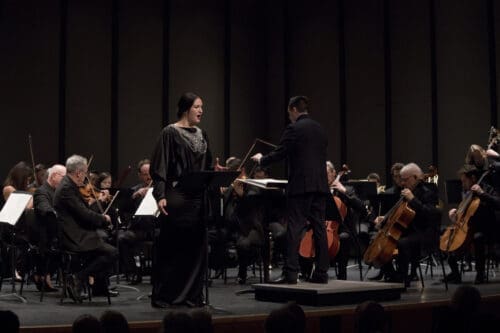
The Mascagni Intermezzo from Cavalleria rusticana gave the hall a moment to breathe. When Davidsen returned for “Vissi d’arte,” there were passages of real incandescence. But the voice remains fundamentally a Nordic instrument, and Italian melody asks for something warmer at its core. The steely resonance and unflinching projection that make Davidsen so formidable in Wagner work against the pliant Italianate lyricism that Puccini ultimately craves. One can admire the achievement without pretending it is the same thing.
One matter demands a sentence: “Nessun dorma” was printed in the program. De Tommaso did not sing it. The audience, which had been generous all evening, made its disappointment known. The orchestra played Grieg’s “Morgenstimmung” and the room settled. Davidsen’s Grieg song, Op. 33 No. 2, was a quieter thing entirely — the voice pulled inward, more searching than projecting, and you heard for a moment what it might sound like in a smaller room. De Tommaso’s “Core ’ngrato” came next: singing that has made up its mind and stays made up, indifferent to whether the hall is convinced.
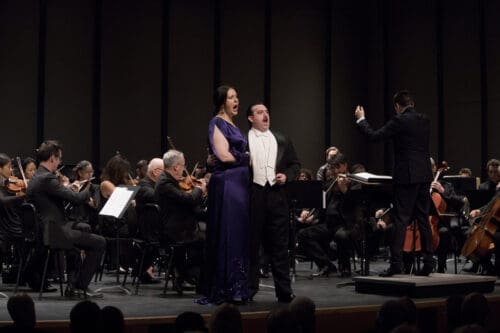
Richard Strauss’s “Befreit” was another matter entirely: here the Nordic grain became an asset, the voice fully at home in the harmonic language, the long lines uncoiling with complete authority. The Kálmán aria that closed the program proper, “Heia, in den Bergen” from Die Csárdásfürstin, was something else again: operetta demands a particular kind of abandon, a willingness to be charming without apology, and Davidsen has it. The hall erupted.
His encore was “O Sole Mio,” delivered into a hall that was already warm and became warmer. In that full-throated directness, something clarified: De Tommaso is not a singer who calculates. He commits. That quality will take him wherever he wants to go.
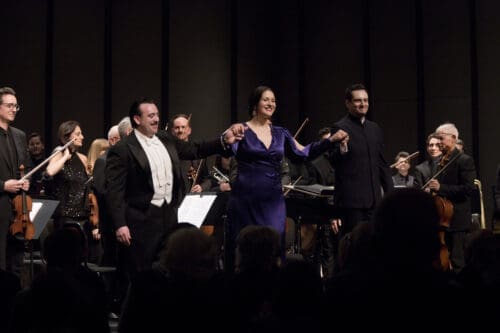
Davidsen shaped this program shrewdly. Her voice and manner of singing are not a natural fit for art song; she is a creature of the opera house, built for projection across an orchestra and two thousand seats, and the program stayed anchored in the dramatic soprano repertoire where she reigns. The encore, however, tested that judgment. “I Could Have Danced All Night” arrived without effort and departed without residue, technically accomplished and dramatically inert: Davidsen does not have a feel for American musical theatre, and the material did not find her. Then came “Lippen Schweigen” from Lehár’s The Merry Widow, which began with what appeared to be a rather tentative waltz request from De Tommaso, sung in surprisingly accented German that the house found charming anyway. The two singers waltzing together on the BroadStage boards became something genuinely lovely: two artists enjoying each other’s company, the music relaxed and fully alive, and the audience, which had been generous all evening, sent them off with everything it had left.
The two artists were operating at different altitudes, and both altitudes were worth attending to. Davidsen has solved the central problem of her voice type: how to take an instrument of such scale and make it serve the music rather than flatten it. She has done this where the music suits her, which is most of what matters. De Tommaso is somewhere earlier and in a harder position: he already has the voice, and now he has to learn when to trust it. That is a longer education than the one that gets you the voice in the first place. She has solved the problem. He is still inside it. Both conditions, this particular evening, were worth the ticket.
✦ ✦ ✦ ✦ ✦ ✦ ✦ ✦ ✦ ✦
photos by Kelvin Blasko
Lise Davidsen and Freddie De Tommaso
Celebrity Series Recital at BroadStage, Santa Monica
reviewed on April 10, 2026
for BroadStage for more events
check out Lise Davidsen and Freddie De Tommaso
✦ ✦ ✦ ✦ ✦ ✦ ✦ ✦ ✦ ✦
