


Areas We Cover
Categories

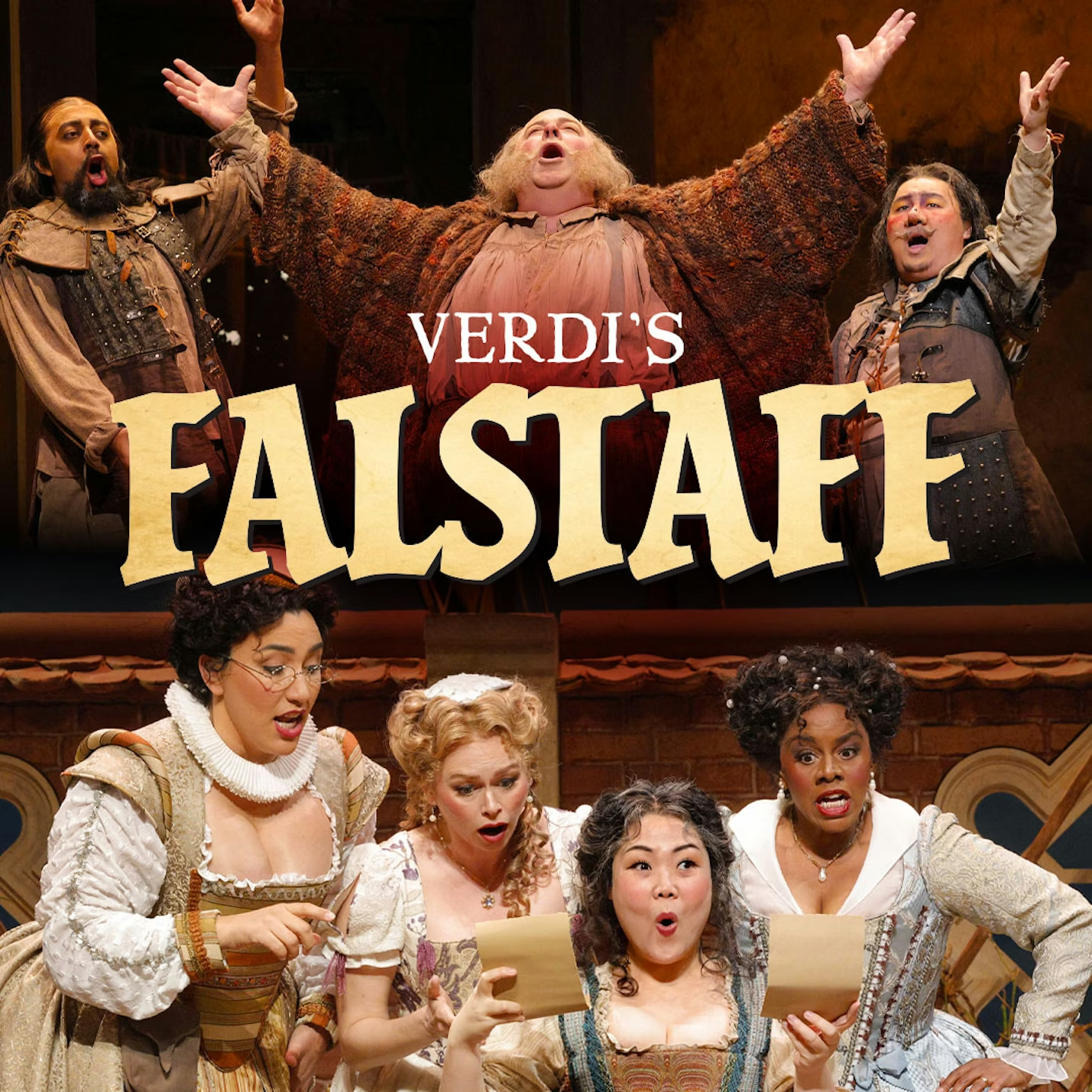
Opera Review: FALSTAFF (LA Opera, Dorothy Chandler Pavilion)
by Michael M. Landman-Karny | April 20, 2026
in Los Angeles, Music, Theater
THE LAST FOOL
A master’s final shrug lands with surprising weight
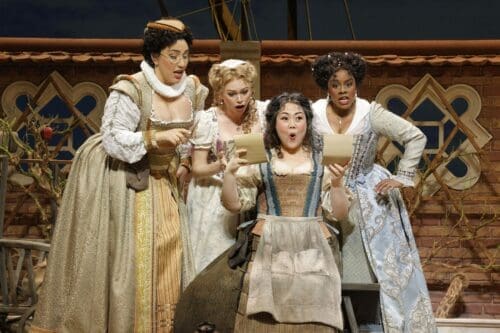
Sarah Saturnino, Deanna Breiwick, Hyona Kim, and Nicole Heaston
Verdi was seventy-nine when Falstaff premiered at La Scala in 1893. He had not written a comic opera since Un giorno di regno in 1840, a failure so complete it drove him to swear off the form for fifty-three years. And here, in what he knew would be his last work for the stage, he spent his final compositional energies on a fat, broke, self-deluding knight who sends identical love letters to two married women and is surprised, each time, that it goes badly. Only a composer with nothing left to prove would bet his farewell on a fool.
Falstaff baffles audiences who arrive from Rigoletto or La Traviata. Those operas run on grief: arias that stop time, set pieces that build to a breaking point, melodies you carry out in your coat pocket. Falstaff refuses all of it. The music is through-composed in a way that obliterates every seam. Themes surface and dissolve before you can grab them. The orchestra runs the joke before the singers land the punchline. You are never given a place to stop and feel. You are swept—and that is the point, because Falstaff himself is swept: by his own delusions, by the women who are smarter than he is, by a world that moved on without him long ago.
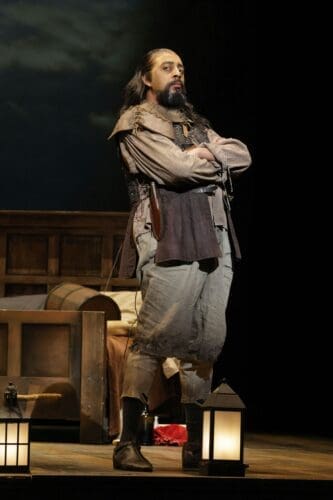
Vinicus Costa
Some critics reach for Wagner to explain that through-composed texture. The argument is overstated. Verdi and Wagner were born in the same year, 1813, and spent their careers as rival poles: the Italian melodic tradition against the German music-drama. Verdi was publicly contemptuous of Wagnerism and watched younger Italian composers abandon their birthright to chase the German fashion with undisguised disgust. What crept into the late Verdi was not imitation but competitive awareness—a man who refused to be outflanked. The expanded orchestral role, the continuous texture, musical ideas tethered to character rather than to formal slots: these are present in ways they are not in Il Trovatore or La Traviata, and Arrigo Boito (a composer himself, a careful admirer of Wagner who kept his compositional distance) brought a structural sophistication the libretto absorbed and made Italian. But the difference is not cosmetic. In Wagner, the orchestra carries metaphysical weight while the singers ride on top. In Falstaff, the voice remains sovereign. The orchestra is witty and intricate and constantly surprising, but it serves the singers rather than transcending them. The score moves with an Italian quickness that is constitutionally foreign to Wagner’s oceanic pacing. Calling Falstaff Wagnerian because it doesn’t stop for applause is like calling a sprinter a distance runner because neither one stands still.
Shawna Lucey’s revival of Lee Blakeley’s 2013 production, using Adrian Linford’s sets and costumes, understands the Shakespearean roots of the material and leans into them. A scrim printed to resemble aged parchment serves as a front curtain and carries projected lines from the Henry plays and The Merry Wives of Windsor before each act. The Globe Theatre aesthetic gives the production a warm, wood-and-candlelight legibility: sight lines are clear, the Garter Inn scenes feel genuinely inhabited, and the stage picture never fights the music for attention. The difficulty is that Falstaff, despite what Boito lifted from Shakespeare’s pages, is not a Shakespeare opera. Boito’s libretto is its own invention: dense, punchy, a machine of internal rhymes and compressed irony with no real equivalent in the source plays. The parchment curtain flags a literary inheritance that the score itself has already absorbed and transformed. Acts I and II are handled with professional physical energy. The Windsor Forest scene in Act III offers a diseased oak tree and uninspiring fairy choreography without achieving the enchantment the scene requires.
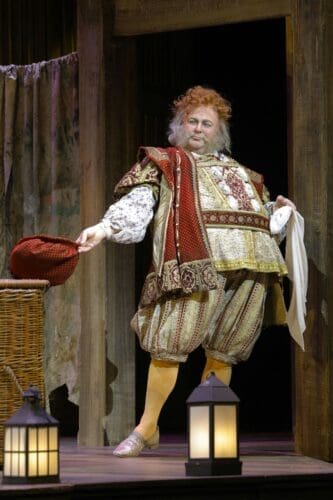
Craig Colclough
Craig Colclough’s Falstaff is gruff, outsized, and intermittently touching. The bass-baritone is a genuine instrument: strong across the full range, capable of dramatic thrust, and nimble enough to navigate Verdi’s rapid-fire patter with clarity and point. His “L’onore! Ladri!” lands with the indignant force of a man who has built an entire philosophy around self-justification and will defend it to the last. The touching arrives in the third act, when Falstaff sits alone outside the Garter Inn having been dunked, humiliated, and stripped of every pretension, and Colclough lets the voice drop to something quieter and unguarded. What the performance wants overall is more of the inner charisma that makes Falstaff’s delusions feel less like foolishness than like a kind of faith. The vocal authority carries the role through every demand the score makes on it.
Nicole Heaston as Alice Ford is the bright center of the women’s ensemble, her soprano warm and precise, her comic timing sharp without tipping into mugging. As Meg Page, Sarah Saturnino is a well-matched partner, the two voices blending easily in the plotting scenes and both alive to the wit Verdi and Boito have loaded into every exchange. Ernesto Petti’s Ford is the production’s most complete dramatic performance: the Act II jealousy monologue delivered with a coiled, genuinely unsettling darkness that briefly pulls the comedy toward something closer to threat. Petti sings with handsome baritone tone and full command of the text, and his Ford is not a plot mechanism but a man.
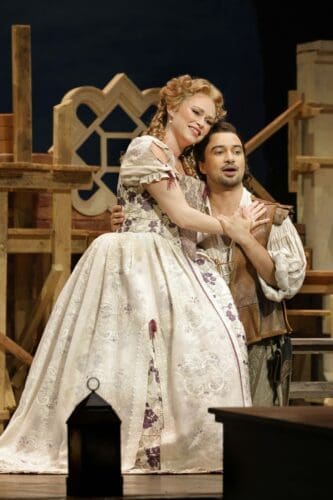
Deanna Breiwick and Anthony León
Verdi gives Nannetta and Fenton the only music in the opera that isn’t in on the joke, and Deanna Breiwick and Anthony León find each other quickly and stay found. Breiwick’s soprano floats the fairy-queen music in the final act with real delicacy. León brings a beautiful Italianate lyricism to Fenton—pure and pliant rather than spinto—that gives the love story its necessary lightness and marks the role as one he was born to sing. Casting agents at European houses should take note. In their Act III duet, the two voices thin to something almost private, and the surrounding comedy holds its breath around them the way a crowd stops when it accidentally witnesses something intimate.
LA Opera resident artists Nathan Bowles and Vinicius Costa, as Dr. Caius and Pistol respectively, play their roles as if they have been arguing with each other for years. Yuntong Han’s Bardolph has a spinto tenor and the kind of comic timing that works because it never announces itself.
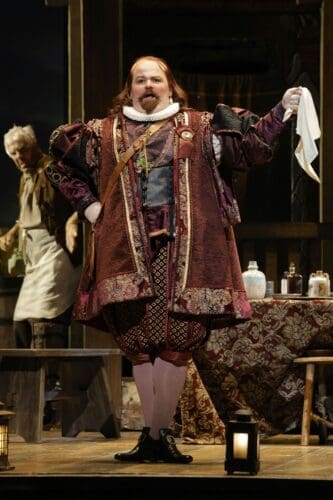
Nathan Bowles
Hyona Kim is the production’s unqualified triumph. As Mistress Quickly, she plays the comedy entirely through the voice rather than at the audience, and the voice rewards that trust: a rich, creamy mezzo with real depth and flexibility, deployed with wit and precision. Her “Reverenza” scenes with Colclough have the character of a game played between two people who both know who is going to win. Kim never lets Quickly tip her hand early. That is a kind of theatrical intelligence you cannot coach.
James Conlon’s work in the pit is what finally makes this Falstaff essential. Verdi’s orchestral writing here is among the genuine glories of late nineteenth-century opera, a score that jokes and mourns and darts and broods often within the same measure, and Conlon reads every shift without telegraphing any of them: the comedy lands because the orchestra never leans into it. The woodwind solos are given their full individual character. The strings in the Nannetta and Fenton scenes carry something warmer and more complicated than the surrounding bustle seems to call for. The rapid-fire conversational passages of Act I move at a pace that makes the wit land without sacrificing any ensemble precision. This is not the ponderous late-Verdi museum piece that certain conductors deliver. It moves. It breathes. It is funny.
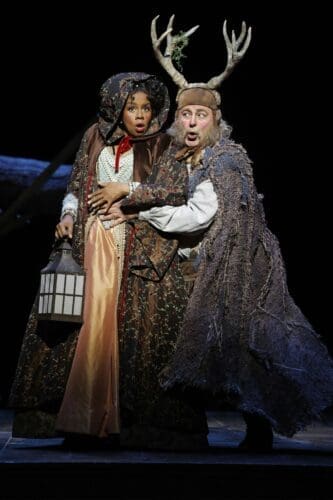
Nicole Heaston and Craig Colclough
The opera ends with a fugue: nine soloists and the full chorus taking up Boito’s concluding text on the universality of folly. The form itself is the joke, intellectual rigor deployed as the punchline to a career built on feeling. In this production, under Conlon’s direction, the fugue earns everything Verdi spent sixty years setting up. Every voice joins the laugh. No one stands apart. Verdi chose to end with a shrug rather than a peroration. When this company and this conductor bring it home, the shrug lands with the weight of a life’s work. The fool, it turns out, was never the one we were laughing at.
✦ ✦ ✦ ✦ ✦ ✦ ✦ ✦ ✦ ✦
photos by Cory Weaver
Falstaff
LA Opera
Dorothy Chandler Pavilion, 135 North Grand Ave.
in Italian with English subtitles
2 hours, 40 minutes with intermission
ends on May 2, 2026
for tickets, call 213. 972.8001 or visit LA Opera
for more shows, visit Theatre in LA
✦ ✦ ✦ ✦ ✦ ✦ ✦ ✦ ✦ ✦
