


Areas We Cover
Categories

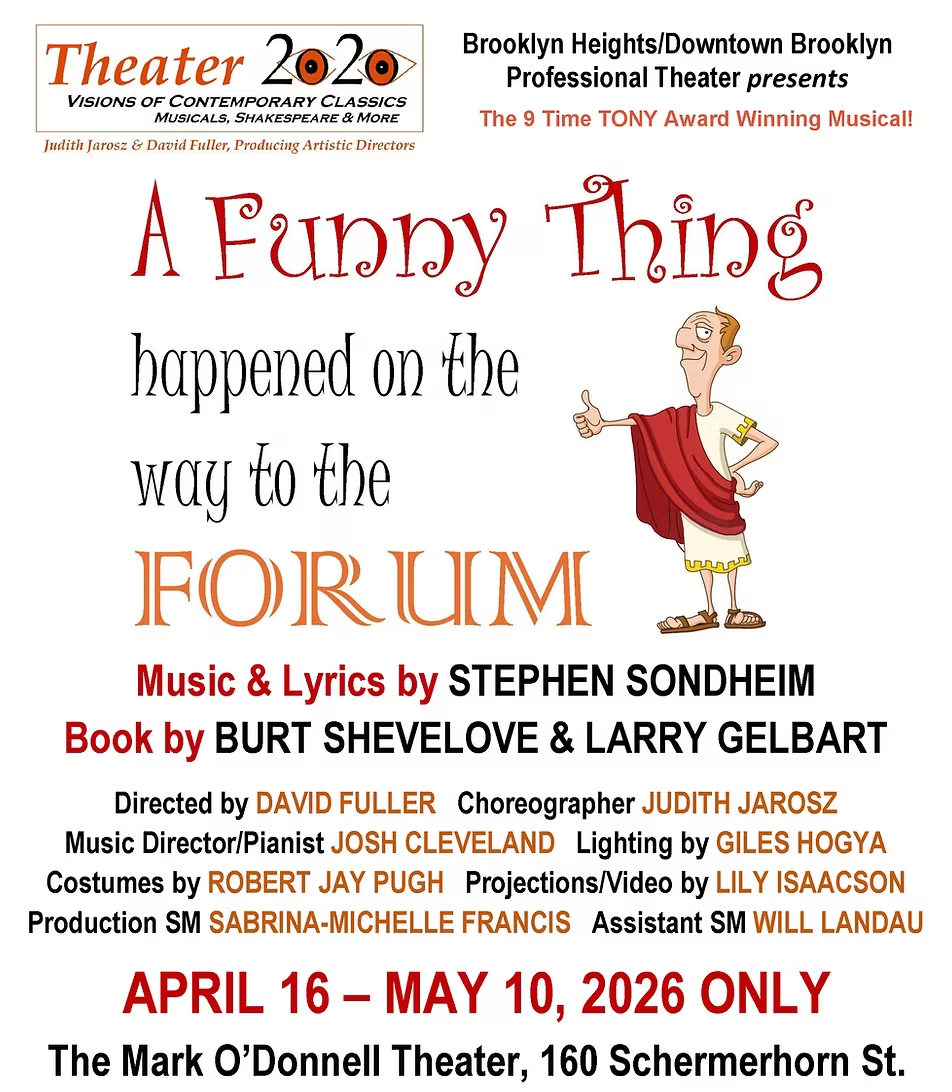
Off-Broadway Review: A FUNNY THING HAPPENED ON THE WAY TO THE FORUM (Theater 2020)
by Rob Lester | April 21, 2026
in New York, Theater
COMEDY TONIGHT—
AND PLENTY OF IT
A zippy, low-budget romp that lands big laughs
When in ancient Rome,
do as the ancient Romans—and moderns—would do:
enjoy the kind of humor that never feels ancient.
This musical confection from 1962 has ageless funny flavors and farcical fun.
If Theater 2020 charged its audience a dime for every laugh-out-loud moment in this Brooklyn Heights production of A Funny Thing Happened on the Way to the Forum, tickets would be much, much more than the current $40-$60 folks pay for a seat to this treat. Daffy but smart, the production moves at a quick but not exhausting clip, with Theater 2020 co-founder/choreographer Judith Jarosz’s dance designs—on numbers such as “Everybody Ought to Have a Maid”—delivering vaudevillian zing and keeping the comedy and company on their toes. There is indeed plenty of “Comedy Tonight,” as the opening number by that title, written by Stephen Sondheim, promises, in this tale of what he described as full of “courtesans and eunuchs, funerals and chases, baritones and basses, panderers, philanderers, cupidity, timidity, mistakes, fakes…” and more.
His songs are well delivered here, sung nicely and precisely, melodies full of grace and spunk, with the cast bringing out the wit and the devilishness in the details of the trademark Sondheim polish in the earliest produced show featuring both his lyrics and music. The sharp dialogue by Burt Shevelove and Larry Gelbart crackles and cracks up an audience ready for madcap, jokey joy. The cast works especially well as a team. Pianist Josh Cleveland is the one-man orchestra, handling the accompaniment with flair and care (some of those Sondheim tunes are quick and tricky, but he sails through smoothly). A cute touch toward the end of the second act incorporates his presence onstage, escorting characters during the climactic chase with a whirlwind of entrances and exits.
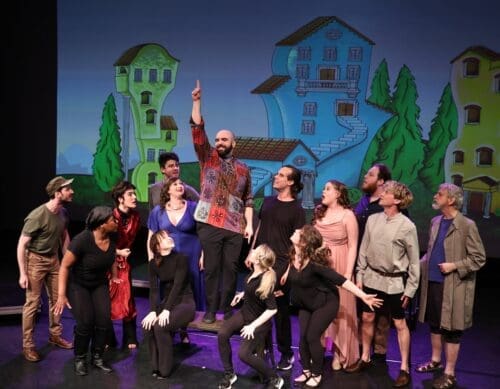
Here’s how it starts: The actors, as actors—not yet their characters—rush on, hastily. The screen is filled at first with clips of recent news headlines, with Donald Trump’s image prominent. The beginning lines of the opening song, “Comedy Tonight,” are at first spoken, and certain phrases about distressing news and “Nothing with kings, nothing with crowns” become pointed and relevant. On the line “Open up the curtain,” an animated red curtain opens, revealing a bright cartoon-style projection (Lily Isaacson) along the upstage wall—showing three houses. This substitutes for a set.
Visually, things are very spare. One imagines that another hundred dollars judiciously spent—and some donated set pieces and costume pieces—would go a long way. Props are few. To suggest being on a roof, actors step up to the higher steps of a small metal stepladder. One wishes they stepped up to “give us more to see” (to quote a lyric from a very different Sondheim score). Robert Jay Pugh’s costume design has some apt touches, but the presumed tight budget might be better spent with some inexpensive sheets and bolts of cloth to make simple but effective togas. Contemporary trousers for some male characters feel haphazard. Not that the deep-voiced Jordan Wolk, who’s terrific as an imposing military-style captain, desperately needs armor to add polish to his strong-as-metal character—but it would add a finishing touch.
There are some fine, satisfying characterizations: seen on the second night of the run (April 17), Jacob Kelleman as Senex and Bebe Tabickman as his shrewish wife grow more commanding as the show goes on; in the small role of the elderly Erronios, Michael Gnat, jogging around the seven hills of Rome seven times, is an audience-pleaser; and Rae Hillman is a delight as Philia, filling out her characterization to be more than just a one-note, vapid version of the virgin who is coveted and clueless.
But it is the remarkable and charismatic Christian James Potterton who is the hands-down star attraction of the cast. As Hero, the naive but curious young man besotted by “Lovely” Philia and ready, willing, and able to win her heart and marriage contract, he nails every moment, sings wonderfully, and has stage presence galore. He lights up the stage (no offense to lighting designer Giles Hogya). This actor is always involved and in the moment. Particularly impressive is how his face reacts in a multitude of ways to the actions and spoken comments of others—a nod, a little smile, a shrug, his body collapsing in despair, a furrowed brow showing worry or confusion, sighing with frustration (a different set of sighs when his beloved comes by)—without resorting to cartoonish overplaying. Bravo!
The key roles of the slaves Pseudolus and Hysterium are usually played by irrepressible comedians known for broad styles, who are on the hammy side. Many such clowns have pursued Pseudolus as a plum role, starting with Zero Mostel in the original Broadway cast and film version. Other stage productions had the part played by Phil Silvers (the original choice), Rip Torn, and in the 1990s Broadway revival, Nathan Lane and then (ignoring gender) Whoopi Goldberg. As the character’s name would indicate, Hysterium is another high-energy part. Jack Gilford played the easily panicked servant in the first Broadway mounting and in the movie; other stagings had Mark Linn-Baker, Arnold Stang, and Jason Graae. It seems these two characters have been played by any mega-funny Tom, Dick, and Larry—meaning Tom Poston, Dick Shawn, and Larry Blyden.
Theater 2020 has cast actors who aren’t cut from that exact cloth. A hard-working and relatively boisterous Ben Schraeger makes Pseudolus, eager to be “Free” instead of a slave, glib and resourceful, but lacking the breezy slyness, nuttiness, or irresistible charm that would complete the character. One of his best moments is handling the challenging, fast avalanche of words in “Pretty Little Picture” with aplomb. Robert Fischetti, the company’s Hysterium, isn’t hysterical or panic-stricken much of the time until pressure increases for his solo song about trying, somewhat unsuccessfully, to be fully “Calm.” Earlier, he seems confident, serene, and in charge. He is younger than others typically cast—more of an attractive leading-man type rather than the expected character actor/comic. But under David Fuller’s direction, both men rise to the occasion and deliver some fine moments with energy and flair.
The casting notice for this production indicated that women would be considered for some traditionally male roles. Indeed, Gillian Mackay Brown plays Marcus Lycus, the buyer and seller of courtesans who runs the house. It works fairly well, and she’s an appealing performer, although the character being treated as male while quite obviously a woman in real life makes Marcus Lycus come off like a brothel madam. The five-member ensemble (four women and one cheeky male with panache, Tommy Kelly) doubles as Lycus’s courtesans and as dutiful soldiers with a bumbling Keystone Cops quality. This double casting allows them to switch back and forth quickly—donning and doffing hats and costume pieces—in scenes where both groups appear. Another cute touch is the use of a hand puppet instead of an actress as one of the twins jointly named Gemini.
Theater 2020’s A Funny Thing Happened on the Way to the Forum is a very funny thing indeed. It’s a well-oiled machine. Next up for this company: A Comedy of Errors.
✦ ✦ ✦ ✦ ✦ ✦ ✦ ✦ ✦ ✦
photo by Gerry Goodstein
A Funny Thing Happened on the Way to the Forum
Theater 2020
Mark O’Donnell Theater, Entertainment Community Fund Arts Center
160 Schermerhorn St, Brooklyn Heights
Thurs-Sat at 7; Sun at 3
ends on May 10, 2026
for tickets ($40-$60. plus fee), visit Theater 2020
✦ ✦ ✦ ✦ ✦ ✦ ✦ ✦ ✦ ✦
