


Areas We Cover
Categories

Theater Review: WINDFALL (Steppenwolf Theatre Company / World Premiere / Chicago)

by C.J. Fernandes | May 5, 2026
in Chicago, Theater
CASH, GRIEF, AND THE
COST OF RESISTANCE
A gripping, immersive premiere dissolves
the line between audience and action
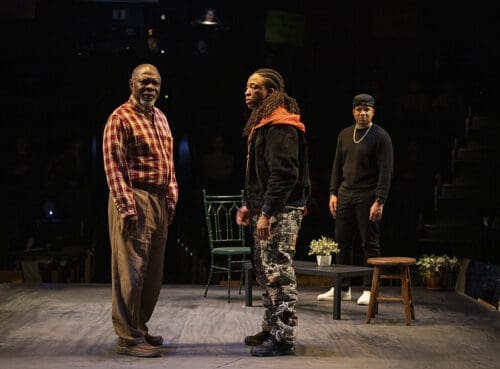
Michael Potts, Esco Jouléy and Glenn Davis
Steppenwolf’s excellent 50th season continues with Windfall, the new play by Oscar winner Tarell Alvin McCraney (Moonlight). Performed in the Ensemble Theatre, Andrew Boyce’s scenic design eschews a traditional set almost entirely. The performance space is a simple raised platform. There’s a bench and a gardener’s rack—and nothing else. Hand-inked protest posters are mounted throughout the space, but look closely and, among them, are advertisements for guitar lessons and other neighborhood services, posters with rap lyrics, as well as self-help bromides.
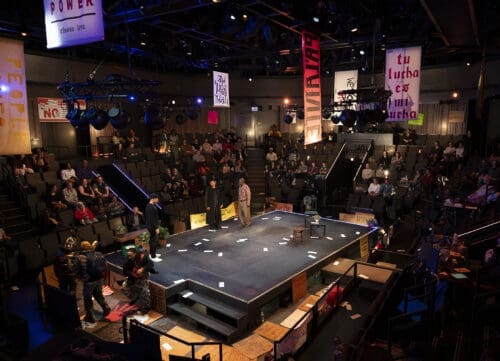
The cast of Steppenwolf Theatre Company’s world premiere of Windfall.
As the audience filters in, Erykah Badu and Sault pour out of the speakers. The ambience is so relaxed and bluesy that it takes several beats to realize when the play begins, and if I had not recognized Namir Smallwood, I might have been clueless for even longer. As Smallwood (Brother 1), Esco Jouléy (Eli), and Jon Michael Hill (Cori) put up more posters, they engage in small talk with audience members, eventually lugging their musical instruments to the center of the platform, where they start to set up camp. We gather that they are protesters occupying a public space in defiance of the police.
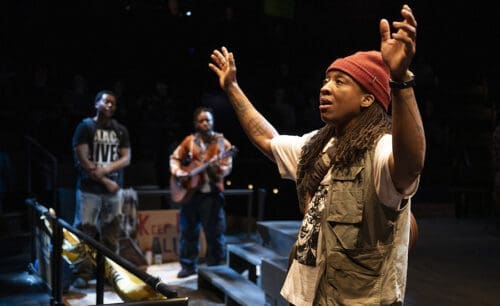
Esco Jouléy, (back) Namir Smallwood and Jon Michael Hill
In a neat subversion of theatrical protocol, they encourage the audience to turn on the flashlights on their cell phones and shine them onto the stage to participate in the protest. It’s a visually stunning moment, though somewhat undermined a minute later by the official announcement about phones and flash photography. Still, the audience has been effectively primed and inculcated into the action of the play—not merely voyeurs, but participants in the demonstration.
In present-day Chicago, a young person has been abducted by immigration officials and is being held in an undisclosed location. Outraged by the raids and brutality, protests rise across the city. Three friends and musicians, led by Eli, join the movement, and in one of the confrontations, Eli is shot and killed.
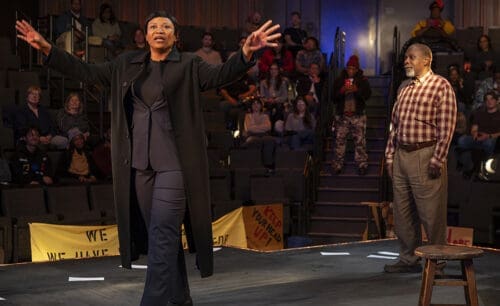
Alana Arenas and Michael Potts with (back, center) Esco Jouléy
In a well-lived house on the South Side, Mr. Mano (Michael Potts), an older Black man, potters about on his front porch, arguing with his dead son, Marcus (Glenn Davis). Mr. Mano is Eli’s father, and the city has offered him a handsome settlement because of the incident that killed his child. Marcus urges his father to take the money, arguing that it would help pay off taxes on the house and provide a cushion for retirement. Mr. Mano refuses, claiming that money is nothing more than a bribe. Besides, he cannot believe that Eli is truly dead. When Marcus, his adoptive son, died, Mr. Mano felt his spirit leave; how is it possible that Eli, his flesh and blood, should pass on without his father sensing it?
And then they receive notice that Eli’s body has vanished from the city morgue.
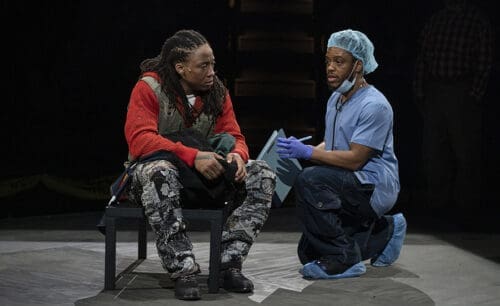
Esco Jouléy, Jon Michael Hill
Awoye Timpo directs with such confidence that Windfall fairly sings. In this, she is aided by McCraney’s gorgeous writing, which establishes distinct rhythms and cadences for the three sets of interactions. When Eli, Cori, and Brother 1 converse, they do so in a style that evokes spoken-word poetry and melodic rap, achieving a lyricism that borders on musical. When Eli bursts into a spontaneous rendition of Marvin Gaye’s “Distant Lover,” the phrasing transforms it into a protest anthem, and the progression from speech to song flows in the most natural way possible.
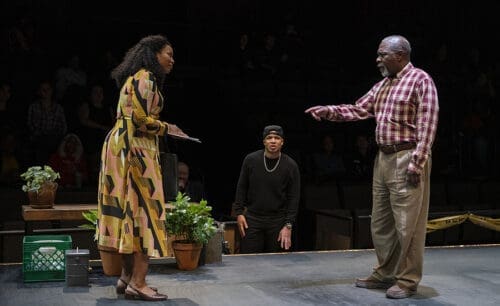
Alana Arenas, Glenn Davis and Michael Potts
Mr. Mano and Marcus converse in plain speech, befitting the most grounded characters in the show, while Alana Arenas, in a scene-stealing trio of roles, performs with exquisite archness as the three women who visit Mr. Mano, each attempting to convince him to take the settlement. None of these tonal shifts feel jarring or out of place. With the wrong maestro at the podium, this play could easily become cacophony, but in Timpo’s hands, it’s a symphony.
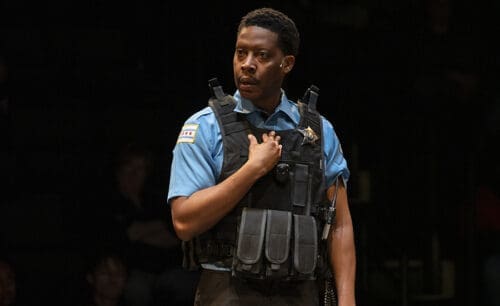
Namir Smallwood
Structurally, more than anything else, Windfall reminded me of that most humble form of mummery, street theatre. It ticks all the boxes: minimal set, lack of a fourth wall, engagement with the audience, audience engagement, and especially pointed political and socioeconomic commentary. Intersectionality is the point here, as McCraney weaves together gender nonconformity, political persecution, racism, homosexuality, the stifling of marginalized voices, and the pressures of toxic capitalism into a tapestry so tightly knit that distinctions blur.
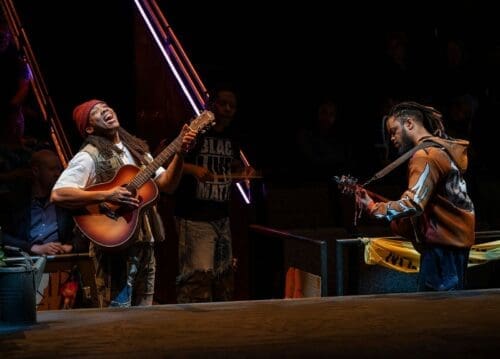
Esco Jouléy, Namir Smallwood and Jon Michael Hill
All of this rests on the shoulders of Michael Potts, who delivers a performance of jaw-dropping complexity—by turns pragmatic, witty, charming, and, in one wrenching monologue on trying to understand the nonbinary nature of his child, absolutely devastating. That is not to say the other performances are lacking; they are uniformly excellent. But the cast understands its task: to function as an ensemble supporting a central performance.
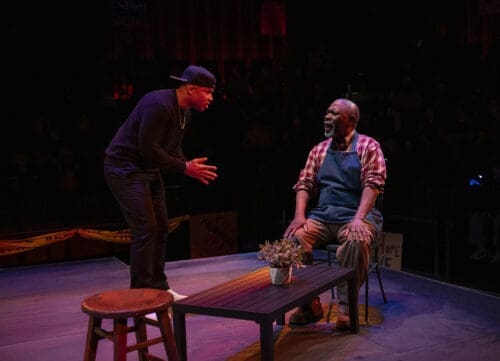
Glenn Davis and Michael Potts
As a critic, I try very hard to maintain an objective distance. During the preamble, I resisted the urge to turn on my phone. I refused to respond to Eli’s exhortations. I wanted to remain a detached observer.
But as Windfall moved toward its dramatic denouement, a character onstage stomped their foot in protest, and I found myself stomping along with a few others, the movement spreading through the audience, building in intensity. Phones were retrieved, flashlights switched on. While Mr. Mano stomped across the stage, declaiming his defiance to the capitalist overlords who control our lives, the theatre erupted into a roar of stomping solidarity; astonishingly keeping time to the rhythm of the poetry being spoken, so that the words still came through with stinging clarity. And when Mr. Mano had dismissed his tormentors, and sank onto a bench in his solitude, breathing slowly as the ramifications of his decision washed over him, I could swear that I heard the breaths of audience members keeping time with him.
But maybe, I was just imagining that synchronized breathing. I cannot be sure. Somewhere during the course of Windfall, my detachment had departed and my objectivity had abandoned me.
That’s not a bad thing.
✦ ✦ ✦ ✦ ✦ ✦ ✦ ✦ ✦ ✦
photos by Michael Brosilow
Windfall
Steppenwolf Theatre Company
Steppenwolf’s Ensemble Theater, 1646 N. Halsted St., Chicago
Tues-Fri at 7:30; Sat at 3 & 7:30; Sun at 3
ends on May 31, 2026
for tickets ($20–$148.50), call 312.335.1650 or visit Steppenwolf
for more shows, visit Theatre in Chicago
✦ ✦ ✦ ✦ ✦ ✦ ✦ ✦ ✦ ✦
