


Areas We Cover
Categories

Theater Review: FREMONT AVE. (South Coast Repertory / Costa Mesa)
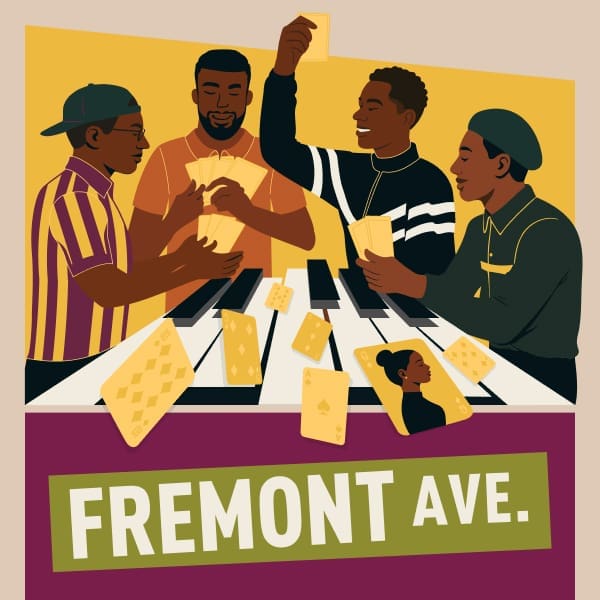
by Michael M. Landman-Karny | May 7, 2026
in Los Angeles, Regional, Theater
THE HOUSE THAT BUILT YOU
A sweeping, structurally ambitious play
that grips in the moment
even as it searches for its final form
There is a moment near the end of the first act of Fremont Ave. when George Plique, a music therapist who cannot stop composing, sits alone at a piano in a room that is too quiet and plays a chord he has never played before. He does not know yet that the chord belongs to the woman who just walked out. He only knows that his fingers found it and that it is hers. Reggie D. White’s play, now on the Segerstrom Stage at South Coast Repertory, is about what happens over the next sixty years: who gets built inside that house, who gets broken in it, and what the people who stay are supposed to do with the pieces.
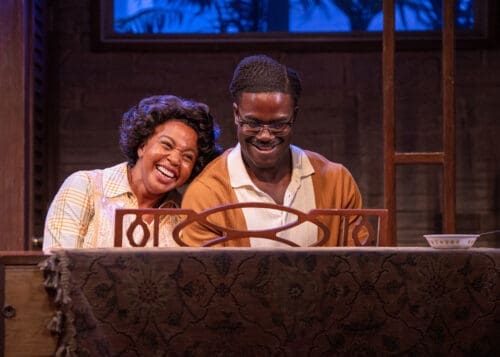
Jerrika Hinton and Bradley Gibson
The short answer is that they play spades. This is a play about a card game the way Fences is a play about a fence or The Inheritance is a play about an apartment: the ritual is not metaphor so much as structural necessity, the thing that holds the social world together while everything personal tries to fall apart. Around the Plique family’s kitchen table, Black men argue law and justice and failure and loyalty across decades, and the particular exhaustion of trying to be excellent in a country that keeps revising the terms of what excellence costs. That exhaustion is not historical. It is this week’s news.
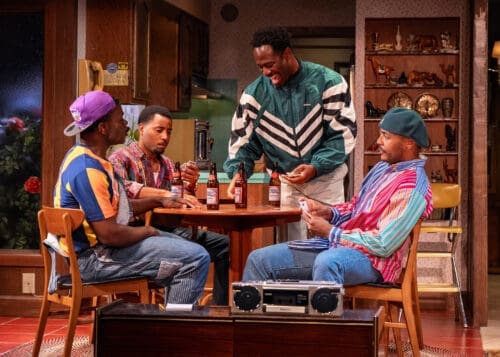
Bradley Gibson, Stanley Andrew Jackson, Wildlin Pierrevil and Jeffrey Rashad
White himself made his Broadway debut in The Inheritance, and the structural ambition carries over. Fremont Ave. spans 1968 to the present in three acts, moving from George and Audrey’s courtship through their son Robert’s stalled adulthood and into a third-generation reckoning in the same house after a funeral. What holds the span together is not exposition but object language: a notebook in which George has written a chord named for every person he has ever loved, a gardening glove, a pot of red beans and rice, a piano that sits in the same corner of Tim Mackabee’s set across all three acts and becomes, over sixty years, a private archive of feeling. These objects accumulate with quiet authority. They are never announced as symbols. They simply sit there until they start to feel like memory. André Pluess’s sound design works in the same register: original music that establishes mood without announcing it, and a radio that moves through decades of pop in the first two acts, pinning each scene to its moment the way a photograph does.
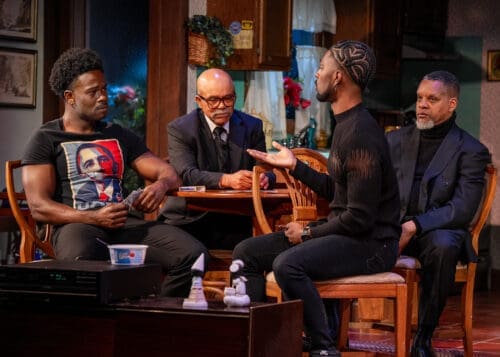
Bradley Gibson, Doug Brown, Galen J. Williams and Kevin Mambo
The play is large. Not just in scope, but in appetite. Three timelines, multiple protagonists, and a wide thematic field: love, class mobility, religion, masculinity, queerness, generational inheritance, all competing for centrality. The result is absorbing scene to scene but less inevitable as a whole. The acts read, at times, like adjacent plays in conversation rather than movements in a single, tightening arc.
Lili-Anne Brown’s direction keeps it from flying apart, but the play keeps adding rather than compressing, and at some point addition becomes its own argument, one this production has not quite decided whether to make or refuse.
The Act Two spades sequences are the most theatrically immediate material in the show. They are funny, specific, and socially grounded, with Stanley Andrew Jackson, Wildlin Pierrevil, and Jeffrey Rashad forming a sharp portrait of Black professional life in the early 1990s. But they pull against the George-Audrey spine the first act has just established. What reads as richness in the room begins to feel like diffusion in aggregate.
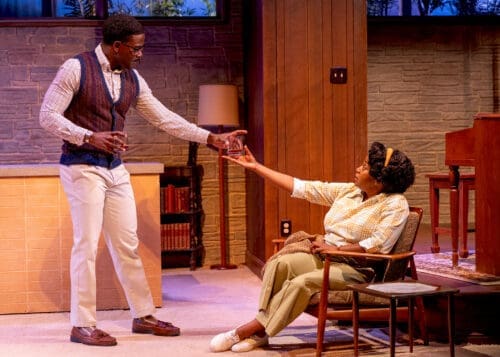
Bradley Gibson and Jerrika Hinton
The monologue problem runs through the evening. The play leans on articulation where it might benefit from collision: characters explain themselves with precision rather than being forced into behavior that reveals them under pressure. The clearest example comes in Act One, when George finally tells Audrey how he feels about her. He tells her she has left her fingerprints on him. He tells her every single thing in the house sings her name. He tells her the chord his fingers found the day they met was her chord, and that music, which used to be technique and form and composition, is now her. Each clause is more exact than the last, and the speech tells you everything he thinks and feels and wants. What it does not do is put him in danger. A scene that cornered him, that forced the feeling out rather than letting him compose it, would cost more and mean more. White can write a speech. What the play sometimes needs instead is a scene that corners someone.
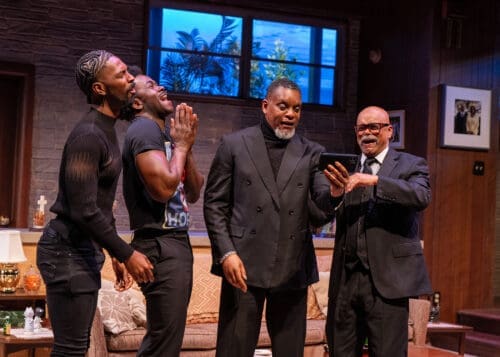
Galen J. Williams, Bradley Gibson, Kevin Mambo and Doug Brown
Bradley Gibson plays George, Robert, and Joseph across sixty years, and what the role requires is not range so much as calibration. As George, he talks with his hands constantly, restless at the piano keys or drumming on the kitchen counter, the energy of a man whose feeling outruns his vocabulary. As Robert two decades later, those same hands go quieter, the restlessness compressed inward rather than released: this is a man grinding through bar exam failure after failure while his law school friends make partner and move on, and Gibson wears the weight of that stall without letting it curdle into self-pity. By Act Three, as Joseph, the compression has become a kind of armor. Joseph has been away on the East Coast for years, has built a life and a relationship, and has come home for a funeral carrying a confrontation with his father that the family’s saved-and-sanctified Pentecostal Christianity has made harder than it needed to be. It is a performance built from subtraction.
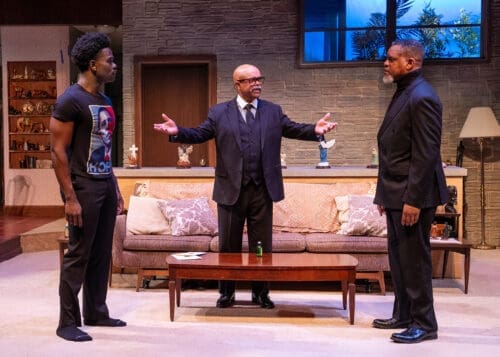
Bradley Gibson, Doug Brown and Kevin Mambo
Galen J. Williams, as Joseph’s partner Damon, brings a different register entirely: fleet, vinegary, the one person in the Plique orbit who names the thing directly and does not circle it first. In a play that sometimes loves its own eloquence too much, Damon is the cold water. He is also, when it counts, the person who walks into the kitchen and holds Joseph from behind without making him turn around. Williams plays the dry truth-teller and the steady comfort as the same instinct, which is the only way the role works.
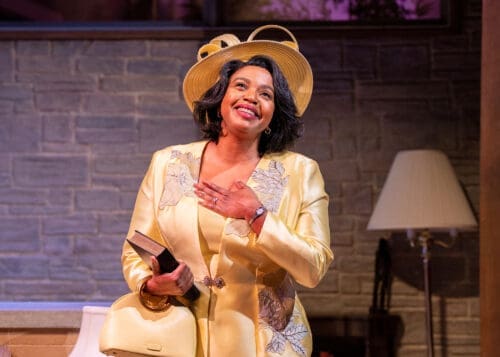
Jerrika Hinton
Jerrika Hinton’s Audrey is written to resist being liked before she is understood. Her Act One confrontation is the fulcrum the production’s second and third acts depend on: she tells George that he has spent months treating her as interesting because he wants to sleep with her and has never once asked her a question about her own life. If that scene fails, nothing that follows has weight. Hinton does not let it fail. The acting is consistently ahead of the writing here, and the production trusts that gap rather than fighting it. Doug Brown plays George in old age, and his late entrance carries a stillness the character has spent three acts earning. It is a brief appearance, but Brown makes it feel conclusive.
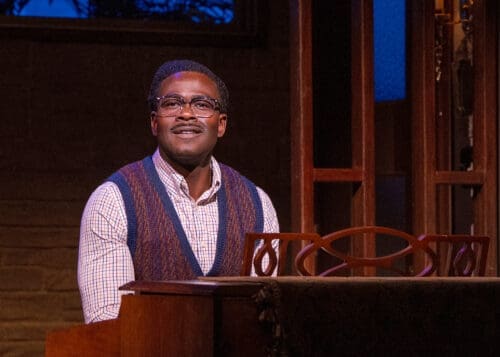
Bradley Gibson
The interludes are the production’s most distinctive formal gesture. White places them between scenes: brief, nearly wordless passages in which a character is left alone to do something, folding laundry, playing chords from a notebook, praying before church, and time passes through behavior rather than announcement. The most arresting of them has Audrey, looking for a misplaced cassette tape, open the piano bench and find the notebook George keeps there, the one in which he has written a chord named for every person he loves. She plays through them in sequence, recognizing each family member in the sound, until she comes to one labeled simply Her. She plays it, and it is her own chord. A piece of paper falls out of the notebook. It is a job offer letter from years before that George never told her about, an opportunity he passed up to stay where they were. We see her register what it cost him to keep it from her, and what it cost him to refuse it. No one explains any of this. The interlude ends. When the others work at that level, they are irreplaceable. When they do not, they contribute to a sense of sprawl that Brown’s production manages but cannot entirely solve.
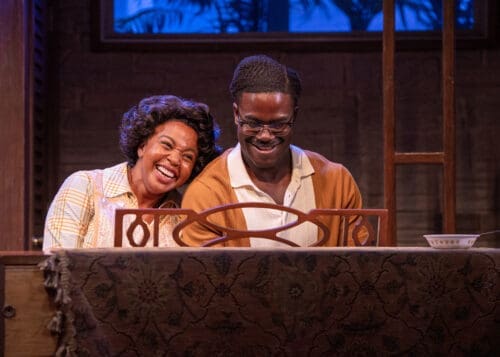
Jerrika Hinton and Bradley Gibson
None of that changes what Fremont Ave. announces about the person who wrote it, or what it does to you in the room. Whatever the structural complaints, the play succeeds on the terms that matter most: you care about these people before you understand why, and by the time you understand why, the caring has gone deep. George and Audrey’s sixty years inside that house accumulate until their weight is real, and White earns that weight without sentimentality. White is one draft, maybe two, from the play this one keeps reaching toward. The piano never moves. Everything else still might.
✦ ✦ ✦ ✦ ✦ ✦ ✦ ✦ ✦ ✦
photos by Scott Smeltzer
Fremont Ave.
South Coast Repertory
a co-production with Arena Stage in D.C.
655 Town Center Drive, Costa Mesa
ends on May 23, 2026
for tickets ($36–$139), call 714.708.5555 or visit SCR
for more shows, visit Theatre in Los Angeles
✦ ✦ ✦ ✦ ✦ ✦ ✦ ✦ ✦ ✦
