


Areas We Cover
Categories

Off-Broadway Review: BIKE SHOP: THE MUSICAL (Theater for the New City)
by Rob Lester | May 7, 2026
in New York, Theater
PUT THIS IN YOUR WHEELHOUSE
A show that takes its audience on a ride, and
shifts gears from drama to comedy and back
The oft-heard practical advice to authors hoping that their stories, novels, songs, plays, etc. will ring true is: “Write what you know.” Generally attributed to Mark Twain—who did pretty well for himself with his verbiage—it doesn’t have to mean taking the purely autobiographical route or mixing three quarts of truth and a couple of pints of pure fiction and fantasy.
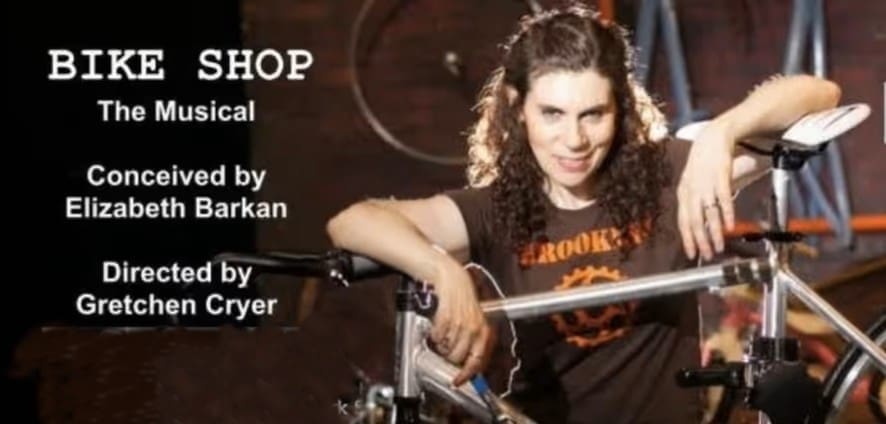
Well, let’s consider the case of Bike Shop: The Musical, about a woman who got a job as a bike messenger in her youth and found herself working in a Brooklyn bicycle repair/sales shop founded by a family member and teaching a spin class. Its story began as a monologue written and delivered by Elizabeth Barkan, who in real life—you guessed it—got a job as a bike messenger in her youth and found herself working in a Brooklyn bicycle repair/sales shop founded by a family member and, yes, teaching a spin class. About a decade ago, it was expanded into a one-woman play (she was the one woman). Now it has become a multi-character musical. Her real story was a jumping-off point, with some elements absent or added for the drama in the fictionalized tale and we can assume that in her actual interactions with other people, neither she nor they suddenly broke into song with verve and neatly rhymed lyrics.
Singing, acting, storytelling (she also serves as narrator, directly addressing the audience) and bicycle smarts and bicycle parts are all in her “wheel”house. Miss Barkan, playing the likable lady who likes bikes, has co-written the lyrics and dialogue with Caroline Murphy and the melodies are by Youn-Young Park, with additional music by Ms. Murphy, Ms. Barkan, and Gerry Dieffenbach.
Upon her bicycle, our initially perky protagonist, Bobby, proclaims herself to be a pro, singing that she is “Street-wise!” as she handles the handlebars and everything the traffic will allow. But trouble is ahead. When she switches her attention to working on other people’s bikes, she boasts about a different skill: “I Can Fix Anything.” And it doesn’t take much for us to imagine what will be potential truths, to add “anything but my fears” or “anything but my broken dreams” or “anything but myself.”
Creditable performances are turned in by all in this emotional but not melodramatic tale of a woman with a supportive family. Well, at least they are supportive of her, but there are conflicts and old wounds among each other while they are more patient with Bobby. This is especially true when, early in the play, she is traumatized by a not-at-all incidental accident on the road, on the job, while rushing to deliver a package on time. The anguish causes her to put the brakes on working as a bike messenger and to retreat to the family nest. (In this case, the nest is the family-run business that gives the musical its title, and she doesn’t seem to have much of a personal life as a couple of decades go by.)
Bobby toils in the shop alongside her widowed father (David Edwards) and her uncle (Joe Symon), who is a rabbi and fitness instructor. The latter has a very welcome comic relief musical number with high energy amid the drama and tensions, some of which are caused by the sudden return of another family member (Madeleine Doherty) who’s been away for years and has a new calling. Also coming back into Bobby’s life is a crush (Jim Newman) from decades ago, possibly rekindling romantic feelings. Like the father, he’s a military veteran, with his service having taken a toll. There’s tenderness and shyness in their cautious reunion, with the repair of his bicycle from the old days and supposed interest in the on-site spin class as convenient excuses to be at the shop for something other than shop talk.
The songs, action, and dialogue are engaging and often warm, and can be very much on target but sometimes arguably too much “on the nose” in summing up points. Bobby buries herself in her work as avoidance—a safe space. Do we want to be told early on that she seems “Frozen” (a song) and hear the terse line of narration “People say I was hiding”—or do we want to come to that opinion ourselves as the plot unfolds, like those unnamed “people” she mentions? “Funny how a single moment changes everything you had planned” is a truism, but might emphasize a reality check that is too obvious, too soon, or too sad and painful to dwell on for some audience members who had a similarly woeful “single moment.” Some statements make (possibly irresistible) comparisons to those two-wheeled modes of transportation, such as “feeling like a wheel that couldn’t spin.” And sometimes there’s a touch more repetition than is needed to absorb a message or description. A song may go on a bit long and restate worthy observations and feelings, but thus reach an emotional peak soonish, without bringing the characters to a new place.
All in all, Bike Shop and its company handle things well, with poignant moments, presenting characters who are sympathetic—even when not showing their most admirable traits or in the most fascinating situations. We can thank the guiding hand of director Gretchen Cryer, who, also as a gifted performer and wordsmith over the decades, has a rich history of making things authentic, vital, life-affirming, and engaging.
✦ ✦ ✦ ✦ ✦ ✦ ✦ ✦ ✦ ✦
Bike Shop: The Musical
Theater for the New City
Cino Theater, 155 First Avenue (between 9th and 10th Street)
90 minutes, no intermission
Mon, Wed–Sat at 8; Sun at 3
ends on May 17, 2026
for tickets ($15–$20), visit Ovation Tix
for more info, visit Bike Shop Musical
✦ ✦ ✦ ✦ ✦ ✦ ✦ ✦ ✦ ✦
