


Areas We Cover
Categories

Theater Review: SANCTUARY CITY (Chance Theater / Anaheim)

by Michael M. Landman-Karny | May 11, 2026
in Los Angeles, Regional, Theater
THE COST OF STAYING
A rigorously observed production
that grips in silence, even as the
play leans toward explanation
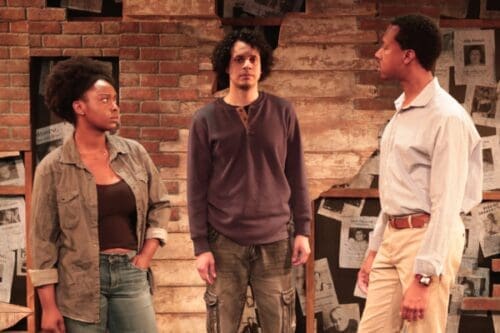
Vicky Yvonne, Spike Pulice, and Jonathan Keyes
There is a language people invent when citizenship can vanish with a knock at the door. It moves sideways. It disguises itself as ordinary conversation. It turns omission into grammar. Martyna Majok’s Sanctuary City hears that language with uncommon precision, then, in its later movements, begins explaining what it was initially wise enough merely to observe. American drama has rarely known how to write undocumented life without translating it into uplift or thesis. Characters arrive carrying their circumstances as exposition. The predicament explains the play. The play mistakes explanation for drama. Majok, at least for a long while, escapes that trap. She builds something riskier: a drama shaped as much by what cannot be said as by what can.
Set in Newark, New Jersey after 9/11, the play follows two undocumented teenagers, B and G, bound together by precarity so constant it has become atmosphere. Here vulnerability is never merely emotional. It is administrative, legal, bodily. Even speech carries exposure. At the Chance Theater, director Oánh Nguyễn understands the play’s strength lies in not overstating itself. His production trusts pressure. Spike Pulice and Vicky Yvonne work in the fractured rhythms Majok writes so acutely: evasions, unfinished thoughts, jokes deployed as camouflage. They do not perform trauma. They maneuver inside it. A sequence in which the two invent an illness to explain visible injury lands with quiet devastation because no one pauses to tell us what it means. Survival has already done that work.
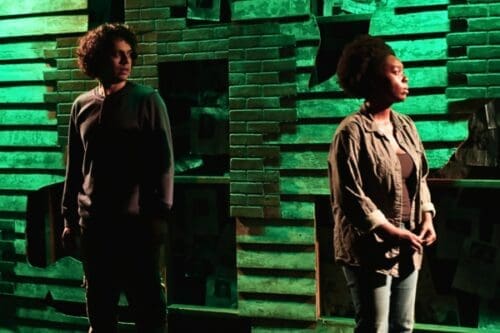
Spike Pulice and Vicky Yvonne
Pulice gives B a face that watches every door. The loyalty to G is constant. So is the second thing underneath it, the want of a country that will let him stay, a country he was raised to call his own. He does not choose between them. He keeps both alive in the same breath. Yvonne plays G the other way around. She will do anything to keep B safe, and she means it, until the play hands her a fact she can understand but cannot absorb. The recoil comes from a good person finding out what she is willing to withhold. It is the most uncomfortable acting in the production.
This is where the play is at its finest, when the political condition and the personal one are indistinguishable, when a cover story becomes a portrait of an entire system moving through human bodies. The intimacy between B and G is similarly unsentimental. It is not romanticized solidarity but something rougher and more convincing, loyalty made out of need, habit, and the terror of having nowhere else to go.
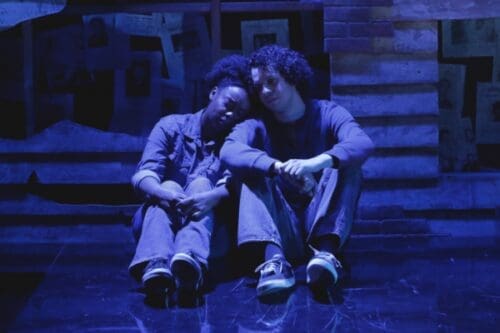
Vicky Yvonne and Spike Pulice
Then the play shifts. G is naturalized. B is not. The asymmetry is now permanent, and the law has handed her a way to fix it: she can marry him. Years later Henry enters, B’s boyfriend, played with grave intelligence by Jonathan Keyes. B is in love with him. A green-card marriage to G would save B’s life and end the one he has built with Henry in the same signature. Love, legality, and obligation begin pressing against one another in ways the theater seldom stages with this much moral unease. It is exactly where the play ought to deepen.
Instead, something loosens. Not all at once. More like a subtle change in pressure. Scenes once driven by silence begin articulating themselves. What had emerged through behavior begins leaning toward argument. The drama does not collapse, but its authority shifts. Majok begins interpreting what she had previously allowed to remain dangerous. That loss matters, because the marriage dilemma itself is extraordinary. It reveals how immigration law can make intimacy transactional without draining it of feeling. It is among the coldest and most original things in the play.
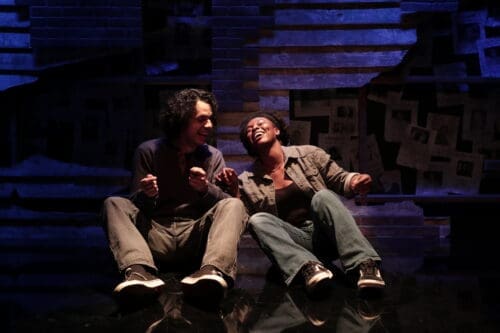
Spike Pulice and Vicky Yvonne
But coldness is harder to sustain than indignation. At moments, Majok’s intelligence can feel almost punitive, testing the characters with a severity the drama does not always need. The play begins in danger and edges, perhaps too willingly, toward argument, where the raw instability of life starts giving way to the tidiness of thought. Compared with The Cost of Living, where contradiction remained beautifully unresolved, Sanctuary City begins, in its later passages, to mistrust ambiguity. It grows more eloquent and less mysterious. And mystery was where its power lived.
Nguyễn’s production resists that drift wherever it can. Fred Kinney and Mio Okada-Nunez’s scenic and costume design works abstractly and argumentatively at once. They fill the visual field with “Missing” photographs, the homemade kind taped to phone booths and chain-link in the weeks after the Towers came down, intercut with the faces of those vanished more recently into ICE custody. Two decades of American disappearance share a wall. Their costumes do quiet work, picked clothes that name a year and a paycheck without saying so. Andrew Hungerford’s lighting and sound design handles the production in two halves. The first forty-five minutes come in jolts, time fractured, scenes cutting before the last one has landed.
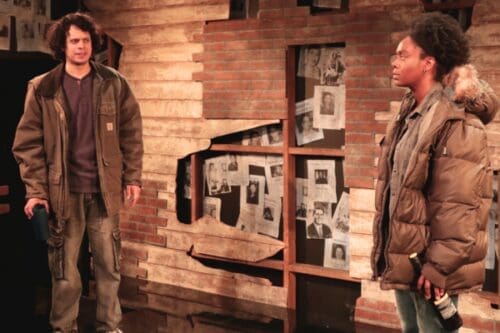
Spike Pulice and Vicky Yvonne
Then the lights and sound settle, and the actors start breathing in real time. Pulice and Yvonne hold onto the unstable emotional weather of that first act even when the writing leans toward statement. Keyes does something rarer still: he protects Henry from becoming an idea. And that humanity matters.
Because for much of its first half, Sanctuary City achieves something uncommon in contemporary American drama. It makes politics feel not thematic but physiological, lodged in syntax, in hesitation, in what a body learns to conceal. Few plays hear fear written into ordinary speech this acutely. Which is why the second half disappoints not because it fails, but because it reaches toward explanation when it had already touched something harder to name.
Majok built a play capacious enough to hold uncertainty. Then she answered it. And in doing so, she diminishes a work that had come very close to greatness.
✦ ✦ ✦ ✦ ✦ ✦ ✦ ✦ ✦ ✦
photos by Doug Catiller
Sanctuary City
Chance Theater
Fyda-Mar Stage, 5522 E. La Palma Ave., Anaheim
1 hour 45 minutes, no intermission
ends on June 7, 2026
for tickets, call 888.455.4212 or visit Chance Theater
for more shows, visit Theatre in LA
✦ ✦ ✦ ✦ ✦ ✦ ✦ ✦ ✦ ✦
