


Areas We Cover
Categories

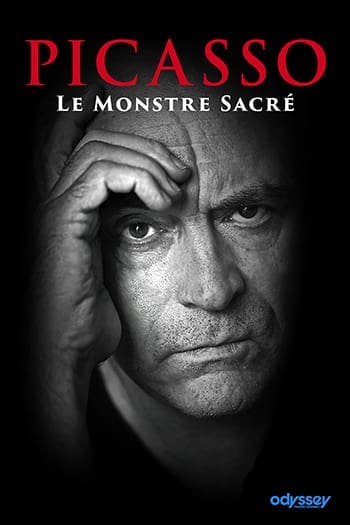
Theater Review: PICASSO: LE MONSTRE SACRÉ (Odyssey Theatre Ensemble / Los Angeles)
by Ernest Kearney | May 12, 2026
in Los Angeles, Theater, Tours
THE MINOTAUR IN THE MIRROR
A powerful performance anchors a
portrait that never fully reveals its subject
The journey of Picasso: Le Monstre Sacré to the Odyssey Theatre in L.A. is both convoluted and tragic. It began with Terri D’Alfonso (also spelled “Terry” in the program). An American with a long career in Italian Swiss Television, D’Alfonso had also collaborated with Giorgio Strehler, who helmed legendary productions at the Piccolo Teatro in Milan.
At some point, D’Alfonso found herself captivated by the Spanish artist Pablo Picasso (1881-1973). This fascination was cleaved between veneration for Picasso’s artistry and abhorrence at his lifelong violence and mistreatment of the women in his life. Her desire to explore this conjunction in the artist—bestowing beauty to the world while dispensing suffering to those who loved him—became an hour-long, four-person play, The Loves of Picasso, which approached the subject from the views of the abused women. In 2016, D’Alfonso adapted this work into a twenty-eight-minute short film which she also directed. Shot on Capri, the film featured British actor Peter Tate, whose intense portrayal of Picasso was universally praised.
Following screenings in New York and Berlin, D’Alfonso was scheduled to present her film in London. On that night, however, Tate came before the curtain and announced to the stunned audience that the director had collapsed three weeks earlier. D’Alfonso did not regain consciousness, dying the day prior to the screening.
2018 saw The Loves of Picasso staged in London’s West End, with Tate again as the artist. Then, in 2023, under the title Picasso: Le Monstre Sacré, D’Alfonso’s work was adapted as a one-man show by Tate and director Guy Masterson, which debuted at the Edinburgh Fringe.
It is this variation that can now be viewed on the Odyssey’s stage.
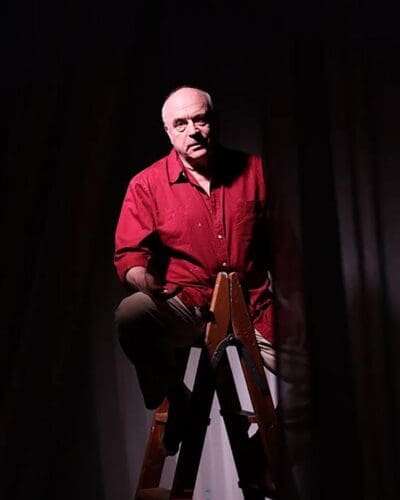
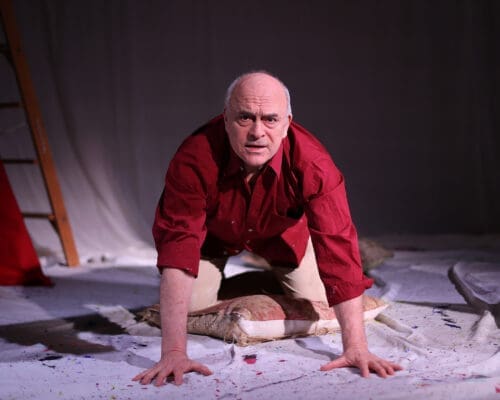
It is understandable why Tate has held so tenaciously onto this role. From the opening moment, with his mother’s warning little “Pablito” to stop looking into the sun or he’ll go blind, Tate’s performance as “the sacred monster” has an intensity that is scorching.
A sheet drapes down, representing the canvas that awaits the artist’s next work. Masterson and set designer Eirini Kariori then spread the sheet outward over the stage, creating a confined arena that accents the intimacy of Picasso’s reflections while also establishing that he is as much a work of his own creation as any he painted on canvas.
As the canvas serves to frame Picasso’s reflections, it also serves as the screen on which the fleeting figments of his memories float over. These reminiscences are black-and-white slivers selected from D’Alfonso’s short film with performances by Tate as well as Sandra Collodel, Claudia Godi, Margot Sikaboni, and Milena Vukotic, who appeared in Federico Fellini’s Juliet of the Spirits (1962), and Luis Buñuel’s The Discreet Charm of the Bourgeoisie (1972).
But while taking inspiration from D’Alfonso’s work, Masterson and Tate have provided a reverse reflection of her intentions. At the core of The Loves of Picasso were the victims of the artist’s appalling sexual entitlement; now the women have been reduced to mere shadows that waft mistily over the scene. Masterson and Tate have not resorted to blaming the victims; they have simply negated them.
“If a woman gets close to me,” Picasso proclaims, “I destroy them.” There is no remorse in this statement, no more contemplation or reflection than one would expect of a driver commenting on just another insect splattering against his windshield as he sped down a rural back road.
In this isolation, the show is reduced to a litany of Picasso’s sins against the women in his life, with only a marginal nod toward the punishment his actions bring down upon him.
One of Picasso’s favorite motifs was that of the Minotaur, the horrific creature of Greek mythology with the body of a man and the head of a bull, for whom the ancient Athenians were compelled to make a yearly sacrifice of young virgins. The Minotaur is a monster, and therefore requires no reason to justify its monstrousness. An attempt at extending this rationale to Picasso by his donning a Minotaur head fails, because we know behind the mask, there is a man.
For those familiar with Picasso’s life, there is nothing new here; for those unaware of his history, or unacquainted with the narcissism he sought to excuse with the paper tiger of artistic ardor, the play offers a plethora of examples but scant insight into whether his creative fervor and fiendish ferocity share a common foundation. Still, there is no denying that whatever frustration arises from this failure is nevertheless muted beneath the passionate dynamism of Tate’s performance.
✦ ✦ ✦ ✦ ✦ ✦ ✦ ✦ ✦ ✦
photo by Brigitta Scholz Mastroianni / NUX Photography
Picasso: Le Monstre Sacré
Odyssey Theatre
2055 S. Sepulveda Blvd., Los Angeles, CA
65 minutes, no intermission
Thurs–Sat at 8; Sun at 3
ends on May 17, 2026
for tickets ($15–$35), call 310.477.2055 ext. 2 or visit Odyssey Theatre
for more shows, visit Theatre in LA
✦ ✦ ✦ ✦ ✦ ✦ ✦ ✦ ✦ ✦
