


Areas We Cover
Categories hhhh

Theater Review: SCARAMOUCHE (City Lit Theater / Edgewater Presbyterian Church / Chicago)

by C.J. Fernandes | May 18, 2026
in Chicago, Theater
EN GARDE, YOU FOOLS
A spirited cast and plenty of swashbuckling fun
can’t quite compensate for a forgettable score

The Ensemble
“He was born with a gift of laughter and a sense that the world was mad.”
That terrific sentence opens Rafael Sabatini’s 1921 novel Scaramouche. A smash hit on publication, this swashbuckling adventure has been adapted to film and theatre multiple times and now makes its way to the stage of the City Lit Theatre as a musical by composer/lyricist Kingsley Day, who co-wrote the book with James Glossman.
Scaramouche: A Musical in Two Acts opens on a medieval stage. Literally. Dominating Trevor Dotson’s scenic design is a small stage of the sort constructed by traveling troupes. The rear is occupied by a projection of a curtain. DJ Douglass’s impressionistic projections play across the screen, conveying the various locations. The quartet of musicians is hidden behind the stage. The rest of the performance space is largely bare. Props and wigs are mounted on a back wall and occasionally withdrawn from a costume chest. Music director Kevin Zhou strikes up the band, the cast bounds into view and launches into the opening number (“The Tale of Scaramouche”), and we’re off to the races.
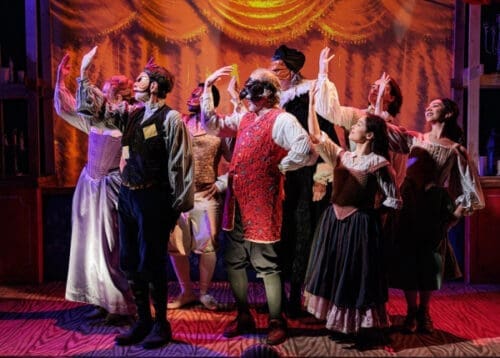
The Ensemble
Scaramouche follows the plot of the novel fairly closely. It is the eve of the French Revolution, and in a village in Brittany, a young lawyer André-Louis Moreau (Ethan Smith) and his best friend, a priest-in-training, Philippe de Vilmorin (Connor Ripperger), run afoul of a local landowner, the Marquis de la Tour (a splendid, sneering Kent Joseph). Incensed by his cruelty, Philippe lets the Marquis goad him into assault, provoking a duel. An expert swordsman, the Marquis dispatches Philippe in short order. Recognizing the act for what it is—cold-blooded murder—André-Louis goes to the city to lodge a complaint against the Marquis, a complaint that is summarily dismissed by the King’s lieutenant. On his way back, he falls in with a demonstration, and using Philippe’s words, rouses them to action with a stirring oration, setting up the uprising that will go on to become the French Revolution.
Condemned at court for treason, André-Louis flees his estate and takes up with a traveling commedia dell’arte troupe of actors, taking on the character of Scaramouche in their productions, the name by which he will now be known.
And then things get complicated.
As is standard in the genre, the story ties itself up into increasingly intricate knots, throwing in multiple romantic interests, mistaken identities, misunderstandings, sword fights, and more plot twists than you can brandish a sword at; all building up to a snarling mess until, with a quick yank, the knots unravel and everything straightens out through a series of revelations that beggar belief. It’s all completely ludicrous and all good fun.

Ethan Smith and Laura Michele Erle
Director Beth Wolf is a veteran of Shakespeare’s comedies and knows her way around this silliness, keeping things moving at a brisk pace. The large cast seems to be having fun—very important in this kind of show—and their exuberance is infectious. Mr. Smith makes for a fine if bland Scaramouche, but the standout performers are Ripperger, Joseph, and Laura Michele Erle, who plays Aline, one of Scaramouche’s love interests. Ripperger steals the show pretty much every time he is on stage in his multiple roles; Joseph plays his part like a villain from a silent film, with a smarmy smile and a glorious mustache that just begs to be twirled—I swear, had he twirled his mustache I would’ve squealed and added an extra star to this review—and Erle is perfect as the spirited Aline. She is also the best singer in the show. What all three performers have in common is that they are perfectly attuned to the near-camp nature of the material, something with which the rest of the cast struggles. And a special mention to Shea Lee, whose walk and expression when she plays the servant Benoîte have to be seen to be believed, receiving a roar of laughter merely by stepping onto the stage.
There are two major problems with Scaramouche: the first is the ending, which works better on paper than it does on stage—to be fair, it’s disappointing in the novel as well—but is especially rushed in this production. Big revelations drop and before they’ve had time to register, the show has already moved on. In general, the plot-heavy second act is weaker and could use some tightening up.
The second, and far more problematic issue, is the score, which is, to put it bluntly, not particularly memorable. Unlike Loki and Octet, two other musicals currently playing on small Chicago stages, the score for Scaramouche is more traditional in composition, but while it’s pleasant enough during the show, the songs fade from memory almost immediately after leaving the theatre. A few hours later, the only melody I could recall was the opening strains of “Entitled to Be Happy.” And even given the limitations of the space and budget, visually there’s not much going on with the scenic and lighting design.
Don’t get me wrong. Scaramouche is a lot of fun: it is frequently very funny, the ensemble has terrific chemistry, and it is beautifully directed, well-acted and, for the most part, well-sung. As a play it would have received a much higher grade from me but as a musical, it unfortunately falls short.
✦ ✦ ✦ ✦ ✦ ✦ ✦ ✦ ✦ ✦
photos by Steven Townshend of Distant Era
Scaramouche
City Lit Theater
1020 W. Bryn Mawr Ave. in Chicago
2 hour 30 minutes with intermission
Fri and Sat at 7:30; Sun at 3; Mon at 7:30 (June 1)
ends on June 14, 2026
for tickets, visit City Lit Theater
for more shows, visit Theatre in Chicago
✦ ✦ ✦ ✦ ✦ ✦ ✦ ✦ ✦ ✦
