


Areas We Cover
Categories

Theater Review: A MAN OF NO IMPORTANCE (The Bent / Palm Springs)
by Stan Jenson | May 16, 2026
in Palm Springs
(Coachella Valley), Theater
A LITTLE SHOW WITH
A VERY BIG HEART
The Bent’s first musical proves this
company is ready for anything
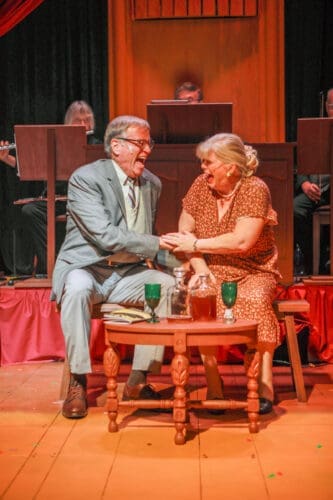
The Bent, Palm Springs’ queer theatre company, closes its fourth season with its first musical, A Man of No Importance — and what a debut it is. This intimate chamber piece proves the company’s trademark excellence can easily expand to encompass a cast of 16 actors and three musicians without losing any of its precision or heart.
With music by Stephen Flaherty, lyrics by Lynn Ahrens (Ragtime, Once on This Island, Anastasia), and a book by Terrence McNally (Love! Valour! Compassion!, Kiss of the Spider Woman), the musical fits beautifully inside the relatively modest confines of the Palm Springs Cultural Center stage.
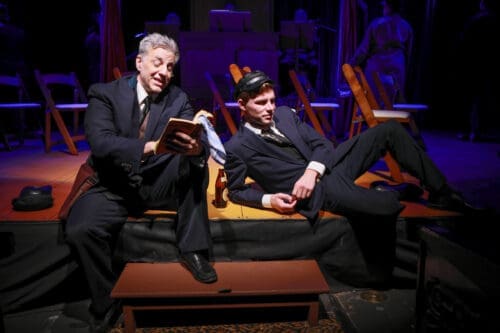
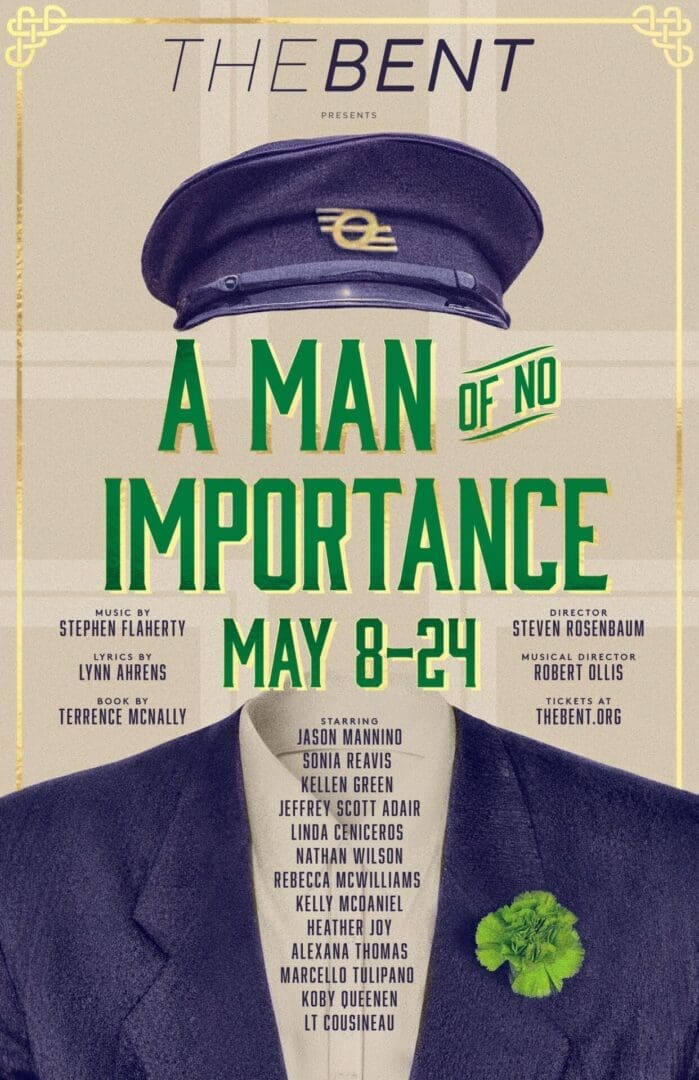
The story centers on Alfie Byrne (Jason Mannino), a Dublin bus conductor whose daily existence is defined by invisibility. Only in the evenings, directing the amateur Saint Imelda Players in the basement of a local church, does Alfie truly come alive. Mannino’s impeccable Irish accent and wonderfully expressive face make him magnetic to watch — no small feat for a character whose defining quality is his supposed insignificance. Alfie dreams of staging Oscar Wilde’s Salome, but Father Kenny (LT Cousineau) finds the material far too risqué for church-sponsored theatrics.
Alfie’s daily life revolves around his handsome young coworker Robbie Fay (Kellen Green) and his sister Lily (Sonia Reavis). Green effortlessly embodies the easy charm of the “every Irish bloke” Alfie quietly longs to become, while Reavis delivers one of the production’s richest performances. Her portrayal of Lily is filled with tiny behavioral details — spoken asides, sighs, nervous laughs — all while effortlessly floating glorious soprano lines above the orchestra. She makes the role feel entirely lived in. Lily has been seeing Mr. Carney (Jeffrey Scott Adair), but refuses to move forward with the relationship until Alfie himself settles down.

Into Alfie’s carefully controlled life comes Adele (Linda Ceniceros Gonzalez), whom he hopes will play Salome in his production. Though she initially mocks his devotion to amateur theatre, Alfie persists. Meanwhile, he tells Lily he has “met a girl,” largely because he knows it is what she desperately wants to hear. Lily, naturally, takes the fantasy much further than he intended.
Alfie’s true passion remains his theatre troupe, and every member of the Saint Imelda Players emerges as a vivid individual. Much of the show’s humor comes from Alfie’s casting announcements for Salome, which are met with varying degrees of outrage by the company. The ensemble work throughout is terrific.
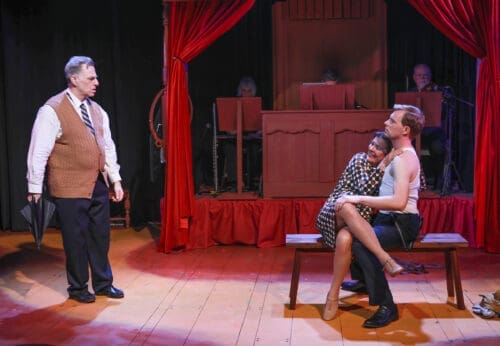
The emotional center of the show shifts when Robbie brings Alfie to a local pub, where he meets Breton (Koby Queenen), whose flirtatious attention awakens feelings Alfie has spent a lifetime suppressing.
The opening of Act II is simply exhilarating. Actors wander onstage casually resetting the space when Kellen Green suddenly launches into a fiery fiddle solo — and from there the sequence explodes into joyous pub revelry. One actor grabs a Celtic drum, another a guitar, another a tin whistle, until the entire cast seems swept up in the celebration. Then Nathan Wilson, previously seen as the troupe’s stage manager, erupts into a thrilling Irish step dance that nearly stops the show cold. It is impossible not to feel re-energized after intermission.
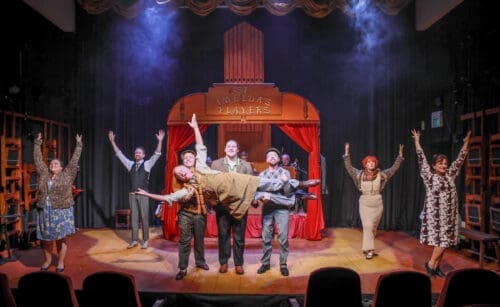
Act II also plunges the story into darker territory. The church shuts down Alfie’s production. Breton and his friends brutally assault him in an act of “poofter baiting.” Friends begin distancing themselves once Alfie’s sexuality becomes public. Yet the production never loses sight of its humanity, and the evening ultimately bends toward compassion rather than despair.
What distinguishes this production above all else is the extraordinary attention to detail. Every performance is sharply etched, every technical element carefully calibrated. The vocal quality rivals that of many touring productions visiting the McCallum Theatre, while the acting remains grounded and deeply human.
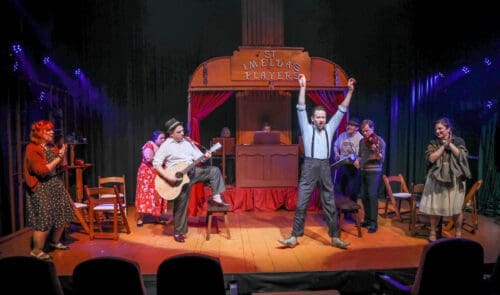
Nick Wass’s lighting design is especially impressive, using tight spotlights and intelligent lighting effects to guide the eye with remarkable precision despite what appears to be a relatively modest rig. His sound design is equally strong: crystal clear without ever sounding artificially amplified. Chery Lanning’s costumes are deceptively effortless, perfectly suited to both the actors and the world they inhabit.
Steve Gibony’s set design is deceptively simple but extraordinarily clever. An upstage proscenium trimmed with red velvet curtains frames the three-piece orchestra, revealed early in the evening with delightful theatrical flair. Since the converted cinema offers no real wing space, Gibony ingeniously constructed wall-mounted wooden racks where actors can hang folding chairs rather than awkwardly carry them on and offstage. Even better: much of the carved wood decorating the proscenium came from a salvaged secondhand-store headboard.
Music Director Robert Ollis deserves enormous praise for the musical clarity achieved throughout the production. Every lyric lands cleanly, harmonies remain beautifully balanced, and ensemble numbers soar with confidence and warmth. Joined by Lee Wolfe on violin and Linny Smith on reeds, Ollis creates a sound that feels authentically rooted in an Irish pub tradition. At times, you can practically smell the Guinness.
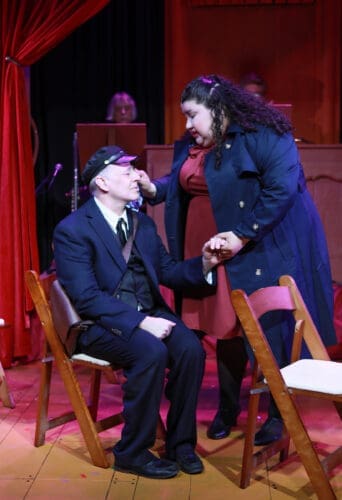
And then there is Artistic Director Steve Rosenbaum, whose staging throughout borders on miraculous. Rather than treating movement and scene changes as separate functions, Rosenbaum fuses them together into one continuous flow. Actors pass props to one another with balletic ease; tables, chairs, and benches appear and disappear almost invisibly as bodies swirl across the stage. Nothing feels mechanical. The production moves like a living organism. Combined with Wass’s lighting, the staging guides the audience’s attention so fluidly that every emotional beat lands with clarity.
Most importantly, however, the company never loses sight of the story’s aching humanity.
This production is so polished, emotionally rich, and thoroughly accomplished that it seems almost unfair it will play only three weeks in Palm Springs. The performances are uniformly excellent, the musicians superb, and the production itself easily stands alongside nearly any touring musical to visit the Valley this past year.
photos by Jim Cox
A Man of No Importance
The Bent Theatre
in association with The Palm Springs Cultural Center
Camelot Theatres, 2300 East Baristo Road in Palm Springs
Thurs-Sat at 7; Sun at 2
ends on May 24, 2026
for tickets ($42), visit The Bent
