


Areas We Cover
Categories

RICK BLAINE DIDN’T NEED A CONFESSION BOOTH-He Had a Roulette Table, and Curtiz Knew It
by Aveline MacQuoid | May 12, 2026
in Extras
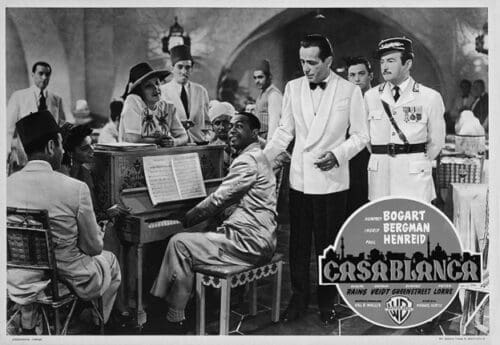
You can never forget the movie character that made a great impression on the viewer. With this piece, we wanted to analyze some behavioral patterns of Rick Blaine from Casablanca and revisit the directorial mastery of Mr. Michael Curtiz, known as a versatile director, who created one of the most iconic movies of all time, yet ensured a professional environment where great characters like Rick could grow.
The wheel is where Rick stops pretending
The smartest thing Curtiz does with Rick is place his decency inside action that looks casual. That is why the sequence around the gaming room is worth mentioning. The film has already shown Rick as controlled, cool, and careful with distance. He does not drink with customers. He does not hand out warmth for free. Speaks in short, dry lines and lets other people fill the silence.
Then Annina, the young wife under pressure, comes to him with a question that is really a cry for help. Rick first answers in the hard voice he uses to protect himself. Curtiz lets that hardness sit there. He does not rush to soften it. Then Rick walks into the next room, watches the husband at the table, and quietly turns the game. At that moment, casino roulette is not decoration and not local color. It becomes Rick’s private language, the place where he can do good without making a speech about goodness.
That choice says almost everything about Curtiz’s understanding of the character. Rick helps, but he helps sideways. He cannot bear open sentiment, so he hides generosity inside procedure. He uses the house, the croupier, the spin, and the crowd. The gesture is elegant because it stays in character. Curtiz does not force Rick into sainthood. He lets him remain proud, guarded, and slightly embarrassed by his own heart.
The beauty of the scene comes from that friction. Rick saves a marriage without asking for gratitude, and he does it through a roulette casino game, a public game that Curtiz films as a secret act of mercy. The scene also matters because it prepares the whole final movement of the film. Once we have seen Rick quietly lose money in order to protect somebody else, his later sacrifices no longer feel sudden. They feel earned.
Even the smaller follow-through matters. Rick begins breaking his own rules, including paying for others and stepping closer to people he had kept at arm’s length. Curtiz uses money here not as a symbol of greed, but as proof of what Rick is finally willing to give away. It almost reminds us of this meme:
Why this small scene carries the whole film
The roulette episode is not just memorable because it is touching. It is memorable because it is structural. Curtiz places it where it can quietly reframe everything we think we know about Rick. Up to that point, he looks like a man who survives by staying untouched. After it, we start to see that his cool surface is a method, not a truth. The scene becomes a hinge between attitude and character. It is also one reason the film’s reputation has lasted so strongly across decades.
| Marker of lasting stature | Current or official record | What it says about the film |
| Academy Awards performance | 8 nominations, 3 wins | Curtiz’s work was recognized at the highest level in its own moment |
| AFI standing | #1 on AFI’s love stories list; 6 AFI quote entries | The film lives in memory as both feeling and language |
| National Film Registry | Added in 1989, one of the first 25 films | Its preservation value was recognized early and officially |
Curtiz makes the movie feel romantic, clever, and tense all at the same time. That is why it can feel both elegant and full of life.
The film’s reputation also shows how important it became:
- The American Film Institute ranks Casablanca as the number one love story in cinema.
- It also has six famous quotes on AFI’s memorable quotes list.
- The Academy records eight Oscar nominations and three wins.
That is a rare mix of praise, memory, and lasting cultural power. It helps explain why even a short scene at a gaming table can carry so much of the film’s identity.
Curtiz’s real trick is scale
What feels unique in Curtiz’s direction is his sense of scale. He can move from a crowded room to one small glance without losing force. Curtiz keeps all of that in motion. He gives Rick a café full of noise, music, transactions, and interruptions, then lets one simple action cut through it. That is why the roulette scene lands so hard. It is not louder than the rest of the film. It is quieter, and more exact.
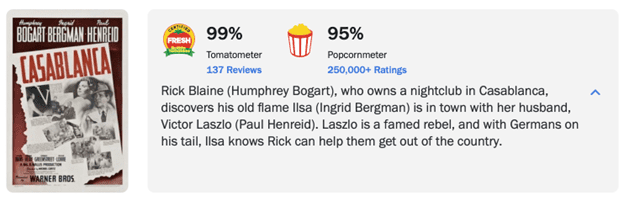
The film’s hold on audiences is still visible in current numbers. On Rotten Tomatoes, Casablanca holds a 99% Tomatometer from 137 reviews and a 95% audience score from more than 250,000 ratings, which is remarkable for a film first released in the early 1940s. Roger Ebert once called it “one of the most popular films ever made,” and that line fits because popularity here is not shallow familiarity. It is repeated emotional recognition.
People keep coming back to Rick because Curtiz never reduces him to one note. He lets him reveal himself through choices, and the finest of those choices is made not in a speech, but at a table, with a spin, in front of strangers. That is the kind of directing that lasts.
Curtiz knew that Rick Blaine did not need to explain his soul out loud. He only needed one well-placed act of grace, and a camera patient enough to see it.