


Areas We Cover
Categories hhhh

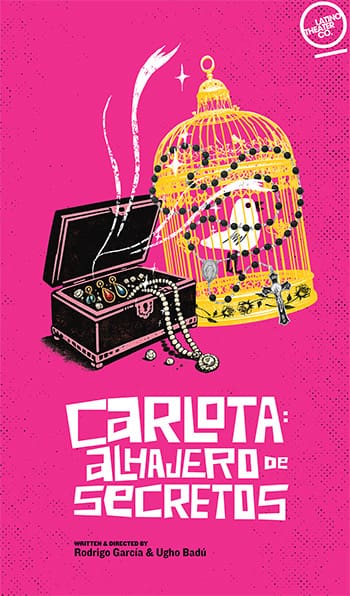
Theater Review: CARLOTA: ALHAJERO DE SECRETOS (Latino Theater Company / LATC)
by Michael M. Landman-Karny | May 22, 2026
in Los Angeles, Theater
LORCA IN DRAG,
WITH HIS CLAWS INTACT
Rodrigo García and Ugho Badú reimagine
a Spanish classic without dulling its edge
Lorca wrote for women’s voices and then watched the world go silent on him. Carlota: Alhajero de Secretos (Carlota: Jewelry Box of Secrets) hands those voices to men, and the swap is the honest move. Rodrigo García and Ugho Badú take The House of Bernarda Alba, recast it as queer and Latino, and preserve the original’s blade while letting in sass and laughter.
Federico García Lorca, a Spanish poet and playwright, finished The House of Bernarda Alba on June 19, 1936. Weeks later, Nationalist forces shot him near Granada. The play reached the stage only in 1945 and stayed banned in Franco’s Spain until 1964. It traps a widow and five unmarried daughters inside eight years of mourning. No men appear. Lorca lets the walls do the cruelty and the heat build. This production puts its thumb on exactly that.
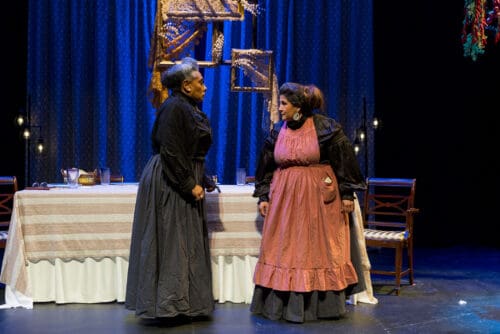
Sergio Dávila and Carolina Pérez
The bones are faithful, with one important compression: Lorca’s five daughters become Carlota‘s three. Carlota (Sergio Dávila) runs a faded hacienda on manners and appearances. Mari Fer, Mari Tere, and Mari Pepa remain fluent in crochet and tableside etiquette, shut off from the world. The nanny Prudencia (Carolina Perez) and part-time housekeeper Consuelo (Yatzil Ruiz) work the edges. A funeral brings a suitor into Mari Tere’s view, and the sisters turn on each other. Dolores (Ricardo Cortés), back after decades away, has a looser idea of how a woman gets to live.
All eight characters are women, though six are played by men; the servants are not. The arrangement gives pause for about a scene, then turns the screw the openly gay Lorca had built. With women, the repression can look like an unlucky condition, something the daughters were born into. With men, it looks like what it is: a role drilled into them under threat. Every corrected posture reads as rehearsal rather than nature, and the demand to perform “lady” becomes visibly a demand. The cruelty lands as cruelty, not custom.
García’s costumes track the divide on sight: mother, friend, and daughters in black; servants in color. Carlota’s grip stays visible at a glance.
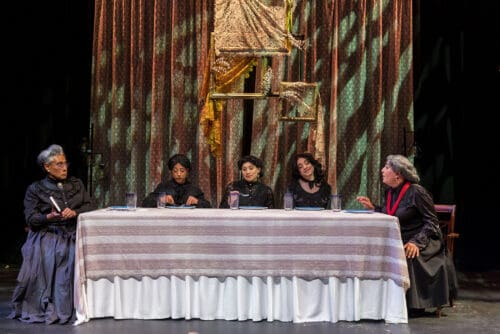
Sergio Dávila, Janvier Berber, Adrian Campos, Ugho Badú and José Martínez
Dávila is the engine. His Carlota carries authority like a held breath and releases it slowly into grief. This version is much funnier than Lorca’s tragedy, sometimes broadly so, but the jokes do not cheapen the cruelty. Perez ages into Prudencia with soft, musical kindness; Ruiz answers with a bright, quick Consuelo. The daughters, Janvier Berber-Acosta, Badú, and Adrián Campos Arenas, ride telenovela melodrama without dropping the hunger underneath it. Cortés gives Dolores the right carefree sass.
The Almodóvar shadow is there too, as permission, not imitation. The play shares his taste for women on the edge, kitchens as confessionals, family history as contraband, and melodrama that can turn funny without turning false. The color, the heat, the bodily embarrassments, the bolero ache, and Dolores’s late entrance all tilt the evening toward that Spanish movie world where excess tells the truth.
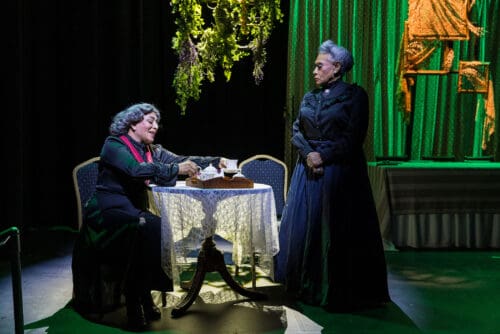
José Martínez and Sergio Dávila
The text is not always as disciplined as the staging. A few secrets arrive too neatly, and some of the aphoristic language circles feelings the actors have already delivered. Without spoiling the plot, the central object promised by the title could carry more dramatic weight. The cast keeps the play moving as behavior rather than thesis, and that usually outruns the trouble.
Leigh Henderson‘s set is plain and exact: a long dining table, a smaller kitchen table, wooden spoons, clay bowls. It shifts cleanly and keeps the tension climbing. Noemi Barrera‘s lighting dims on cue and earns its suspense. The piece runs in Spanish, and it should; García and Badú lean into Lorca’s poetry but add a Latin American idiom, and the refranes (folk proverbs) carry music English cannot.
One real friction: the supertitles sit high above the stage and pull the eye off the actors. Sit farther back for an easier view.
Carlota trusts its source and its audience. Lorca wrote about voices shut inside a room. This company gives them back, in the language they were meant for, and the room answers.
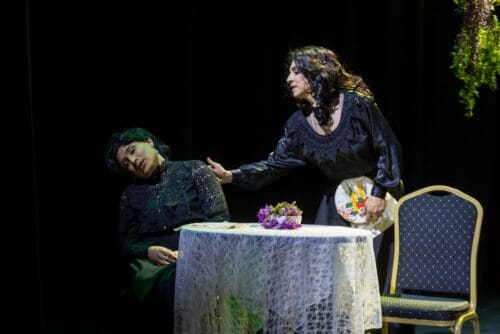
Adrian Campos and Ugho Badú
✦ ✦ ✦ ✦ ✦ ✦ ✦ ✦ ✦ ✦
photos by Grettel Cortes Photography
Carlota: Alhajero de Secretos
Latino Theater Company
Los Angeles Theatre Center
514 S. Spring St. in Los Angeles
ends on May 24, 2026
for tickets, visit Latino Theater Company
for more shows, visit Theatre in LA
✦ ✦ ✦ ✦ ✦ ✦ ✦ ✦ ✦ ✦
