


Areas We Cover
Categories

MEOW WOLF: WHERE IMMERSIVE ART MEETS LIVE ENTERTAINMENT
by Susan Hall | July 21, 2026
in Art and Museums, Extras
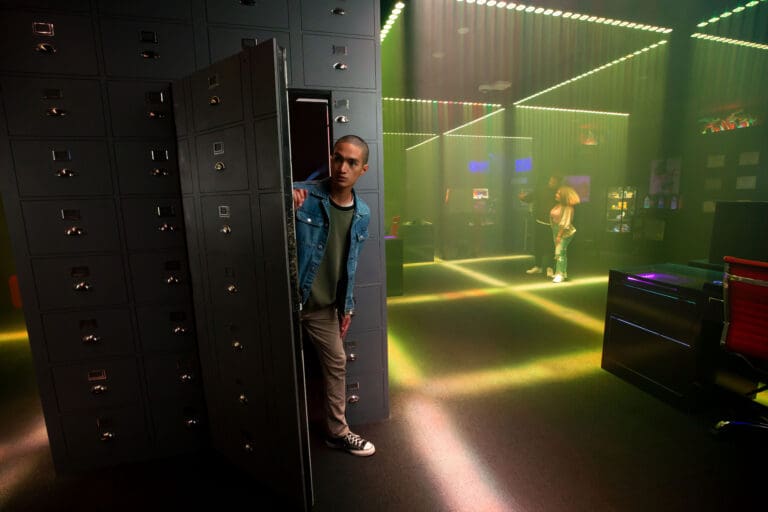
Meow Wolf is difficult to describe because familiar labels never quite fit. It is part gallery, theatrical set, maze and narrative game. Visitors open cupboards, crawl through unexpected passages, answer strange telephones and follow story fragments that may never resolve in the same way twice.
That participation makes Meow Wolf a clear example of immersive art and live entertainment converging. Its installations borrow theater’s pacing, the environmental storytelling of video games and the open-ended curiosity of a dream. Whether someone arrives through a recommendation or a search for “meowwolf,” the central idea is the same: the audience completes the experience.
From a Santa Fe Collective to a Multicity Art World
Meow Wolf began in 2008 as a small collective of Santa Fe artists making and exhibiting work together. That collaborative foundation still defines the company. A permanent exhibition may involve painters, sculptors, architects, fabricators, writers, performers, musicians and digital artists, with individual pieces contributing to a larger fictional world.
The breakthrough was House of Eternal Return, which opened in Santa Fe in 2016. Its apparently ordinary Victorian house contains portals into other dimensions, while documents, videos and household objects reveal the story of the fictional Selig family. A visitor can simply enjoy the rooms as visual spectacle or investigate the underlying mystery. Neither approach is treated as the “correct” one.
That model expanded into permanent exhibitions in Las Vegas, Denver, Grapevine and Houston. Los Angeles and New York projects are also in development. Meow Wolf now operates at a scale far beyond its collective origins, but the installations still feel less like a traveling franchise than connected entries in an eccentric shared universe.
The Visitor Becomes a Performer
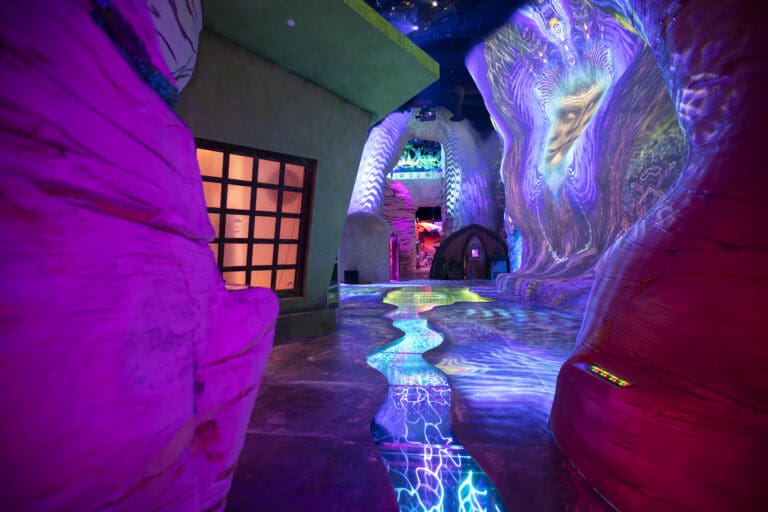
Meow Wolf’s Projected Desert in Las Vegas (photo by Kate Russell)
Traditional theater assigns clear roles: performers act, technicians shape the environment and spectators watch. Meow Wolf rearranges that relationship. Without an actor guiding the scene, visitors choose routes, test objects, exchange theories and react visibly to discoveries. Other guests become part of the atmosphere.
This is why the work can feel theatrical even when no scheduled performance is taking place. Lighting controls attention. Sound suggests unseen activity. A narrow hallway builds tension before a room opens into an enormous, brightly colored environment. The installations use entrances, reveals and changes of scale in much the same way a stage production uses cues and scene transitions.
The difference is control. Meow Wolf lets people miss entire rooms or encounter narrative pieces out of order. That is not a flaw; it creates the pleasure of personal discovery.
Five Exhibitions, Five Different Portals
Each current location uses the same broad language of interactive art but develops its own identity. Santa Fe’s House of Eternal Return begins with a domestic mystery. Las Vegas turns a satirical supermarket into Omega Mart, where absurd products lead into a story about a powerful corporation. Denver’s Convergence Station connects four surreal worlds through a fictional transit hub and contains more than 70 interactive installations.
The Real Unreal in Grapevine returns to a family home opening onto impossible spaces, while Houston’s Radio Tave imagines a community radio station transported into another realm. Hidden passages, nonlinear stories, tactile art and extravagant color make the locations recognizably related, while different settings prevent them from feeling replicated.
Where Live Events Enter the Picture
Meow Wolf is not only an exhibition producer. Santa Fe’s Fancy Town and Denver’s Perplexiplex are dedicated venues inside the larger experiences. The company’s concert and event spaces allow musicians and audiences to meet within an environment already charged with fiction, color and sensory detail.
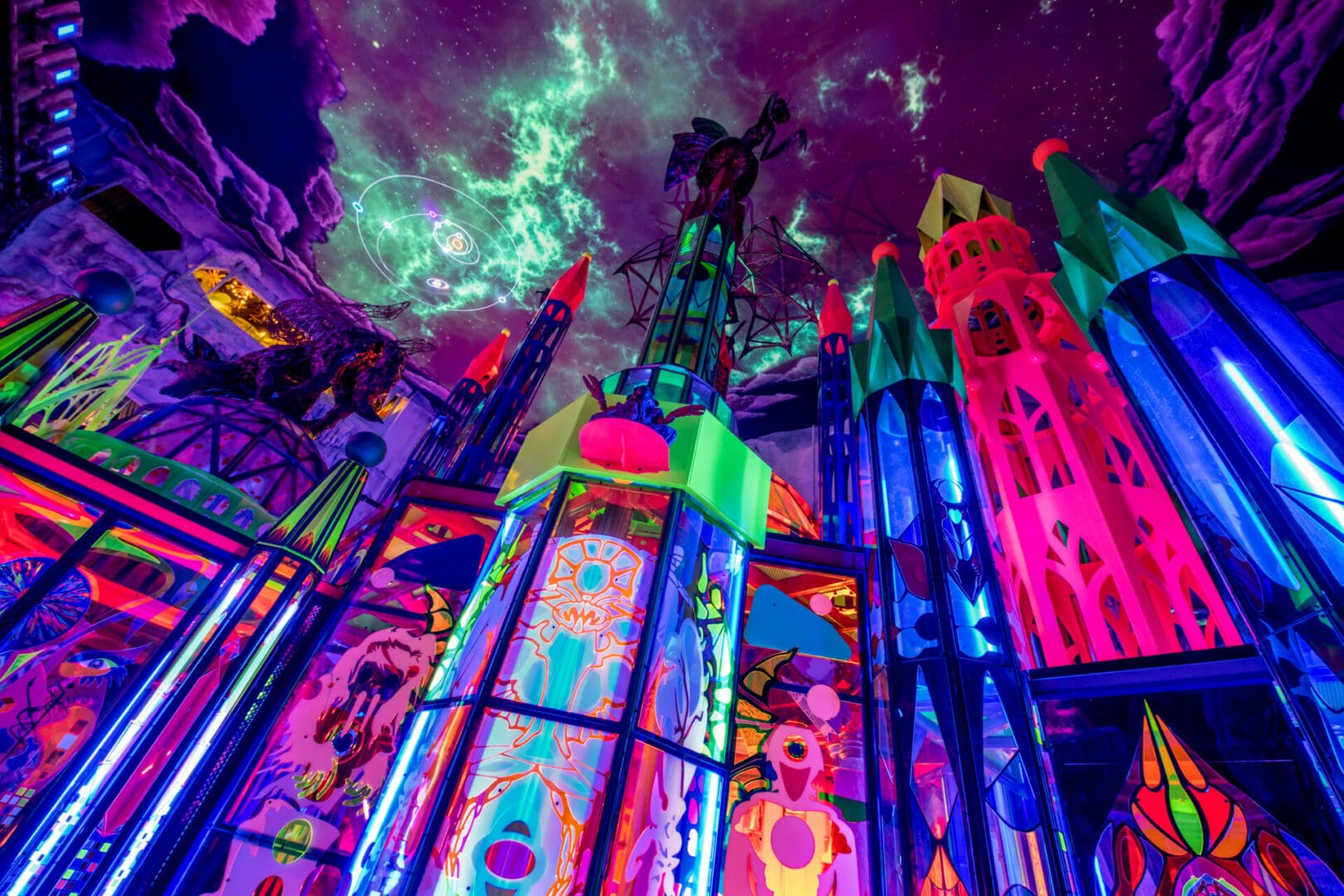
The Cathedral at Meow Wolf Denver’s Convergence Station (photo by Jess Bernstein)
That changes a show’s context. The evening can begin with exploration, and the installation gives the event a visual identity no neutral black-box venue could reproduce. Even visitors ignoring the deeper narrative enter with a heightened awareness of place.
The model also points toward a broader future for live entertainment. A venue can possess its own story, visual language and audience rituals, with concerts and special programming acting as temporary layers within a permanent world.
Technology That Does Not Feel Like a Demonstration
Screens, sensors, projection, responsive sound and lighting help Meow Wolf’s environments react to visitors. The technology is embedded within handmade surfaces, fictional machines and sculptures. Its purpose is to make the world feel alive, not advertise a device.
That restraint matters. Immersive entertainment can become an equipment showroom when every interaction is explained. Meow Wolf trusts visitors to touch, listen and experiment. A button might trigger light, reveal a recording or apparently do nothing. Uncertainty becomes part of the design.
The same appetite for atmosphere appears across entertainment formats. Digital destinations such as casino Lucky Circus also use color, sound, pacing and discovery to turn a functional interface into a themed environment. Meow Wolf’s distinction is that the experience is architectural and social: people move through a shared physical space, and their choices become visible to everyone around them.
What First-Time Visitors Should Expect
There is no need to understand the wider mythology first. Allow enough time, wear comfortable clothes and follow whatever looks interesting. Groups may separate briefly or notice different details; comparing discoveries is part of the fun.
Visitors who prefer a clear beginning and ending may find the nonlinear structure disorienting. The exhibitions do contain stories, but they do not deliver them like a conventional play. Plot is distributed across rooms, documents, audio, video and interactive objects. It is possible to leave with unanswered questions, and that incompleteness encourages discussion and repeat visits.
More Than a Backdrop for Photographs
Meow Wolf’s bright colors and surreal rooms are photogenic, but reducing them to social-media scenery misses the achievement. A playful object may carry a clue; a comic detail may connect to a corporate satire; an apparently chaotic room may reveal several artists’ distinct voices.
That balance between spectacle and depth explains Meow Wolf’s position between visual art and live entertainment. It offers the scale and immediacy of a major attraction without requiring visitors to become passive consumers. The doors open, the lights are on and the world is waiting—but the event does not fully begin until somebody steps inside and starts exploring.
