


Areas We Cover
Categories

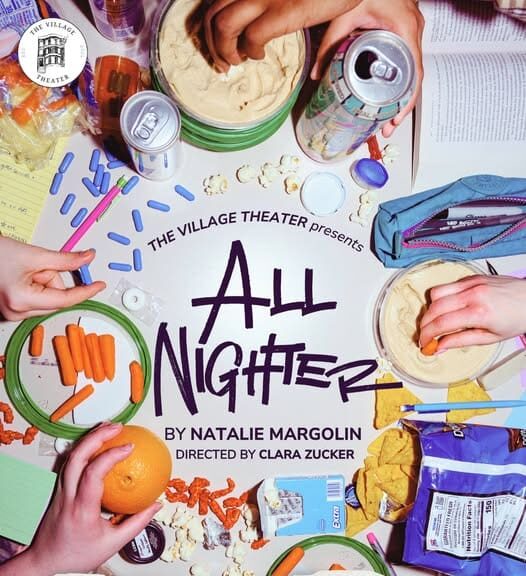
Theater Review: ALL NIGHTER (The Village Theater / Rivendell Theatre Ensemble / Chicago)
by C.J. Fernandes | July 31, 2026
in Chicago, Theater
CRAM SESSION, CRASH COURSE
Natalie Margolin’s sharply observed comedy
captures the fleeting intensity of college friendships

Emma Samuelson, Becca G Anderson, Emma Dunlop, and Mea Allen
Natalie Margolin’s All Nighter, which opened Off-Broadway in 2025, makes its Midwest premiere at Rivendell Theatre in a production from The Village Theater. The play unfolds over one long night in a study hall at a small liberal arts college in Pennsylvania.
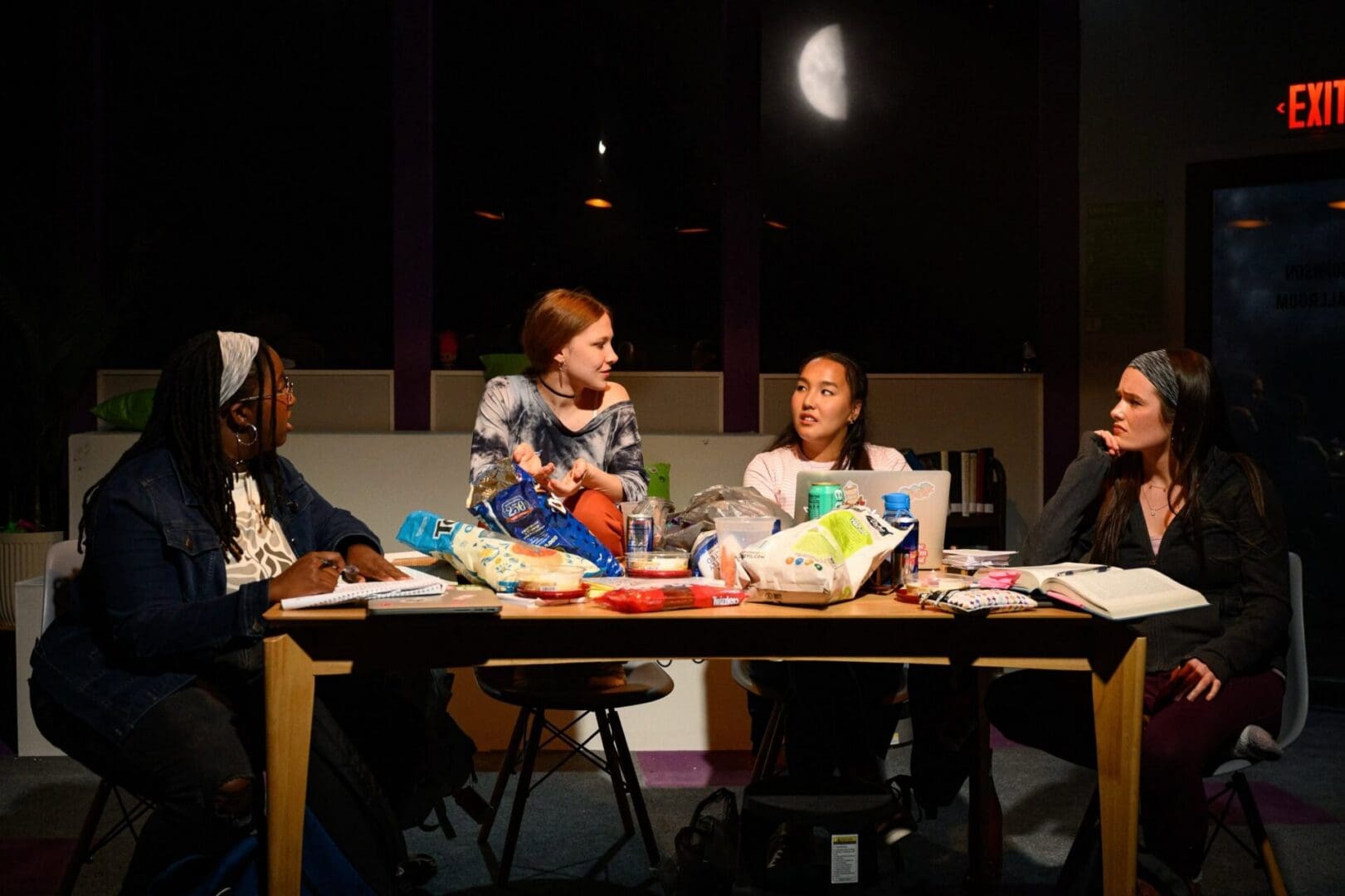
Katelyn Montgomery (scenic design) and Tina Arfaee (properties design) get the details exactly right. In the Johnson Room, a former ballroom converted into a study area, a long wooden table occupies most of the space. Uncomfortable chairs, the now-standard risers replete with brightly colored cushions, a ubiquitous bulletin board festooned with flyers, barrel cushions, and the requisite book truck complete the setup. With a single glance, one is immediately transported back to college.

Mea Allen and Naomi Zhanel Kalter
A half-moon shines through the window as Darcie (Naomi Zhanel Kalter) rushes in. Throwing an irritated glance at something in the distance, she settles at the table, pops a pill, opens her laptop, and gets to work. Darcie is awaiting the arrival of her best friends and housemates for a cram session. It’s the week before graduation, and this is expected to be the last all-nighter the four friends will ever have to endure.
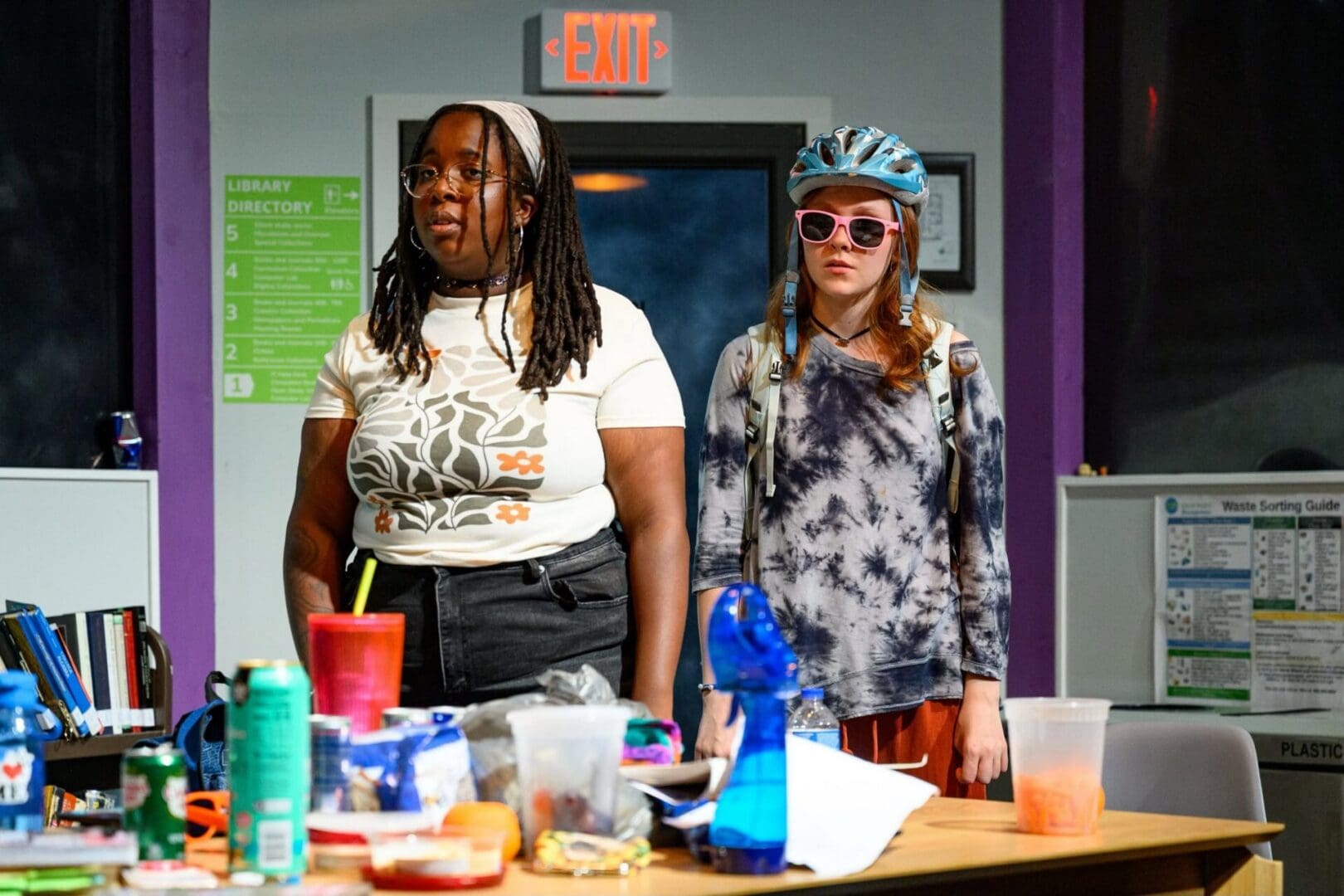
Becca G Anderson and Mea Allen
Soon, jittery and anxious Lizzy (Mea Allen), level-headed Jackie (Becca G. Anderson), and finally the stylish Tessa (Emma Samuelson) arrive, the latter bringing with her a gust of energy along with what appears to be several pounds of snacks and sweets, including multiple containers of hummus. Within minutes, the tenor of the room changes completely. This is now a chaotic study table. The chatter is nonstop, conversations begin midstream and end just as abruptly. It’s a beautifully directed and blocked sequence by Clara Zucker, establishing the relationships among the four women, their shifting loyalties, and the conflicts simmering beneath the surface. You quickly realize that All Nighter is a particular kind of play: each character fits an identifiable type, and each carries a secret destined to emerge before dawn.

Becca G Anderson, Mea Allen, Emma Samuelson, and Naomi Zhanel Kalter
That observation isn’t meant pejoratively—just descriptively. The women are alarmingly cavalier (to this late Gen-Xer, at least) about popping Adderall. Lizzy has brought enough of her prescription pills to keep all four awake through the night. There is also a fifth classmate, Wilma, played by Emma Dunlop in a delightfully deranged performance. Wilma hasn’t slept in 48 hours, is spectacularly high on…something—I forget exactly what—and repeatedly swoops into the room, dropping truth bombs, succumbing to hysterics, rushing off to commune with the moon, and generally having the time of her life.

Mea Allen
All Nighter follows a fairly predictable structure, but Margolin seems less interested in reinventing the wheel than in capturing a very specific emotional landscape. None of the evening’s revelations are particularly surprising, yet what proves intriguing is that most of them aren’t revelations to the characters themselves. These young women have lived together for four years. They know nearly everything about one another and consciously choose to overlook certain truths to preserve the fragile ecosystem of their friendship. With one notable exception, the surprises belong almost entirely to the audience. In a clever structural inversion, the secret that ultimately detonates the evening is one the audience has known almost from the beginning.
Becca G Anderson, Mea Allen, Naomi Zhanel Kalter, and Emma Samuelson
I may have described the four women using a single defining characteristic each, but that’s largely for convenience. These are beautifully wrought characters, and the actors, one and all, are superb. Wilma, of course, is the exception. She is the sort of character who exists only in plays—and in obnoxiously twee indie films—but she’s essential to All Nighter. Besides being consistently hilarious, she provides the outsider’s perspective needed to shake up the foursome. She is their friend and classmate, but crucially she is not part of the clique. That allows her to unsettle them in ways they never could themselves. I cannot say enough wonderful things about Dunlop, who is a mood-shifting force of nature. By the halfway mark, her mere entrance is enough to trigger a ripple of laughter throughout the audience.

Naomi Zhanel Kalter and Emma Samuelson
College is a strange phase in life. Barely an adult—if that—you are pulled away from home and everything familiar and thrown into an unfamiliar world surrounded by strangers who are usually just as nervous and unprepared as you are. The friendships formed there can become startlingly intimate, especially considering how ephemeral they often prove to be. Graduation sends everyone off into the “real world,” a phrase the characters return to repeatedly throughout the play. All Nighter can be frustrating in its refusal to probe more deeply into the inner lives of its four women, but as the evening unfolded, I began to wonder if that wasn’t precisely Margolin’s point. Rather than offering psychological excavation, she paints a portrait of people caught in that liminal space between childhood and adulthood.
In one angry outburst, a character exclaims, “We never have to see each other again after we graduate!”
It’s true.
And I suspect they won’t.

Becca G Anderson
Most college friendships slowly fade after graduation. People move away, begin careers, get married, have children, and forge new relationships. The texts become less frequent until they eventually stop. But those friendships are rarely forgotten. Instead, they become encased in amber—perfectly preserved. The rough edges soften, petty grievances dissolve, and the bickering fades into distant memory.
Then one evening you’ll find yourself sitting in a neighborhood bar, sipping a drink and reflecting on a play you’ve just seen, when an old face unexpectedly drifts into your thoughts. You’ll wonder how they’re doing and think, “I really should look them up.”
✦ ✦ ✦ ✦ ✦ ✦ ✦ ✦ ✦ ✦
photos by Cole Carrico
All Nighter
The Village Theater
Rivendell Theatre Ensemble, 5779 N. Ridge Ave. in Chicago
Thu–Sat 8; Sat & Sun 3
ends on August 8, 2026
for tickets ($12–$70), call 872.529.6792 or visit The Village Theater
for more shows, visit Theater in Chicago
✦ ✦ ✦ ✦ ✦ ✦ ✦ ✦ ✦ ✦
