


Areas We Cover
Categories

Theater Review: FALLING DOWN THE MOUNTAIN OF GREAT STORMS (Broad Theatre / The Rosette / Austin, TX)
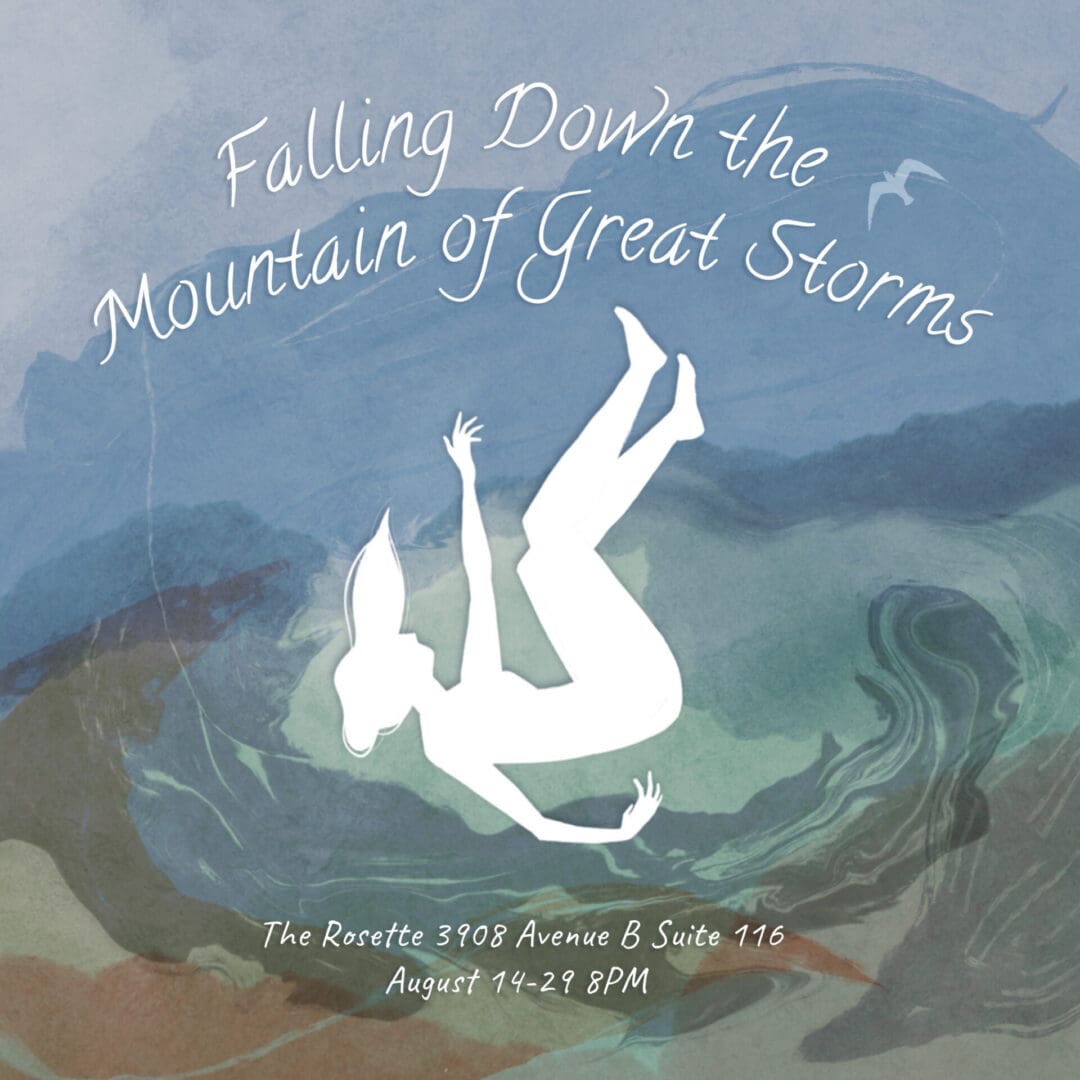
by Leo Emerson | August 15, 2026
in Texas, Theater
WHEN IT RAINS, IT POURS
An ambitious, sometimes mesmerizing
meditation on catastrophe takes big risks—
and occasionally loses its footing
Years ago, I argued with a friend over whether Cormac McCarthy was too difficult a novelist. My friend found his prose dense, confusing, and hostile, but I insisted that McCarthy was actually training us. It’s intentional that the reader doesn’t understand everything all at once, and as the reader progresses, they subconsciously adapt to McCarthy’s style. It is a technique that rewards patience.
Greg Romero brings a similarly uncompromising style to Falling Down the Mountain of Great Storms, which is making its premiere at The Rosette, presented by Broad Theatre. The play begins within the frame of an academic conference. Audra, our lead, points at a large notepad on a stand with a retractable wand, flipping through slides that relate to catastrophe. She dissects the etymology of the word—how, in Greek, catastrophe translates to “an overturning.” The tone is loose and improvisational, enabled by a sympathetic audience. However, there seems to be something wrong with Audra. She has had her own catastrophe, she says, her face contorting. Suddenly, the scene pivots as Audra jumps up on a coffee table and chants, “Earthquake, Forest Fire, Hurricane, Volcano!” accompanied by dynamic lighting and sound cues.
From that moment on, the production leans hard on raw atmosphere. The Rosette stage is tiny and ill-suited for dramatic theater. It’s meant more for intimate musical performances, like a classical Spanish guitarist. The stage design by Remy Joslin is therefore minimal: fake plants line the edges of the stage; a coffee table sits in the center; and the actors sometimes bring on folding chairs to sit in. To compensate, Mike Vernusky (sound) and Amy Lewis (lights) use an abundance of effects to complement the narrative. Simple cues like a wash of blue light for rain or the flat hum of hospital static help anchor the play in reality. Even more vital are the sound effects representing Audra’s internal anguish, such as the horn blast of a tugboat.
Audra appears to suffer from severe PTSD, which explains her transformational terror. Many scenes are punctuated by Audra having a sudden collapse as she tries to face her trauma. Romero gives no time for exposition in these moments. Instead, he blitzes the audience with different characters, settings, and moments in time. As the story builds, it becomes easier to understand the play’s complexities, with the scenes acting as a deconstruction of Audra’s memory in relation to the catastrophe that has befallen her.
Mental health sits at the very heart of the play. Audra’s mother, Lanette (Suzanne Balling), struggles with substance abuse and depression, and that generational trauma bleeds directly into Audra’s own life. Meanwhile, Audra’s love interest Barry (Adonis Anderson), a young Black man, shows signs of autism and speaks with a stutter. Yet the thematic purpose of these traits remains vague. Scenes grow tedious and repetitive as the narrative retreads the same emotional ground. Romero’s writing can feel emotionally flat, relying on humor to smooth over the play’s more indigestible moments.
Where the play does succeed is in its more surreal moments. Intertwined with the human drama of Audra, Lanette, and Barry is the animal drama of Hedgehog (Delan Crawford), Fox (Jude Jecker), and the Herons (Lisa Kobdish and Samantha Plumb). Not only is their inclusion visually interesting, but emotionally the animals add a frenetic and enigmatic complexity. Although Romero uses them as metaphors, they aren’t confined by those metaphors. Kobdish and Plumb, a heron mother-and-chick pair, contrasts with the mother-daughter combo of Audra and Lanette. Their scenes feature Kelly Hasandras & Olivia O’Hare‘s balletic movement as they stride across the stage in long steps. Combined with Lewis’s superb lighting, Jenny Rosario‘s animal costumes, and dazzling makeup, Kobdish appears otherworldly. I was transfixed by her appearance as she stood in a bluish spotlight, her plumage ruffling and her makeup dazzling.
Likewise, Jecker and Crawford deliver solid performances. Jecker in particular has a “fuck you” attitude to being onstage that delights.
Stier struggles in the lead role of Audra. Although she brings high energy and a complete commitment to the material, she fails to channel that energy into a precise characterization. She appears even less assured alongside acting veteran Balling, who commands the stage with ease as Lanette, making their mother-daughter dynamic feel uneven because Balling is so much more present. Balling’s delivery of the “Skywomen” monologue is a highlight of the production, as is her ability to convey the apathetic misery of a woman who has only known suffering. Stier recovers some ground in her comedic moments, showing sweet and awkward chemistry with Anderson, who does well as the awkward Barry, but he is limited by a script that doesn’t ask much of him.
Despite these strong individual moments, the production suffers from its pacing. Opening night clocks in at an hour and forty-five minutes, which is reasonable on paper, yet feels much longer. Director Molly Fonseca allows the actors far too much leeway in their choices. Many scenes are mired in actorly pauses or a slow delivery that hinders an audience doing its best to stay attentive to an already demanding play.
In the end, Falling Down the Mountain of Great Storms operates much like memory itself: fragmented, intense, and occasionally exhausting. Like the McCarthy novels I once defended, Romero’s play asks us to be patient with its disorientation and learn its language as we go. The difference is that the patience isn’t always rewarded. While the production could benefit from a tighter directorial hand and deeper character development, its mesmerizing visual moments and several standout performances keep it anchored. It is a bold, original work that isn’t afraid to stumble in pursuit of something real, and theatergoers who appreciate ambitious local work will find plenty to admire.
✦ ✦ ✦ ✦ ✦ ✦ ✦ ✦ ✦ ✦
Falling Down the Mountain of Great Storms
Broad Theatre
The Rosette, 3908 Avenue B, Suite 116 in Austin
Thu.–Sat. 8
ends on August 29, 2026
1 hour and 45 minutes, no intermission
recommended for ages 13+
for tickets, visit Broad Theatre
✦ ✦ ✦ ✦ ✦ ✦ ✦ ✦ ✦ ✦
