


Areas We Cover
Categories

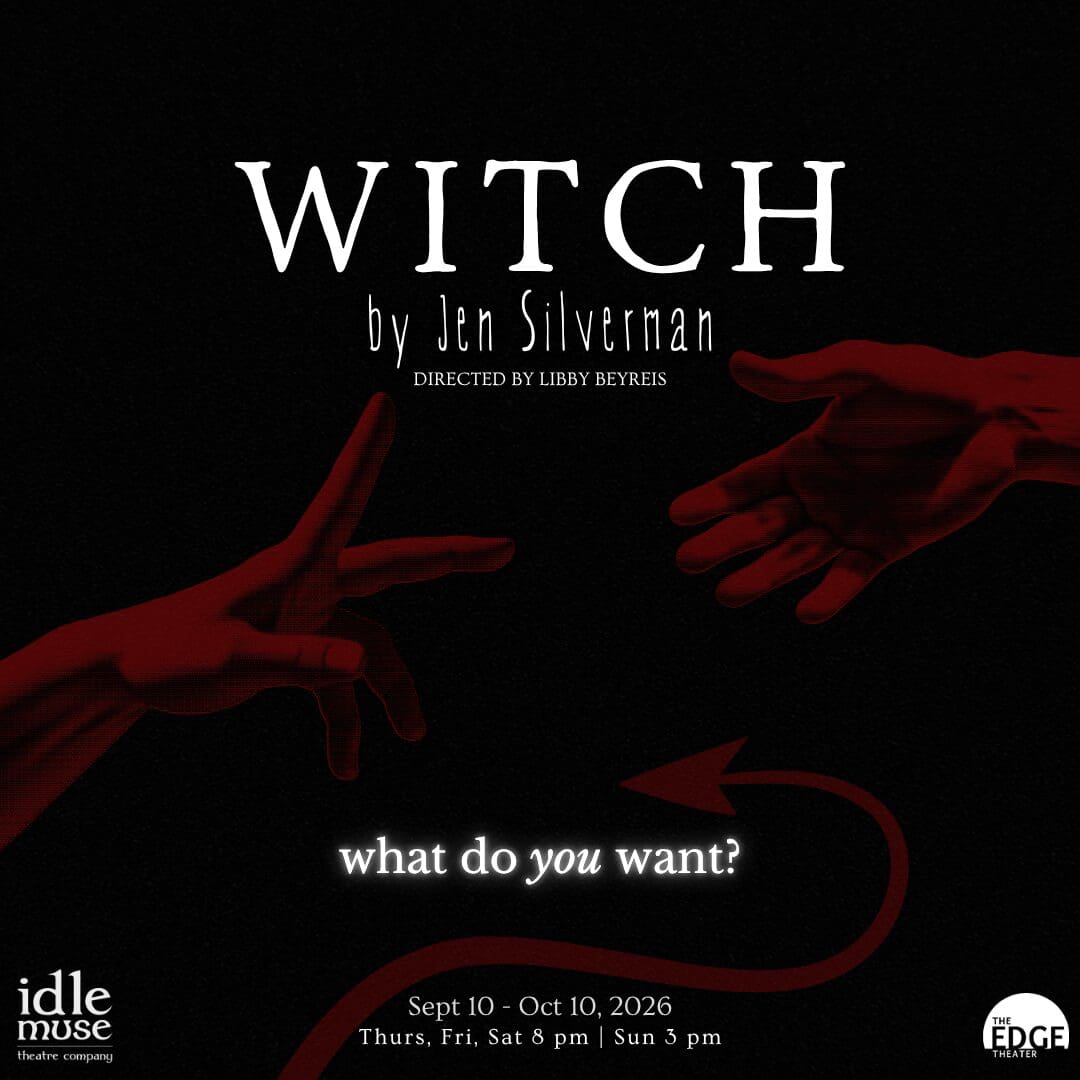
Theater Review: WITCH (Idle Muse / Chicago)
by C.J. Fernandes | September 15, 2026
in Chicago, Theater
SCRATCH IT
Silverman’s Jacobean reworking is
hilarious, dark, and exhilarating

Mara Kovacevic and Nathaniel Kohlmeier
How does one determine if an adaptation is a success? Does it require rigorous fidelity to the source material? What if it honors the spirit of the material but not its text? Or what if it just uses the bare bones of its source as a springboard for exploration?
Full disclosure: until the conclusion of its opening monologue, I was completely unaware that Jen Silverman’s Witch was a reworking of the seventeenth-century Jacobean drama The Witch of Edmonton by William Rowley, Thomas Dekker, and John Ford. The fiery declaration that gave it away made me sit up, but it also made me a little nervous. Where would this fall on the adaptation spectrum?

Cameron Austin Brown and Nathaniel Kohlmeier
That monologue is delivered by Elizabeth (a superb Mara Kovacevic), perched on a stool in a set that elegantly transitions from a lonely hut to a castle dining room by simply changing the flooring from stone to wood. I don’t know what it is about the fairly standard black box stage at The Edge Off-Broadway, but it seems to inspire set designers. Laura J. Wiley, who also handles the lighting and projection design, does a remarkable job here with all three commissions, creating stunning moods, using patterns of light through window panes to indicate the shifting time of day in the castle, while in the space occupied by Elizabeth’s hut, the light is meager but warm.

Xavier Lagunas and Stephen Dunn
Continuing the 20th anniversary season of Idle Muse, Witch is split into two narratives that intersect only slightly. Old Scratch, otherwise known as the devil – the small “d” is important here – has chosen the village of Edmonton as his latest venue in which to harvest souls. Only there’s nothing “old” about Scratch (Nathaniel Kohlmeier) here; this Scratch is a young, handsome, thoroughly charming and witty man. He first shows up at the castle and sets his sights on Cuddy (Cameron Austin Brown). Cuddy is the only son of Sir Arthur (Stephen Dunn), an old-school manly man who despairs that his sensitive, Morris-dancing son will ever produce an heir. Cuddy doesn’t seem to prefer the company of too many women, although he insists to Scratch that the winsome maid Winnifred (Caty Gordon) is drawn to him. Scratch informs him, with barely concealed glee, that Winnifred is already married in secret to Frank Thorney (Xavier Lagunas), a handsome, virile man picked out of poverty by Sir Arthur and installed in the castle. The mere mention of Frank sends Cuddy into a rage. He promises his soul to Scratch in exchange for the death of Frank, Sir Arthur’s surrogate son.

Xavier Lagunas and Caty Gordo
Scratch waylays Frank, who has his heart set on becoming Sir Arthur’s heir, his secret wife be damned. Frank requires considerably less persuading to part with his soul, and flush with success, Scratch then bounds off to the hut of Elizabeth. Elizabeth is already thought of by the village as a witch and an evil influence. She’ll be easy, he thinks. Only Elizabeth has no desire to barter her soul to Scratch and tells him so in no uncertain terms. Scratch is stunned into silence. No one has ever said no to him before. He has no idea what to do.
Director Libby Beyreis skillfully manages both these plot lines. The pace is assured, and the two hours just fly by. There are a couple of stunning fight sequences, impressively choreographed by Richard Gilbert and Vic Bayona; the latter sequence is intense enough that the entire audience flinched as one, multiple times. But where she excels is with her direction of the actors, who are uniformly excellent. The script is uncommonly generous, giving every member of the cast opportunities to shine. Gordon’s Winnifred doesn’t get to let loose until well into the play, but she carries the weight and frustrations of her character in the way she moves, often to hilarious effect. Lagunas is excellent as a man whose ambition overrides his conscience, and Dunn’s Sir Arthur — the true, albeit inadvertent, villain — is heartbreaking as a man who forgoes the son he has in favor of the one he wants. But the heart of the play belongs to Austin Brown. Brown’s Cuddy is initially presented as comic relief — the character is a fool and a yokel in the original text — but as the story moves along, Cuddy slowly morphs into a tragic figure, and Austin Brown is outstanding, managing to pivot between broad humor, anger, lust, and misery within the same scene without ever seeming forced.

Xavier Lagunas and Cameron Austin Brown
If Cuddy is the heart of the play, Elizabeth and Scratch are its brains. Kovacevic and Kohlmeier have incredible chemistry, and the performances are perfectly calibrated to each other. In marked contrast to the plot complications in the castle, all Elizabeth and Scratch do is talk. Fascinated by this headstrong woman who has bested him intellectually, Scratch cannot get enough of her company. The stories stay mostly separated until the last scene of the play when, with a beautiful piece of writing, Silverman ties them together, not just narratively but thematically as well.

Cameron Austin Brown and Xavier Lagunas
Here we come back to the subject of adaptations. Silverman has updated the language of the play to the contemporary but retained the setting. Extraneous characters have been eliminated and the plots simplified. The humor quotient has been upped considerably. Despite its grim subject matter, Witch is absolutely hilarious, mostly courtesy of Kohlmeier’s preening devil and Austin Brown’s bumbling Morris dancer. But where this adaptation truly shines is in the universality of its themes. Silverman has taken the bones of a classic play, one that is inexorably tied to a specific time and place, and liberated it from the confines of its context. With a few judicious edits, the conversations in this play could have happened last week, and they’ll likely happen in some variation in the week after, and the one after. And yet, they are still not out of place in seventeenth-century rural England. It’s an astonishing piece of literary construction.
Witch ends on a dark, pessimistic note. How could it not? It’s a Jacobean drama, after all. But darkness notwithstanding, when I walked out of the theatre into the fug of a Chicago summer night, I was fairly high-stepping with exhilaration.
✦ ✦ ✦ ✦ ✦ ✦ ✦ ✦ ✦ ✦
photos by Steven Townshend
Witch
Idle Muse Theatre Company
The Edge Off-Broadway Theater, 1133 W. Catalpa Ave. in Chicago
Thurs.–Sat. 8; Sun. 3
ends on Oct. 10, 2026
2 hours, including intermission
for tickets ($20–$30), call 773.340.9438 or visit Idle Muse Theatre Company
for more shows, visit Theatre in Chicago
✦ ✦ ✦ ✦ ✦ ✦ ✦ ✦ ✦ ✦
