


Areas We Cover
Categories

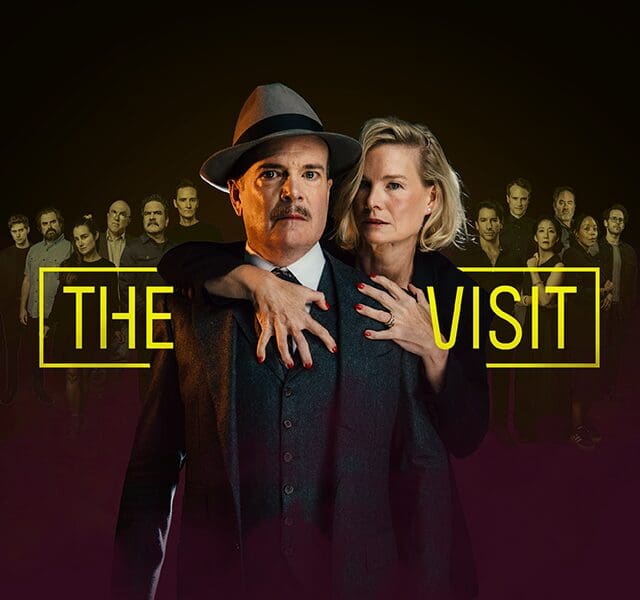
Theater Review: THE VISIT (Pasadena Playhouse)
by Michael M. Landman-Karny | September 17, 2026
in Los Angeles, Theater
A TOWN LEARNS WHAT IT’S WORTH
Darko Tresnjak’s blistering production watches
Güllen purchase its way toward murder
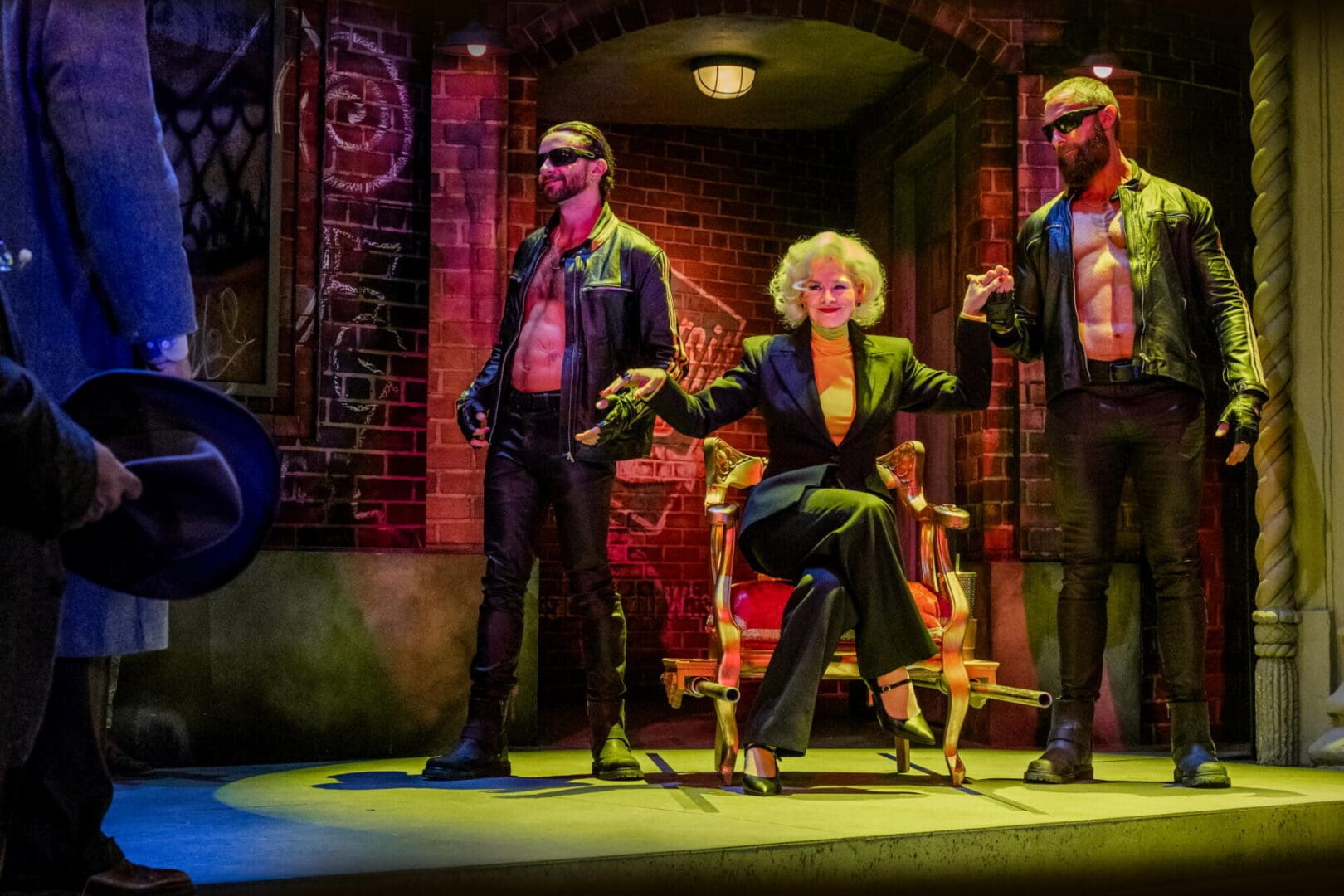
Danny Cron, Melinda Page Hamilton and Will Pellegrini
When the Burgomaster (mayor) of Güllen rises in his most solemn civic register and declares that his town would rather starve than have blood on its hands, Claire Zachanassian lets the speech hang. The richest woman in the world thanks him, studies him for a long moment, and says, “I can wait.” Then she leaves.
That line drives Friedrich Dürrenmatt’s 1956 masterpiece. Pasadena Playhouse gives the play a West Coast premiere alive to its cruelty and comedy in equal measure. Darko Tresnjak directs, with Jefferson Mays as Anton Schill and Melinda Page Hamilton as Claire, reuniting much of the team behind last season’s Amadeus. The Visit is the theatrical event of the Playhouse’s season.
Claire has returned to her impoverished hometown a billionaire. She offers Güllen one billion Swiss francs on a single condition: someone must kill Schill. He is the shopkeeper who got her pregnant as a teenager, denied it in court, and bribed two witnesses to swear otherwise. The town drove her out to a life in the brothels of Hamburg. Dürrenmatt reveals the destination in the first act and dares us to watch the journey. His subject is the language a civilized community develops to excuse an immoral act. Claire understands that before anyone in Güllen. She need only create the economic conditions under which the town persuades itself.
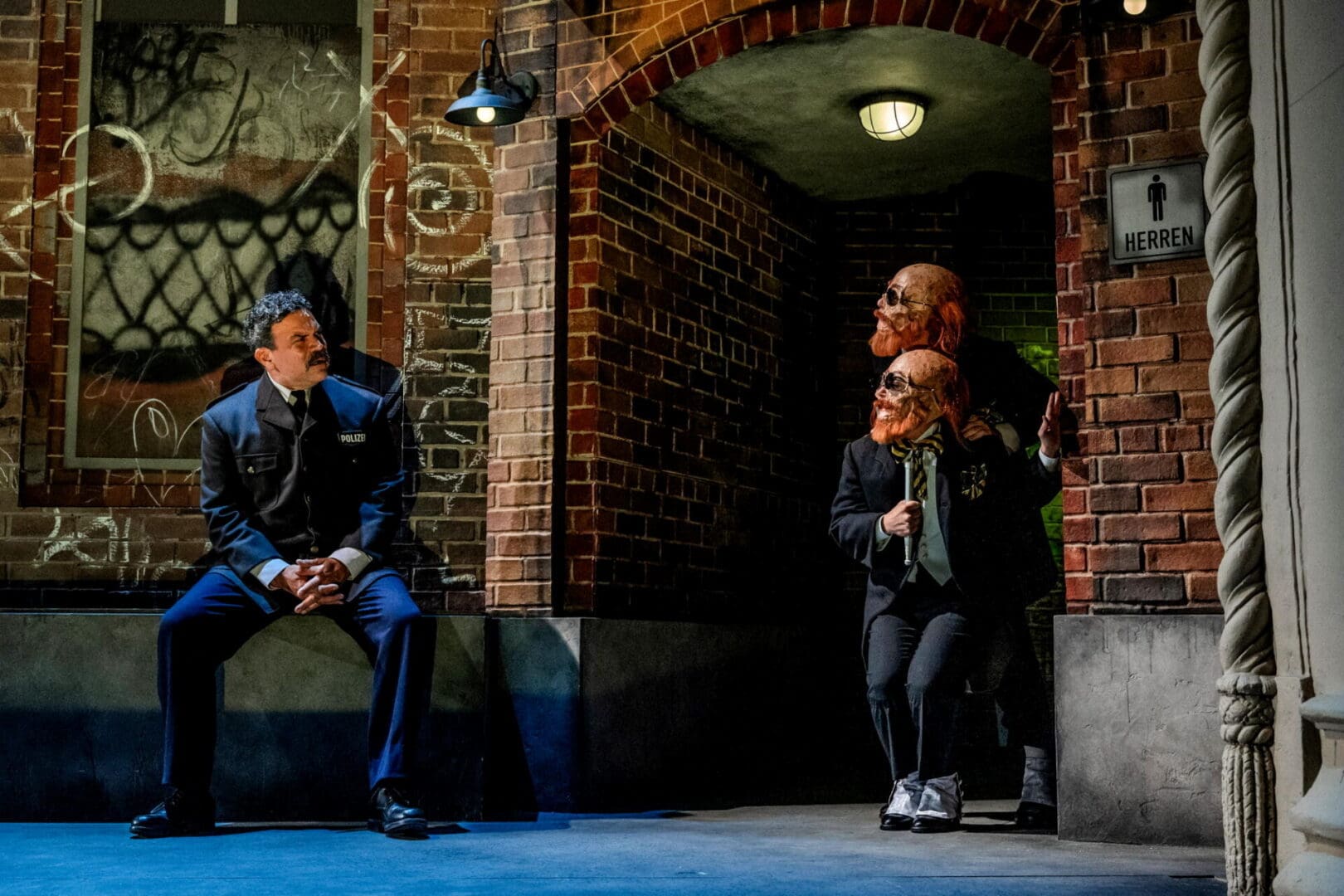
Ricardo Chavira, Lauren Worsham and Jake Levy
Dürrenmatt builds that persuasion out of consumer goods. There is no conspiracy. Schill’s regulars simply start buying better milk, then white bread, cognac, and new yellow shoes, all on credit he is expected to extend. Every purchase is a vote nobody has cast out loud. When the town finally raises its hands on camera for a live television broadcast, the decision has already been made in installments at Schill’s own counter. A fuse blows mid-vote, the lights die, and the Burgomaster restages the ceremony for the tv cameras. Tresnjak tracks the arithmetic with total clarity. Threadbare costumes give way to fur coats and sports jackets. By the final image, the ruined railway station glows with neon and garlands. Prosperity has arrived on schedule, priced at one human life.
Tresnjak trusts the text, and the production is strongest when he does. His additions sometimes strain. The club music scoring Claire’s bodybuilder guards is funny once and mechanical thereafter. Some of the ensemble’s campier readings work early but wear thin by the third act. Contemporary technology and media eventually clutter a transformation that the actors and design have already made plain. These are small faults in a production this sharp, but Dürrenmatt’s script gives every flourish a high bar to clear.
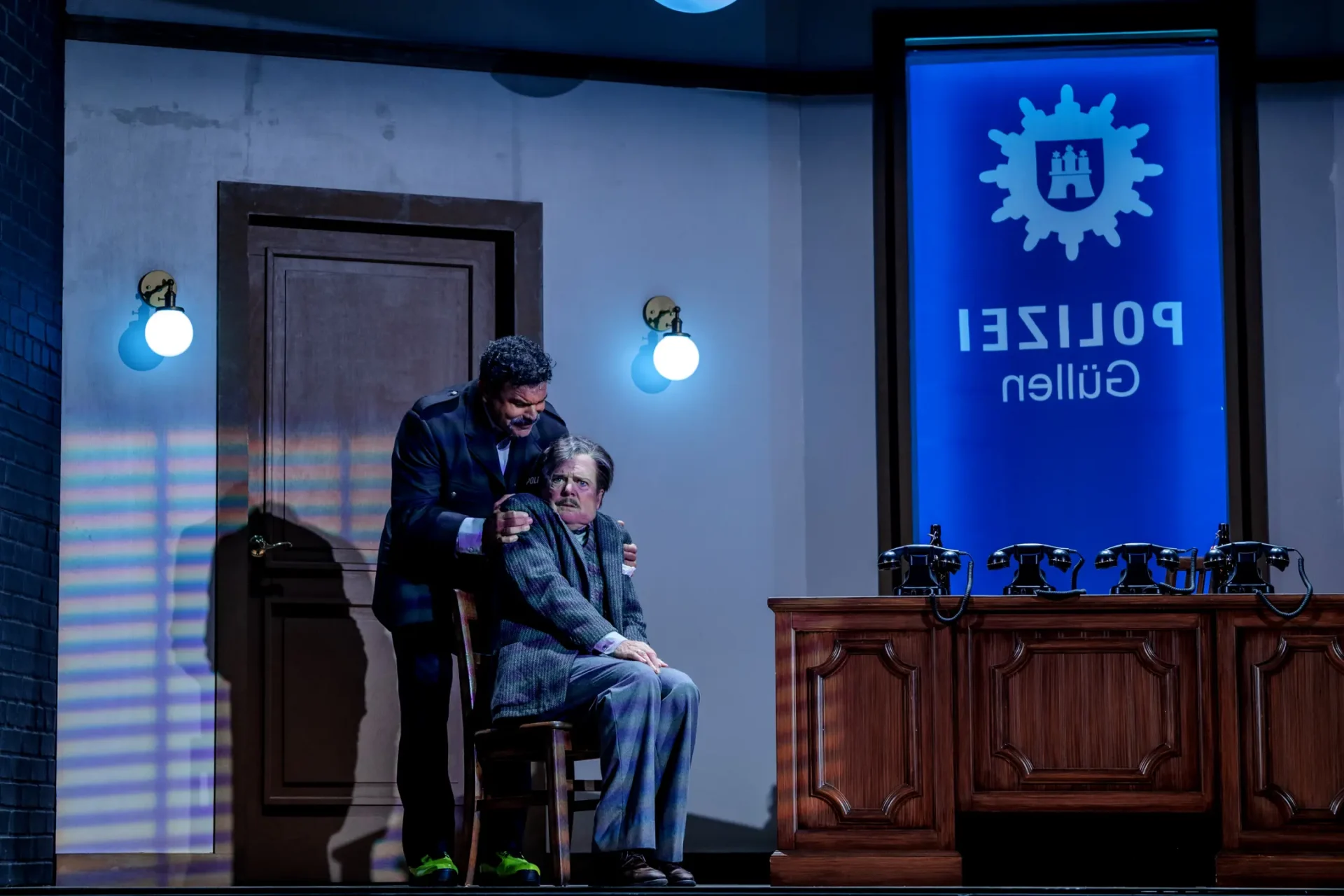
Ricardo Chavira and Jefferson Mays
Alexander Dodge‘s scenic design makes the town’s corruption visible. Güllen opens as a ruin, its railway station too dilapidated for the express to stop, then rebuilds itself before us into something gleaming and false. Aaron Rhyne‘s projections and Matthew Richards‘ lighting move from grey rot to a garish, almost radioactive prosperity. Jonathan Burke‘s sound follows the same course, thin under poverty and brasher once the money arrives. Tresnjak stages the play without intermission, a choice that pays off structurally. An express train refuses to stop in Güllen at the opening. From there, the production runs without pause toward Schill’s death.
Mays gives Schill an extraordinary arc in a single sitting. He begins as a boastful, self-satisfied shopkeeper certain he can charm his way out of the past. He curdles into paranoia as his neighbors’ new shoes and radios tell him what is coming. By the third act, he has reached something close to moral clarity. Schill stops lying just as everyone around him learns how. Mays builds the performance through restraint, and the result surpasses even his Salieri.
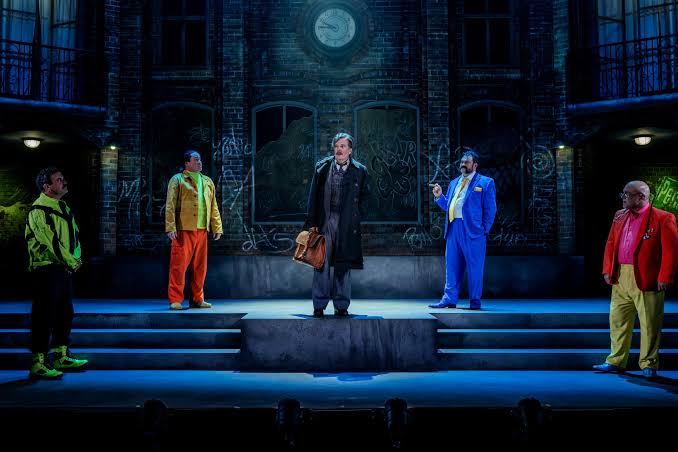
Ricardo Chavira, Adrian LaTourelle, Jefferson Mays, John Lavelle and Matthew Henerson
Hamilton’s Claire is granite with one crack in it. She is unrelenting in the tribunal scenes, dispensing wealth and cruelty from the same flat register. Tresnjak gives her one reprieve: the first-act scene under the tree where Schill once carved a heart into the bark, echoed by the third-act return to the forest. Claire tells Schill about their daughter, Genevieve. She saw the child only once at birth and learned of her death from meningitis in a letter signed by officials whose names she no longer remembers. She cannot even recall the color of the baby’s hair. Hamilton plays that uncertainty as grief. For a moment, Claire’s revenge looks less like appetite than bereavement.
The town falls apart institution by institution, and Tresnjak’s ensemble makes each failure specific. Ricardo Chavira’s Policeman hides behind procedure until he levels a rifle at Schill under the pretext of hunting an escaped panther. John Lavelle’s Burgomaster trades civic pride for a loaded gun he insists Schill use on himself, for everyone’s sake. Matthew Patrick Davis‘s Pastor arrives with his own weapon already strapped on and sends Schill away with a blessing that functions as an eviction. Christian Barillas‘s Teacher gets drunk on the town’s behalf and confesses that he can feel himself becoming a murderer. Sobered up for the town meeting, he delivers the play’s ugliest speech, framing the killing as a defense of “the principles which form the soul of our Western culture.” The actors never reach for villainy. Each character searches for words that will preserve a decent opinion of himself.
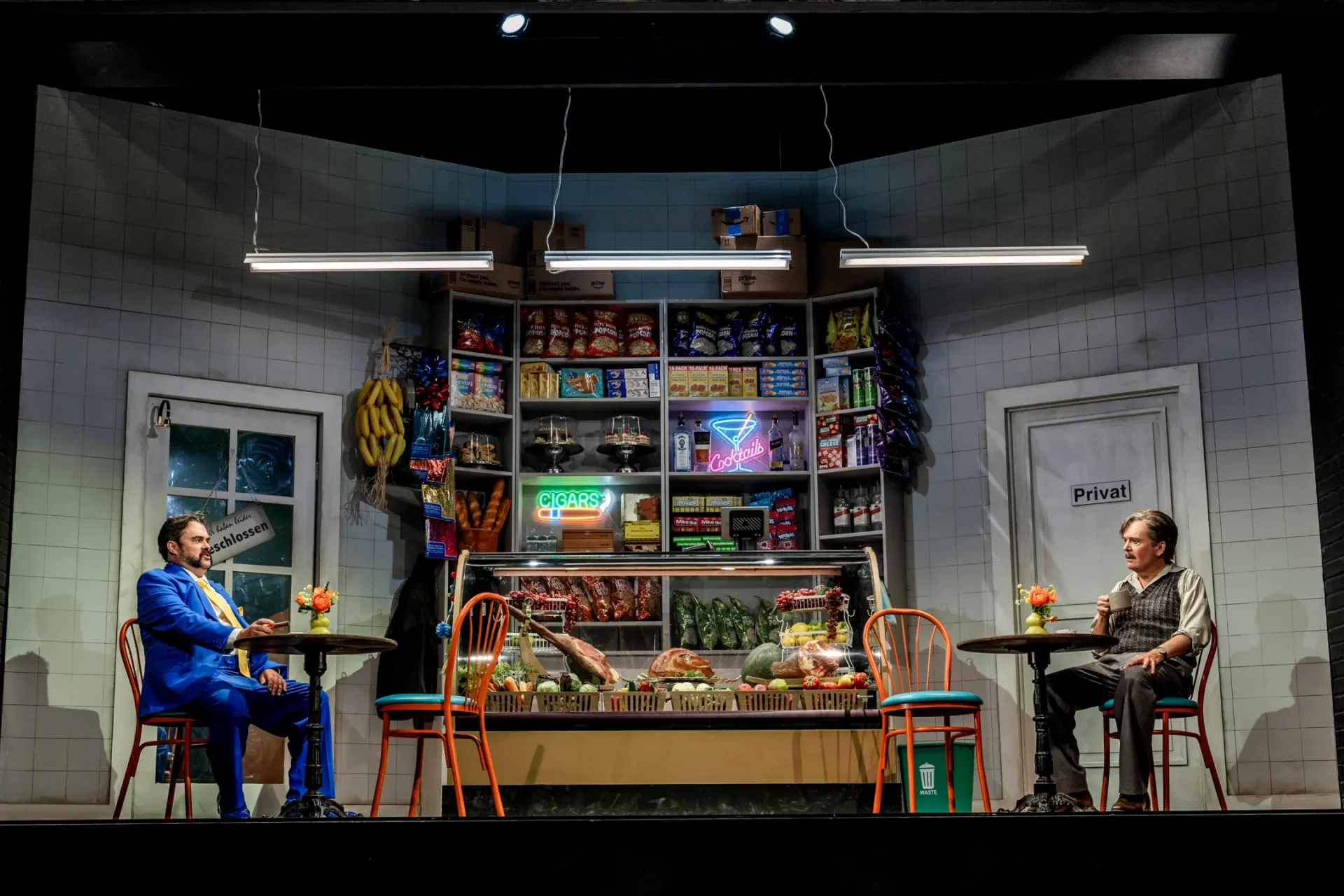
John Lavelle and Jefferson Mays
Maurice Valency‘s English adaptation deserves attention. Dürrenmatt titled the play Der Besuch der alten Dame, literally The Visit of the Old Lady. The German carries a fairy-tale weight: the old woman, the witch, returning fate. Claire arrives as an archetype before she speaks. Valency’s cleaner, more ominous title shifts the emphasis from the woman to the event, sacrificing some of that folklore. He also renamed the victim from Alfred Ill to Anton Schill. The printed script calls the piece “A Drama in Three Acts” and drops Dürrenmatt’s own genre marker, “tragische Komödie,” or tragic comedy. That phrase tells a German audience to laugh at what should horrify it. Tresnjak restores the instruction. The early laughter is part of the trap.
Güllen has no fixed nationality onstage. Dürrenmatt wrote the play in 1955, a decade after formally neutral Switzerland emerged from the war with its factories, rail lines, and reputation for probity intact. Its banks had done business with the Reich, and its border guards had turned away refugees, including Jews fleeing extermination. Prosperity followed. Dürrenmatt’s biographer Peter Rüedi called the play a study in the birth of general prosperity from collectively repressed guilt. Güllen’s journey from ruin to neon, purchased through one convenient silence, follows that history closely. Dürrenmatt left the country unnamed and built a machine that could run wherever the play was seen.
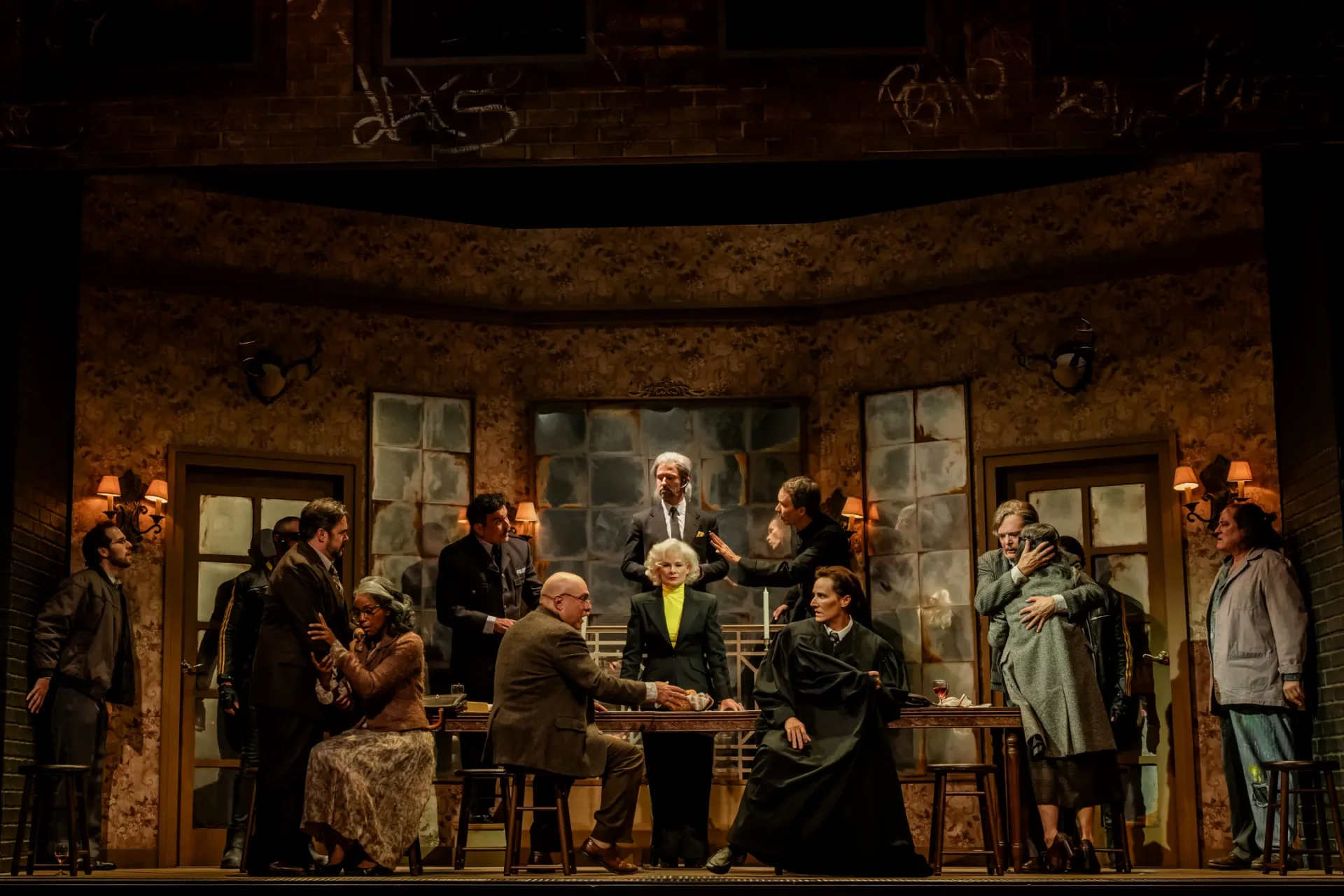
Melinda Page Hamilton, Jefferson Mays and ensemble
Broadway has not seen a major revival since Roundabout’s 1992 production with Jane Alexander and Harris Yulin. Peter Brook’s original 1958 staging for Alfred Lunt and Lynn Fontanne remains the play’s American landmark. Mays has cited the enormous cast and bleak view of humanity as reasons for its rarity. Pasadena’s seventeen actors (reduced from the original 32) make both feel necessary.
By the end, a doctor calls Schill’s death heart failure. The Burgomaster calls it dying of joy, and the town repeats the phrase in unison, like a hymn it already knows. Nobody in Güllen has to admit to murder. The town has already found the words that make it something else.
✦ ✦ ✦ ✦ ✦ ✦ ✦ ✦ ✦ ✦
photos by Jeff Lorch
The Visit
Pasadena Playhouse, 39 S. El Molino Ave. in Pasadena
105 minutes, no intermission
ends on October 4, 2026
for tickets (starting at $48), call 626.356.7529 or visit Pasadena Playhouse
for more shows, visit Theatre in LA
✦ ✦ ✦ ✦ ✦ ✦ ✦ ✦ ✦ ✦
