


Areas We Cover
Categories

Theater Review: FRIDA…A SELF PORTRAIT (Shakespeare Theatre Company / Washington, DC)

by Barbara Papendorp | October 14, 2026
in D.C.
(Maryland / Virginia), Theater
FRIDA’S ART COMES TO LIFE
Vanessa Severo transforms clothing,
movement, and memory into an inventive
and deeply affecting portrait of Frida Kahlo

Vanessa Severo
Frida Kahlo’s self-portraits reveal a woman who refused to separate her art from the physical pain, emotional turmoil, and fierce individuality that defined her life. In Frida…A Self Portrait, written and performed by Vanessa Severo, Kahlo’s world becomes an inventive theatrical experience that blends biography, balletic movement, and imaginative storytelling.
What I found most compelling was the production’s ability to convey emotion through physical imagery rather than relying solely on words. Running a swift 90 minutes without intermission, the performance moves continuously through Kahlo’s memories, relationships, and inner landscape. Its dreamlike quality allows visual images to accumulate, inviting the audience to feel its way through the artist’s life rather than simply follow a chronological account.
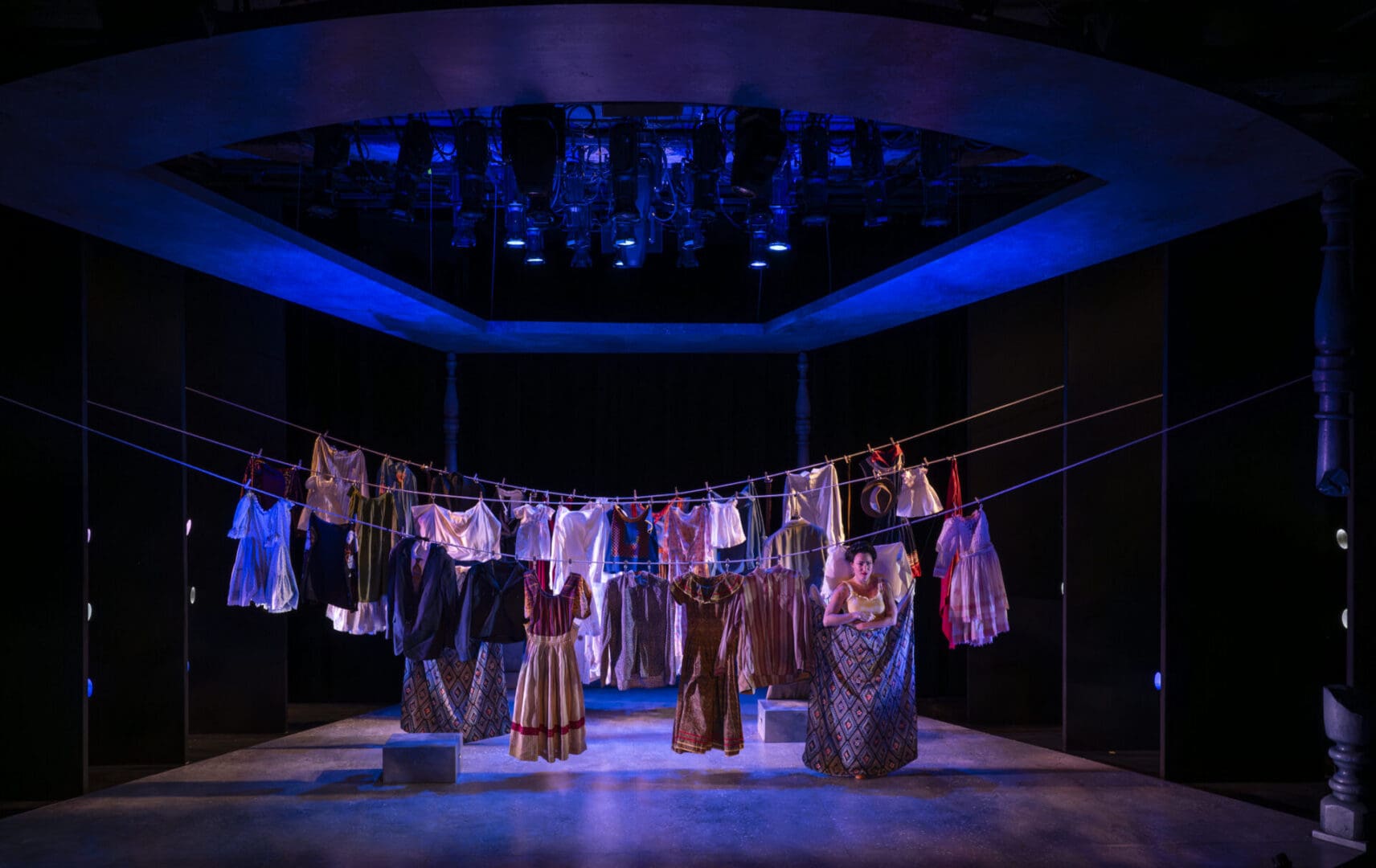
The stark scenic design by Jacqueline Penrod establishes an atmosphere of vulnerability. Deconstructed bed frames occupy the stage, suggesting both a place of rest and the confinement of a body in pain. Three clotheslines strung with sheets, dresses, and suits become much more than background decoration. Used with dramatic effectiveness, they serve as barriers, backdrops, and the raw materials of Severo’s extraordinary physical storytelling.
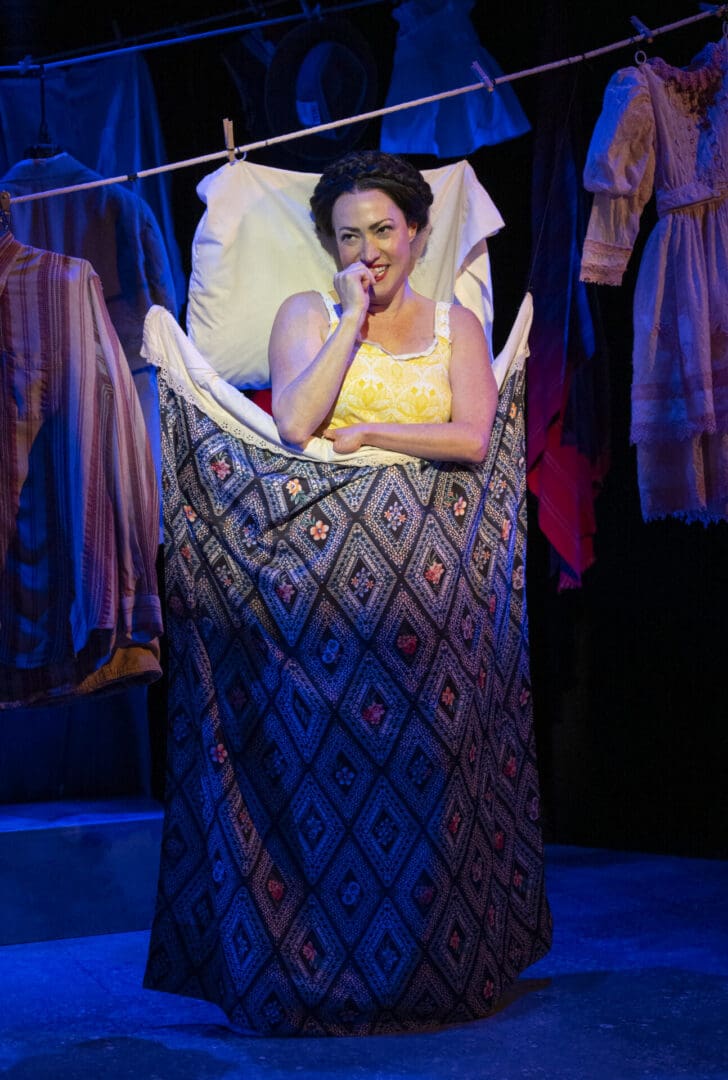
Severo moves with a fluidity that is often dance-like, almost balletic. She shifts between characters and emotional states with expressive precision, allowing gesture and movement to carry meaning that dialogue alone might not convey. I was particularly struck by the transformation of ordinary clothing into puppetry. A dress or suit becomes an animated presence, suggesting a person, a memory, or an emotion that remains just beyond reach. The effect is both whimsical and haunting.
One image stands out: Frida being embraced by Diego’s suit jacket. With no need for a literal representation of Rivera, the garment itself becomes an intimate theatrical partner, enveloping her in the presence of the man who was both her great love and a source of profound heartache. I found this moment especially moving. The jacket becomes more than an article of clothing; it embodies the complicated intimacy of a relationship that continues to shape a person long after its most immediate moments have passed.
Vanessa Severo
The Portuguese word saudade comes to mind—a bittersweet longing for someone or something absent, in which love and loss remain intertwined. For me, this image captures the emotional heart of the production. The clothing puppetry gives physical form to memory, allowing absence itself to become present onstage. There is a tenderness in the embrace, but also an ache: the recognition that love can comfort us even as it reminds us of what hurts.
This imaginative approach feels especially appropriate for Kahlo, whose paintings transformed personal suffering into startling visual landscapes. Yet she was never defined by pain alone. Her humor, sexuality, political convictions, and determination to control her own image were equally central to her identity. Severo reaches beyond the familiar icon—the penetrating gaze, distinctive eyebrows, and elaborate traditional Mexican dress—to suggest the complicated woman behind the image.
The remaining design elements support this sinuous theatrical world. Katherine Davis’s costume design provides the garments that become central to Severo’s transformations, while Rachel Cady’s lighting shapes the shifting moods and Thomas Dixon’s sound design and composition deepen the emotional atmosphere. Under Joanie Schultz’s direction, the production demonstrates how a spare set and a handful of everyday objects can generate a remarkably rich theatrical vocabulary.
For me, the production’s greatest strength lies in these moments when physical invention and emotional truth converge. The balletic movement, the animated garments, and especially the embrace of Diego’s jacket make Kahlo’s inner life tangible without attempting to reproduce her paintings literally. The result is a portrait that is playful in its theatrical imagination and haunting in its understanding of love, loss, and memory.
What lingers is saudade—that bittersweet longing for what is lost yet never entirely absent. Through Severo’s inventive use of clothing and movement, memories take shape, emotions find expression, and the presence of someone gone can fill a stage. In this evocative portrait of Frida Kahlo, art becomes more than a reflection of life; it gives lasting form to the love, longing, and memories that continue to inhabit us.
Vanessa Severo
✦ ✦ ✦ ✦ ✦ ✦ ✦ ✦ ✦ ✦
photos by Michael Brosilow
Frida…A Self Portrait
Shakespeare Theatre Company
Klein Theatre, 450 7th St NW in Washington, DC
100 minutes, no intermission
ends on November 8, 2026
for tickets, visit STC
for more shows, visit Theater in DC
✦ ✦ ✦ ✦ ✦ ✦ ✦ ✦ ✦ ✦
