


Areas We Cover
Categories

Theater Review: HEARTBREAK HOUSE (Antaeus Theatre Company / Glendale)

by Michael M. Landman-Karny | October 26, 2026
in Los Angeles, Theater
A HOUSE NOT QUITE
WORTH LOSING
Antaeus assembles a superb cast for Shaw’s comedy
of a doomed society, but the production lacks the
grandeur and dread to make its downfall devastating
In 1920 the Theatre Guild asked George Bernard Shaw for the rights to revive The Devil’s Disciple. He offered them the premiere of Heartbreak House instead, with a warning: the play would hold an audience for three hours and “send them home exhausted but impressed.” Shaw was in his sixties and famous on two continents. His last play before the war had been Pygmalion. This one came slowly, most of it written in 1916 with the war on. He subtitled it “A Fantasia in the Russian Manner on English Themes.” The Russian was Chekhov. Shaw borrowed the charming, doomed household of The Cherry Orchard and gave up Chekhov’s detachment. His preface names the target: “cultured, leisured Europe before the war.” That meant his own audience, the people who bought tickets to his comedies. He even put himself onstage as Captain Shotover, the half-mad old inventor who sees the wreck coming and says so to people who aren’t listening. The Guild production ran 125 performances. Orson Welles played Shotover in 1938, at twenty-two.
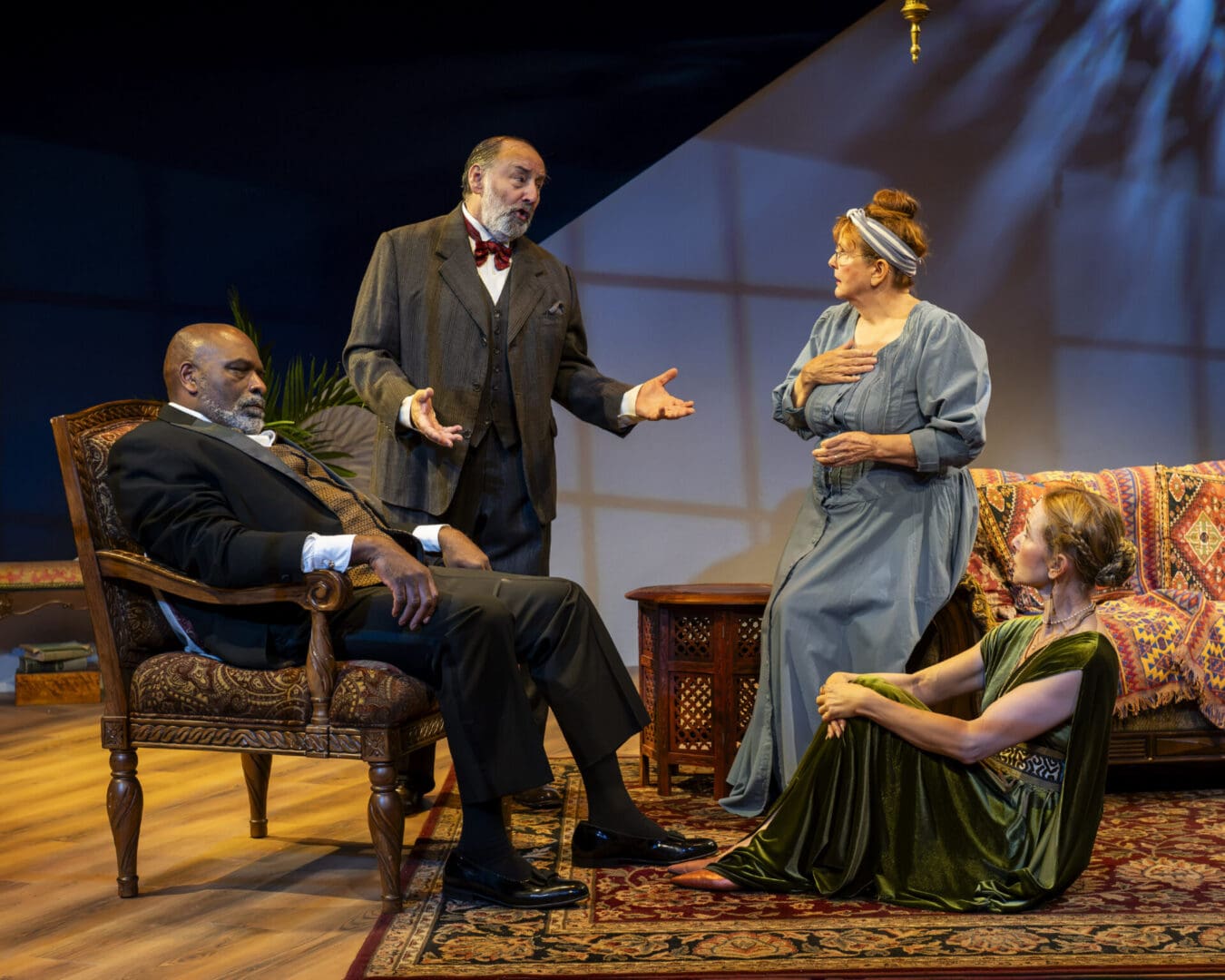
Bernard K. Addison, Arye Gross, Amelia White, Jocelyn Towne
Captain Shotover built his house to look like a ship. Shaw’s stage directions call for a drawing room shaped like the stern of an old sailing vessel, its windows opening onto the Sussex hills. Everyone aboard is adrift, and the captain is eighty-eight. The household is clever and well read, and too busy with love affairs and bruised vanity to look out the window. Nike Doukas, Antaeus’s artistic director, keeps them in Edwardian England. We know what is coming. They don’t. Doukas trusts that gap to carry the irony, and she has cast the play superbly. She has not given them a house worth losing.
Angela Balogh Calin’s scenic design gets the ship and misses the money. Sail-shaped walls curve around the stage, a model ship sits on display, and patterned rugs and hanging lamps fill out the nautical theme. Nothing tells us what these people own. Ownership is Shaw’s whole charge against them. Their idleness is expensive, and the room should show the bill. Calin’s set is serviceable and sometimes handsome. It is also modest, and a play about a class sleepwalking toward catastrophe needs us to see what that class is about to forfeit.
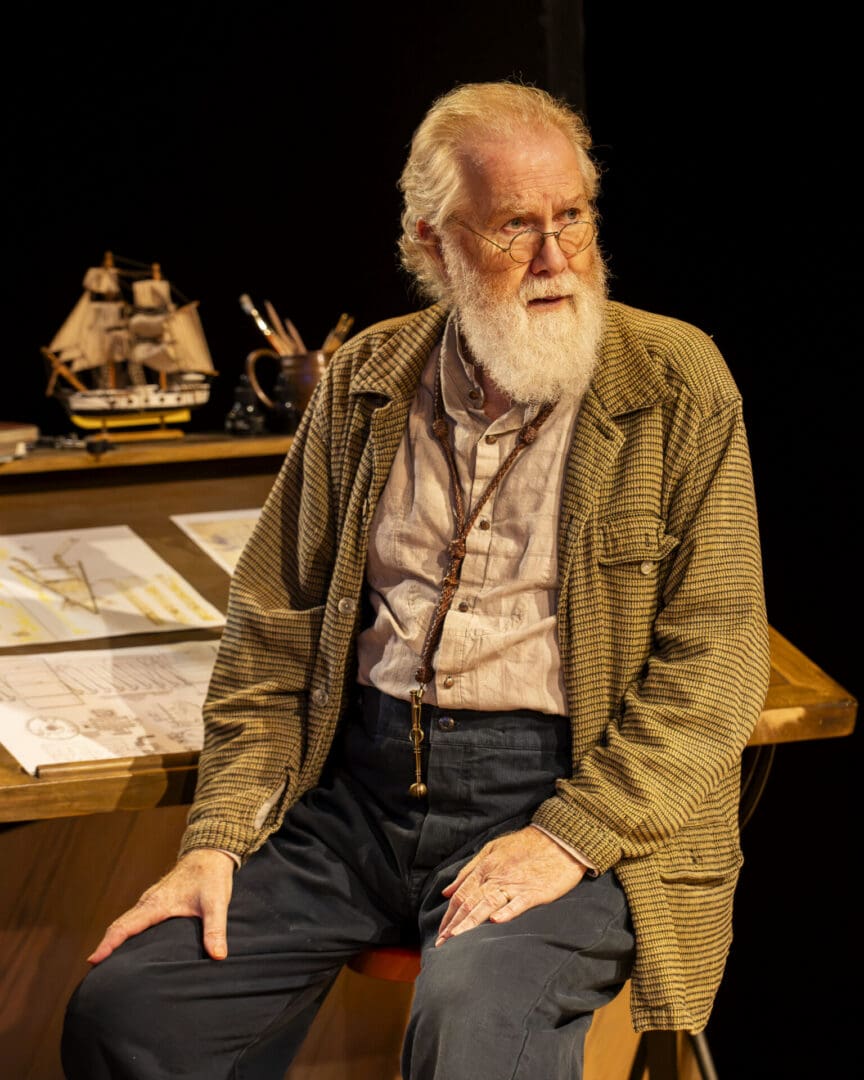
Harry Groener
Harry Groener’s Shotover makes up for a great deal. The household thinks the captain is senile. He is sharper than any of them. Groener wanders into a scene, punctures someone’s pretensions in a single dry sentence, and wanders out as though he had mentioned the weather. His timing is exquisite. The limit shows when the laughs stop. Shotover keeps dynamite in the gravel pit and dreams of a ray that will detonate it at will, so he can kill men like Boss Mangan, a wealthy industrialist. Shaw also gives him the play’s bleakest prophecy, an England drifting while her crew gambles below decks: “She will strike and sink and split.” Groener delivers the wit more reliably than the dread under it.
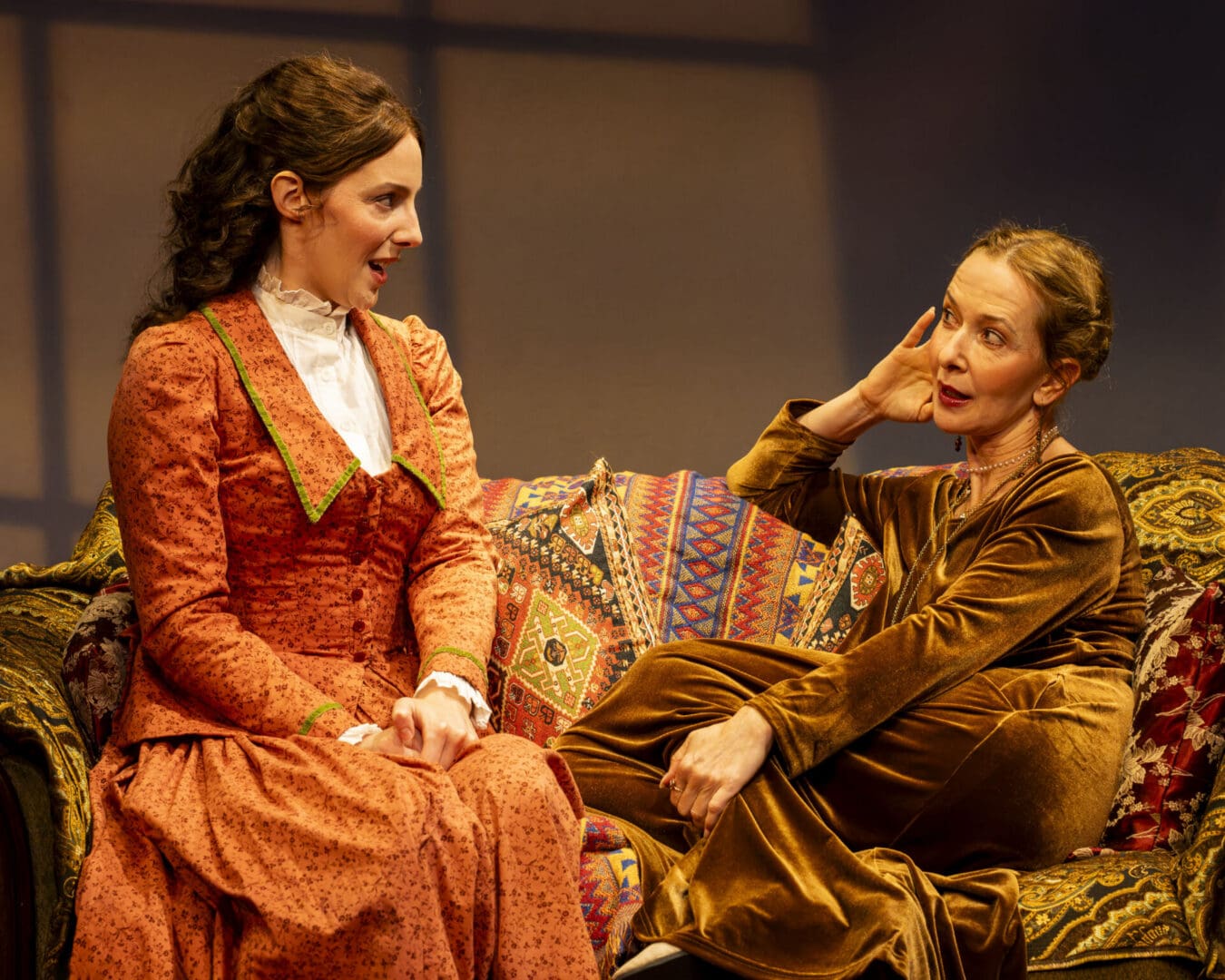
Elinor Gunn, Jocelyn Towne
Elinor Gunn gives Ellie Dunn the right mix of innocence and intelligence. Ellie arrives ready to marry Mangan, whom she believes can keep her family afloat, while nursing a crush on a glamorous adventurer. He turns out to be Hector Hushabye, her hostess’s husband. Gunn makes Ellie’s turn toward calculation persuasive because the hurt stays visible underneath it. Her quiet scenes with Shotover are among the evening’s best. For a few minutes Shaw stops arguing and lets two people understand each other.
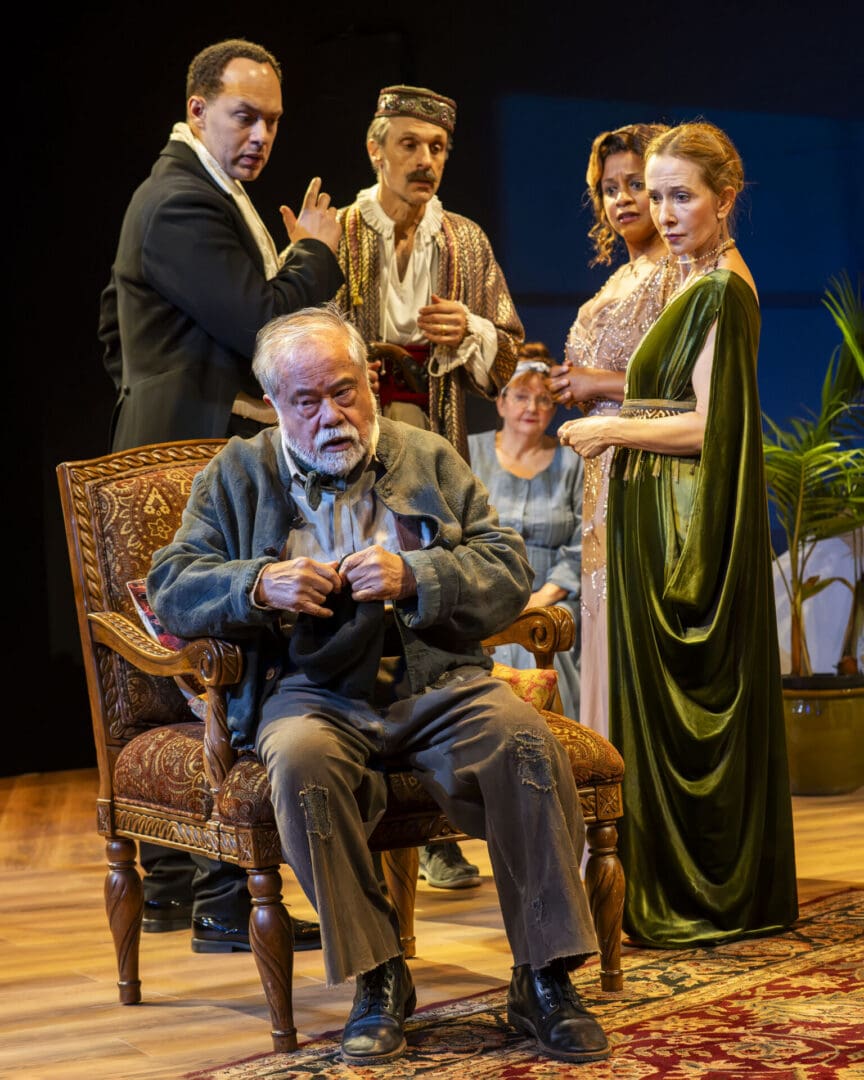
Alex Barlas, Alberto Isaac, Henri Lubatti, Carolyn Ratteray, Jocelyn Towne
Henri Lubatti’s Hector is handsome and roguish enough to explain why women believe the heroics he invents. Carolyn Ratteray’s Lady Utterword is devoted to respectability, and the devotion has never once slowed her flirting. Their scenes play like a card game between two sharps who would rather lose than admit they want to win.
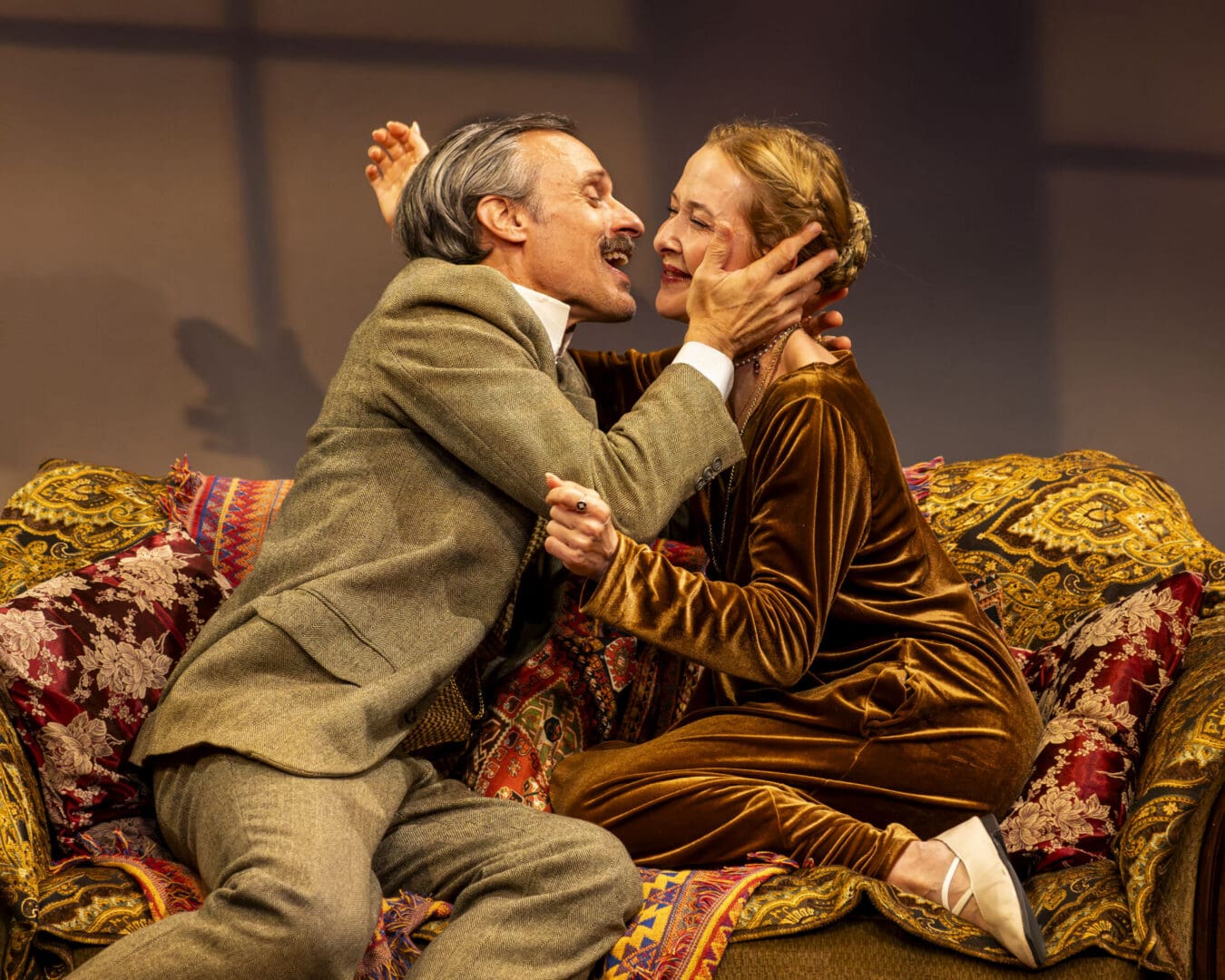
Henri Lubatti, Jocelyn Towne
Jocelyn Towne’s Hesione Hushabye commands the room with the ease of a woman used to being looked at. Costume designer Kate Bergh puts her in a green gown draped like a classical robe, and she presides over the house like a minor goddess. Hesione wants to rescue Ellie from a loveless marriage. She also treats other people’s heartbreak as a parlor game, and Shaw’s comedy runs on that contradiction.
Bernard K. Addison’s Mangan blubbers, pouts, and sputters as his authority drains away among people far cleverer than he is. Shaw’s joke is that Mangan has no money of his own. He runs other people’s. Alex Barlas plays Randall Utterword as so helpless that Mangan looks grown up beside him. Arye Gross gives warmth and sincerity to Mazzini Dunn, the idealist whose business failures put his daughter in this spot. Amelia White’s Nurse Guinness and Alberto Isaac’s unexpected visitor round out a cast that rarely misses a laugh. Their wounds tend to show on first entrance, though, which leaves Shaw’s unmaskings little to uncover.
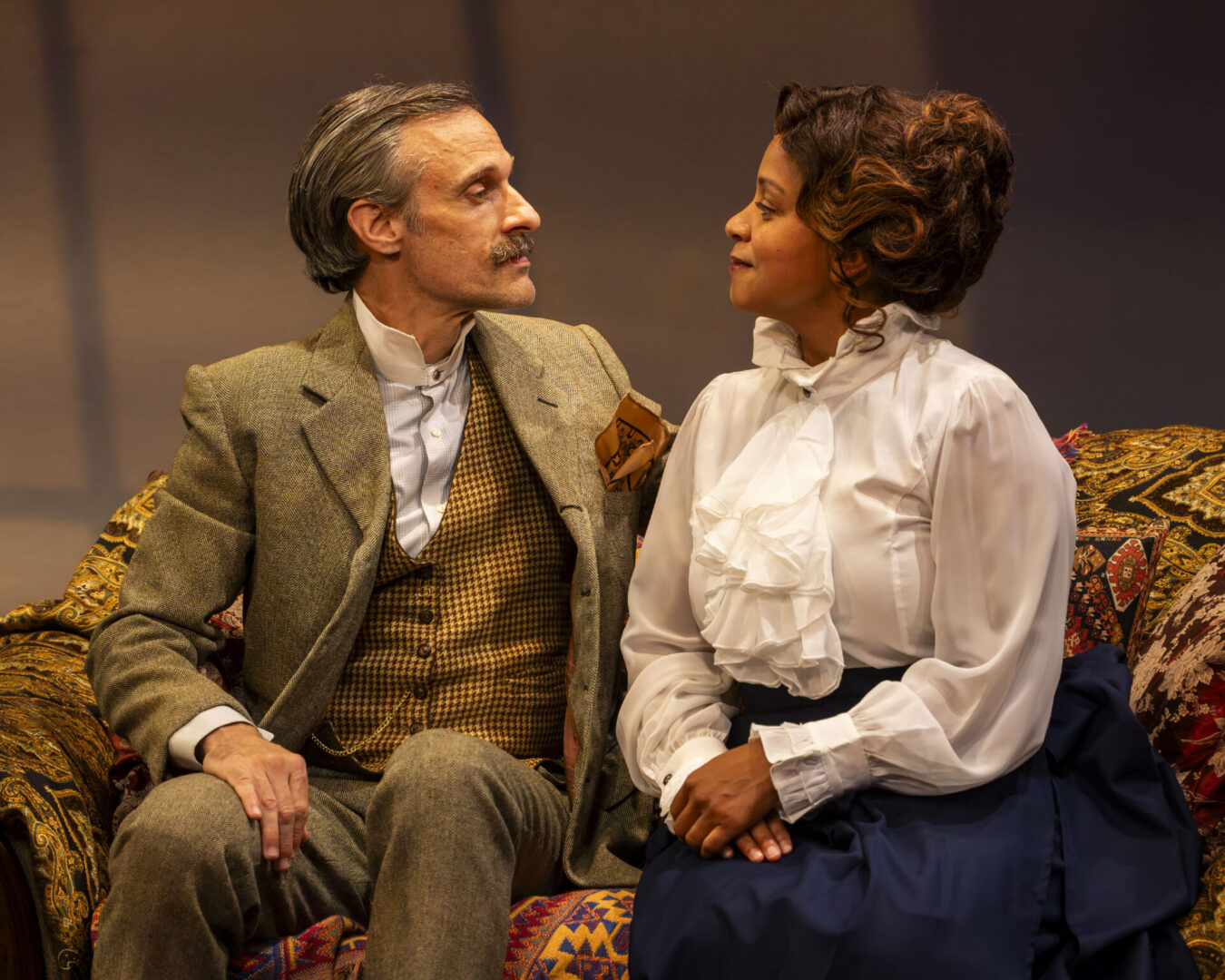
Henri Lubatti, Carolyn Ratteray
At two hours and thirty minutes, the evening makes good on half of Shaw’s promise to the Guild. Shaw rarely ended an argument just because its dramatic job was done, and his characters debate marriage and the future of civilization long past that point. Most of the writing is brilliant. Doukas has trimmed almost none of the rest. Cutting the longer philosophical exchanges and some secondary comic business would have bought the final act real momentum.
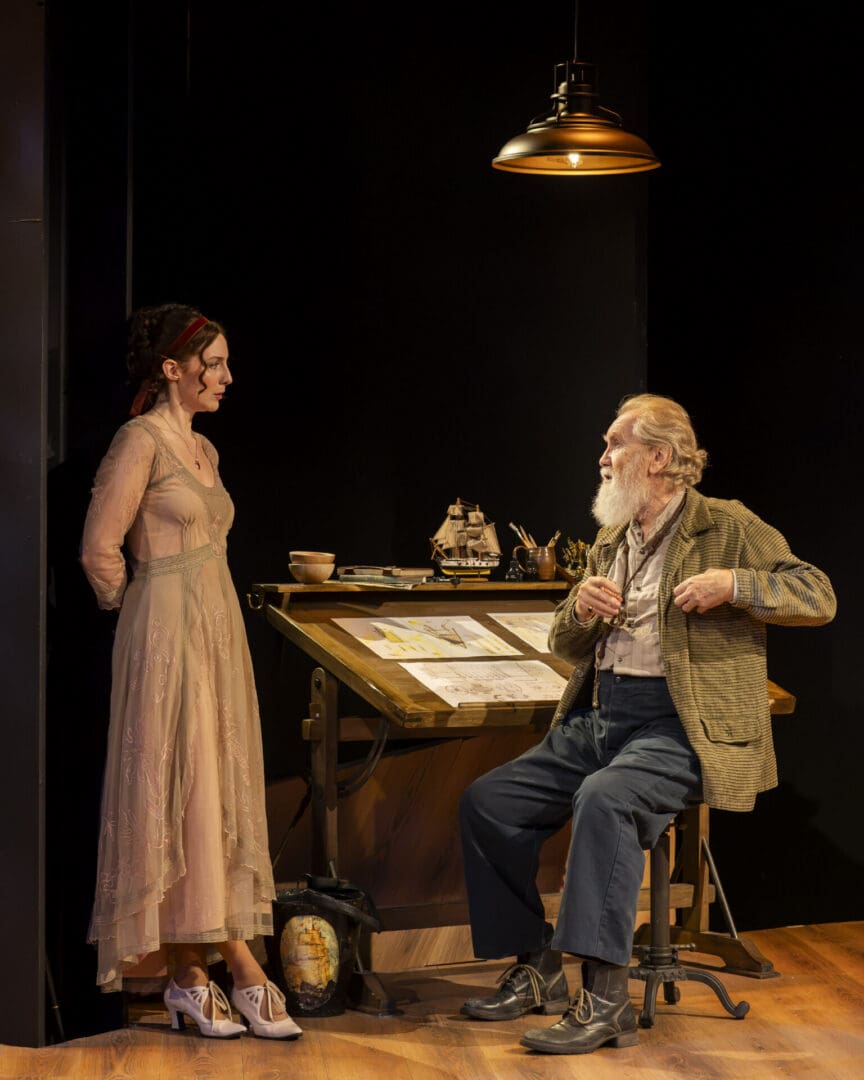
Elinor Gunn, Harry Groener
That act needs it. Shaw sends everyone into the garden on a still, moonless night, and then the bombers come. The shelter of the house should give way to open ground and a hostile sky. At Antaeus the actors step forward onto a vague strip of stage in front of the set, and nothing opens up. After so much talk, the war arrives like the last point in a long debate. Shaw’s characters greet it with something close to joy, which should chill us. Here it registers as an idea. Hector runs through the house switching on every light so the bombers can find it. There isn’t much house for them to find.
✦ ✦ ✦ ✦ ✦ ✦ ✦ ✦ ✦ ✦
photos by Craig Schwartz
Heartbreak House
Antaeus Theatre Company
Kiki & David Gindler Performing Arts Center, 110 E. Broadway in Glendale
2 hours and 30 minutes with intermission
Fri & Sat at 8; Sun at 2; Mon at 8
ends on November 16, 2026
for tickets, visit Antaeus
for more shows, visit Theater in LA
✦ ✦ ✦ ✦ ✦ ✦ ✦ ✦ ✦ ✦
