


Areas We Cover
Categories

Los Angeles Theater Review: VIEUX CARRÉ (The Wooster Group at REDCAT)

by Harvey Perr | December 7, 2010
in Los Angeles, New York
THE PASSION OF TENNESSEE WILLIAMS
“You know, I heard some doctor say on the radio that people die of loneliness’¦.They do. Die of it, it kills ’˜em. Oh, that’s not the cause that’s put on the death warrant, but that’s the true cause. I tell you, there’s so much loneliness in this house that you can hear it. Set still and you can hear it: a sort of awful – soft – groaning in all the walls.â€
РTennessee Williams, Vieux Carr̩
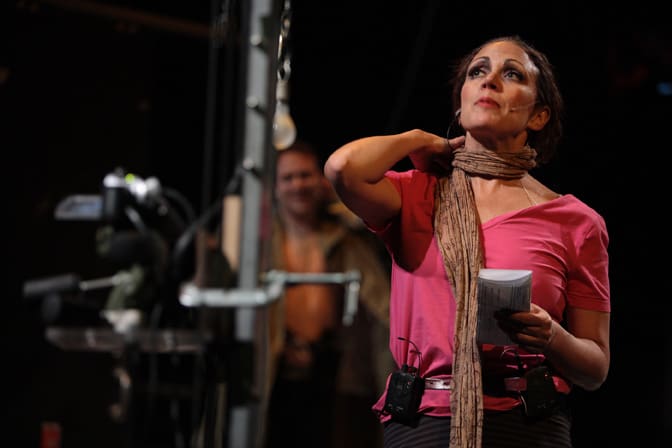
It would be impossible to talk about the life and art of America’s greatest poet-playwright, Tennessee Williams, without mentioning three words that keep creeping into almost any play he wrote: loneliness, restlessness, desire. They were his most persistent themes. The ache in his most disenfranchised characters is as physical as it is emotional and is so palpable that these lost souls would rather abandon themselves to all the wrong people than be helplessly stranded within their own skins. Sometimes, in fact, the only way to move on is to face that loneliness and grab onto any conceivable way out of it.  Few artists have burrowed so deep, with such ferocity and poignancy, to get to the heart of that ache.
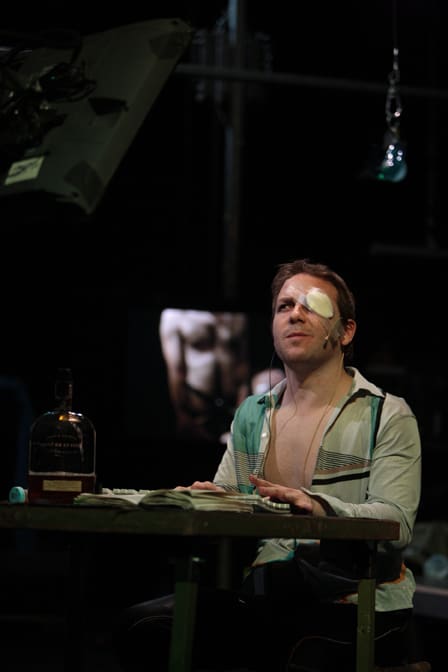 In his early plays – the ones that are revived most frequently – the guidelines are clear; but, as he matured, those guidelines became slightly blurred, because the feelings behind them became darker and more complex. What had been sharply delineated once was now a maelstrom of contradictions. Memory did not make things easier for Williams. Look at The Glass Menagerie and then look at Vieux Carré and you will see how hard it was for him to put the truth under a microscope when the truth became more and more unbearable. Too many of the great later plays are not revived nearly enough – plays like Small Craft Warnings, In The Bar Of A Tokyo Hotel, The Gnadiges Fraulein – and the fact that they were failures when originally produced has been taken as a sign that they were unworthy of Williams. But, surely, the time has come to look at his later work with fresh eyes. They may, quite possibly, define the true nature of his greatness.
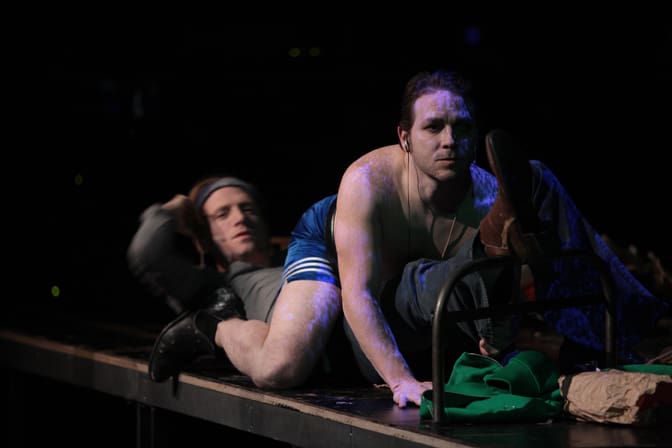
The Wooster Group, famous for its deconstructions of classic texts, has, in the past, stamped their work with a certain detachment and bracing irony, in their attempt to show, perhaps, the fallacies of the work in question when put in a contemporary context. But with their production of Vieux Carré, they have remained almost pristinely faithful to the text, but, more significantly, they have tried to get inside the clutter of Williams’s fevered brain, as it might have been when he was a young writer and, simultaneously, what it was like when he was in the throes of finally finishing the play he had been writing over a period of forty years. On a stage that makes of the New Orleans flophouse – where the play takes place – a junk graveyard, filled with video cameras (a staple of Wooster’s unique theater pieces), a living nightmare is created. And it is, believe it or not, both beautiful to behold and obscenely comic to boot.
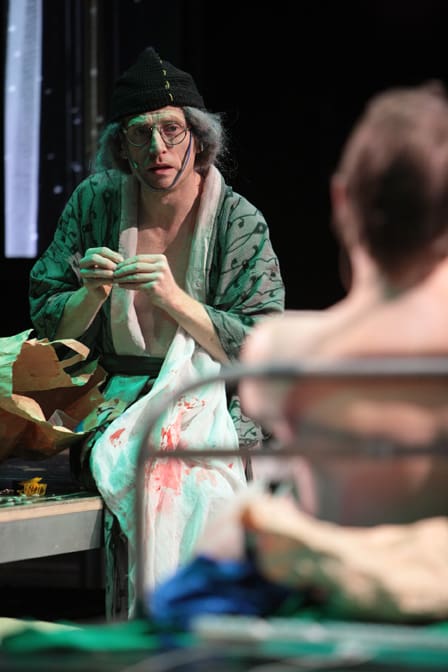 Some of the minor characters – two crazy crones; a society photographer whose own private orgies he photographs; the vagrant who offers the writer a chance for escape – are kept in the background or off-stage or are visible only on video, so the play centers on The Writer. And, like ghosts emerging from the shadows of The Writer’s memory, we have Mrs. Wire (the landlady who sees in The Writer traces reminiscent of her lost son), Nightingale (the tubercular homosexual who understands that what in others is sensual is in him rapaciousness), Jane (“a yellow cab girl with limousine aspirationsâ€) and Tye (the drug addict who is Jane’s paramour and who isn’t gay for less than a hundred dollars). They slip in and out of The Writer’s life, as he slips in and out of their lives, and though they often brutalize the writer, they also inspire him, and when The Writer rises from the torpor of his confused sexuality, he writes about them with maddening intensity, the words going from his typewriter to a screen and seemingly acted out by the characters he is writing about, which is about as glorious a way of theatricalizing the creative process as this reviewer has ever seen put on a stage.
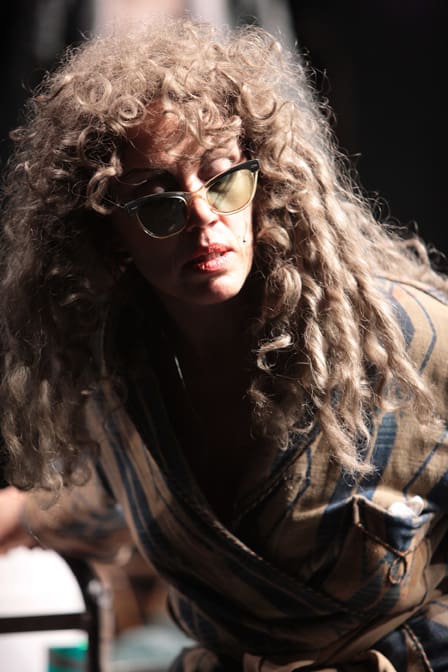 And, as befits a fever dream, Tye and Nightingale (both stunningly played by Scott Shepherd, each adorned with a raging phallus) torture The Writer’s incipient homosexuality, whose naked images on video are juxtaposed with imagined sexual partners. These images have a way of scorching the audience with their lucid definition of The Writer’s inner sexual madness. Wire and Jane (both played by a buoyant Kate Valk, here giving the best performance(s) of her career) offer a kind of solace and intimacy, but both need and demand from him more than he can give them. But it is Ari Fliakos, as The Writer, who anchors this reading of the play with the greatest force; his body language eloquently evokes loneliness, restlessness and desire. In his performance, the spirit of Tennessee Williams returns, so that he, too, emerges as if from the shadows of memory. And Williams and his interpreters have an extraordinary artistic partner in Jennifer Tipton, whose lighting design illuminates those dark corners with chiaroscuro magnificence,
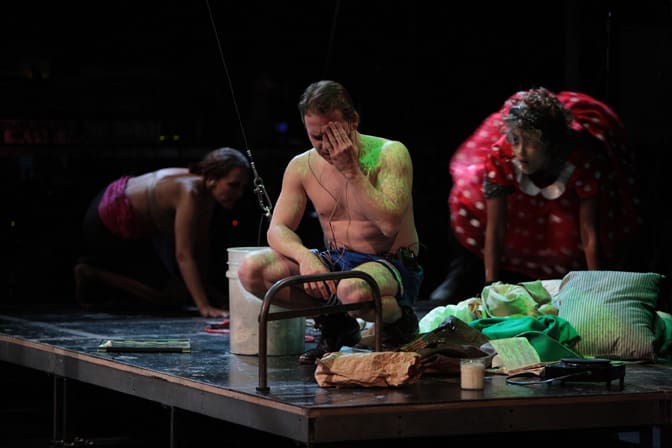
Make no mistake. The Wooster Group’s Vieux Carré is designed for serious theater-goers. Casual shoppers might just as well pass it by. But, if they do pass it by, they will miss a grand opportunity to discover that late Williams had the same gifts for compassion and insight and the same vivid poetic sense as early Williams. And perhaps with a more bitterly profound vision of humankind. Vieux Carré is a masterpiece. The Wooster Group has given it its due. Bless them for it. And get over to the REDCAT, where it is being performed for too brief a time. I promise you: occasions like this are far too rare.
photos by Steven Gunther
Vieux Carré
The Wooster Group
REDCAT, 631 West 2nd St (under Disney Hall)
ends on  December 12, 2010
for tickets, call 213-237-2800 or visit REDCAT
run continues in New York February 7 – 27, 2011
for tickets, visit  Wooster
