


Areas We Cover
Categories

AFTERMATH by Elliot Shoenman – Odyssey Theatre – Los Angeles Theater Review

by Tony Frankel | February 11, 2011
in Los Angeles
MATH PROBLEM
Consummate actress Annie Potts has an auspicious moment at the start of AfterMath: she plays Julie, whose husband has jumped into the Hudson River, leaving behind two grown children and a confoundingly simplistic suicide note. She relates to us, in a monologue that is funny, melancholic and touching, that her math-teaching spouse of twenty years was like rusting metal which slowly erodes until it just snaps. But this new play by Elliot Shoenman (who cut his teeth on sit-com writing) soon disintegrates from the promise of poetic introspection into a surprisingly one-dimensional observation of family dysfunction. For all of its compelling and realistic moments displaying domestic strife, it turns out that the communication problems in this family are not caused by Dad’s departure. In fact, by play’s end, we know very little about dad – we aren’t sure what it was like living with the man, or why Julie was attracted to him in the first place. Instead of plumbing the depths of the survivors’ culpability, the playwright has Julie comically commenting on her menopause or her job – prime elements of situational comedy. The comedy diffuses the drama, which makes the drama feel overwrought and forced, even as it occasionally entertains.
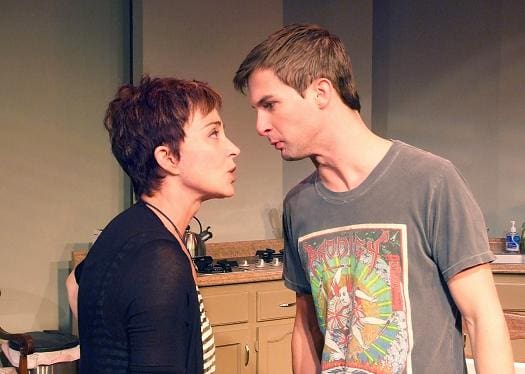 The son, Eric (Daniel Taylor) is The Angry Young Man, right out of Kitchen Sink Realism, except he’s not angry at society, he’s not angry at his father’¦he’s just angry. In fact, we find that he has been a hothead all his life. The poor actor is given nothing to discover about himself, and his monologue reveals precious little, leaving the actor to strain and flounder for deeper emotional resonance.
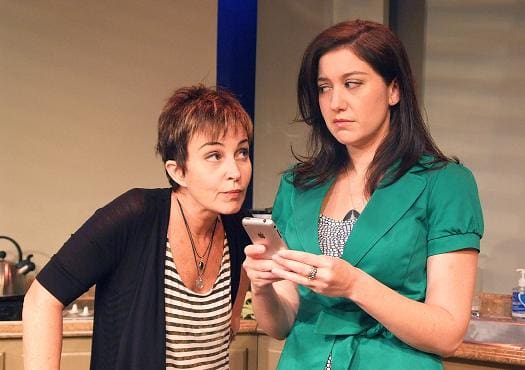
Natalie (Meredith Bishop) is the neglected daughter who has decided that it’s best to keep parts of her life secret from mom, yet we find that secrets have been kept for years before her  father’s suicide. At one point, Julie discovers Natalie’s secret: that she has an upcoming interview with CNN; Julie is pleased at first, but becomes enrages after hearing that the job will be in Atlanta. Based on what we have discovered about Julie thus far, she would have trouble letting go of her 28 year-old daughter even if Dad were still alive. Plus, it’s difficult to summon up any sympathy for Julie, since she discovered the news about CNN by answering her daughter’s cell phone. We get that Julie is a controller, but, really, who just picks up somebody else’s cell phone? Is it a defiant act on the part of Julie that stems from her desperation to keep the family together, or is it a device on the part of the playwright to move the plot along toward its anticlimactic ending? Murky territory, to be sure.
 The schizophrenic context of AfterMath is not helped by Mark L. Taylor’s presentational direction – he has not aided his actors in finding moments of discovery between the words. Nor has Taylor used Adam Flemming’s superlative projection design of New York and childhood photos to any effect. No doubt Shoenman has an ear for dialogue (which Potts is eminently gifted at delivering), but the construction is jerky and the entire play wears its heart on its sleeve. For all of the simplistic revelations, repetitive exposition and broad acting that take place in AfterMath, the real shock is that it still manages to create startlingly realistic snippets of dysfunction.
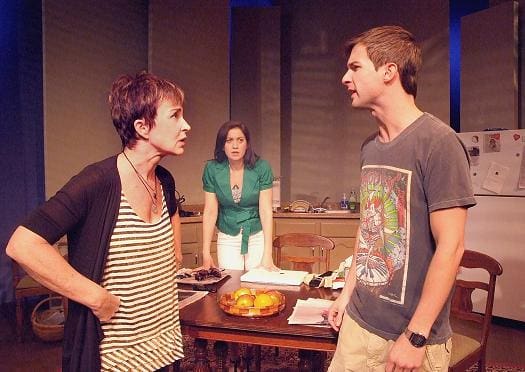 Even though your own nutty family may be called to mind (causing you to chuckle with familiarity), you will not be inspired to call them on the phone to recreate the tidy ending you see on stage at the Odyssey. The play does not resonate, most likely because the creators have not decided if this is escapist or transformative theatre. It tries to be both and, sadly, ends up being neither. It’s no accident that Shoenman does not explore the Math that is in the title of his play – the problem that he has put on the chalkboard is currently unsolvable.
tonyfrankel @ stageandcinema.com
photos by Ed Krieger
AfterMath
scheduled to close March 13 at time of publication
for tickets, visit https://www.plays411.net/newsite/show/play_info.asp?show_id=2657
