


Areas We Cover
Categories

Los Angeles Theater Review: VENICE (Kirk Douglas Theater in Culver City)
by Harvey Perr | October 30, 2010
in Los Angeles
OTHELLO! THE MUSICAL
A thousand years ago, when Los Angeles theater was still taking baby steps (1968, to be precise), an Englishman, Jack Good, had the idea of a musical version of Othello – it wasn’t the first time, of course, Verdi’s opera having quite brilliantly executed the same idea quite a few years before – and it was to create an Othello-Iago conflict in terms of rock and roll, with Little Richard as Othello and Jerry Lee Lewis as Iago hammering out both the music and the battle at separate pianos. Of course, it never got on stage as planned. The powers that were at the Ahmanson decided that Jerry Lee Lewis could do it, but a compromise had to be made and the part of Othello was given to a conventional Shakespearean actor (William Marshall, best known for his title role in Blacula) so that the end result – Catch My Soul – was a peculiar hybrid, neither rock musical nor good Shakespeare, but nevertheless memorable for Lewis’s mad, strutting, musically thrilling Iago. A more successful version, closer, as intended, to rock and roll, but still not what Good dreamed of, appeared in England a year or so later (failure did not deter Good, as it should not deter anyone with a dream). It was clearly an idea ahead of its time. And, if it had been done as Good wanted it done, it might also be more than just a memory today, because the music was wonderful and enough of what was good (Good) about the concept came through, despite the fatal compromises.
Fade. Dissolve.
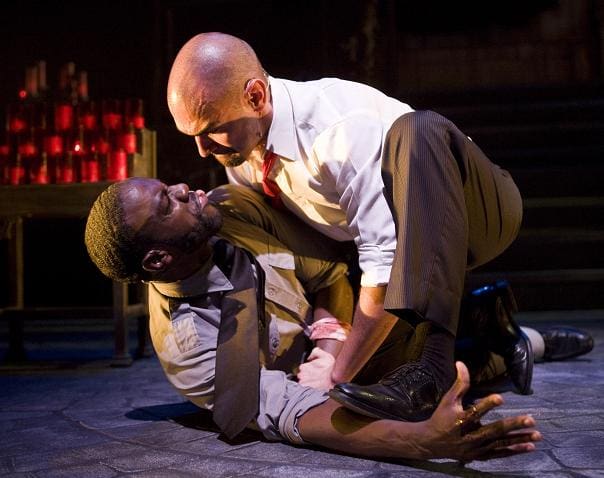
It is 2010 and we now have Venice, the hip-hop version of, guess what?, Othello. Commissioned by the same Center Theatre Group who once brought us Catch My Soul, Venice is having its world premiere at the Kirk Douglas Theatre after years of workshops both here and at the Kansas City Repertory Theatre. Since this reviewer has seen only this version and none of the workshops, all I can say is that, outside of bringing back the memory of Catch My Soul and making me pine for a revival of that version, done as intended, all that Venice prompted in me is to ask why anyone would want to spend so much time and so much money on a project that seemed ill-fated from the word Go!
It’s because everyone wants to create a musical. Everyone, to give the artists responsible their due, wants a contemporary musical that will stand up right alongside the classics we are in danger of reviving at least once too often. But, let’s face it, it’s the money factor. A musical, if successful, makes everyone rich and, one supposes, famous. Caught between commerce and art, a new musical must make compromises (has nothing changed since Catch My Soul?) and, when those compromises work, everyone feels great about the years of sweat and hard work and crazily shifting emotions that they have gone through, and when they don’t work, the question remains: Go back to square one or forget the damned thing?
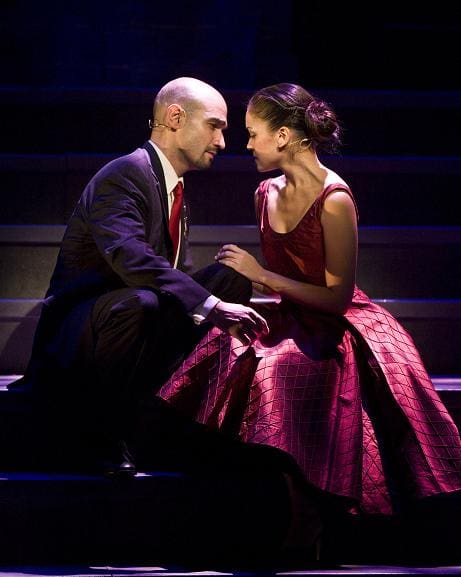 If you are reading into all this that I recommend forgetting the damned thing, you are only partially correct. Nor am I suggesting that going back to square one is an option, either. Good work has already been done. It’s just that it’s a long, long way from being good enough. The music, for example, rocks. At least, it does every now and then, but it isn’t always certain whether it is the Matt Sax score itself or the sophisticated musical arrangements by Curtis Moore that make it rock. Clearly some reviewers find “The Wind Cried Willow†a haunting tune, but a song that rhymes “Willow, Wilow, Willow†with “pillow, pillow, pillow†doesn’t make the grade for this reviewer. So, chances are the score is better than the lyrics, which Sax collaborated on with Eric Rosen (who also wrote the book and directed the show). Is it possible that Rosen wears too many hats? And, though Sax is clearly a brilliant performer who knows how to sell a song, was it such a good idea to turn him into the Tadeusz Kantor of Kansas City Rep, on stage continuously, figuratively writing Venice as we watch it, literally directing it (or, at least, keeping his eye on the way things are going)? It seems, at the moment, like a bit of theatrical overkill. Not to mention the degree of narcissism on display.
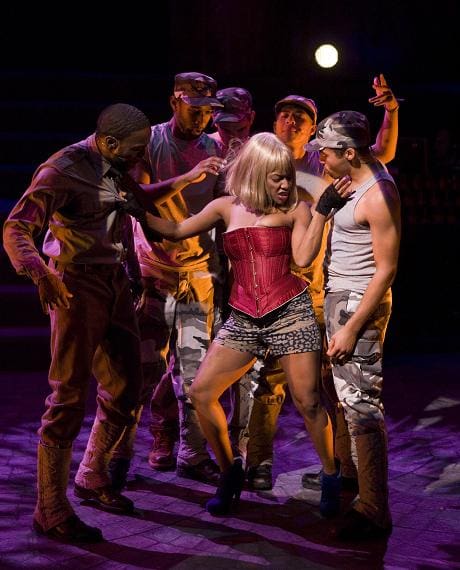 The book is a mess. It is overstuffed with clever ideas. But, really, why choose to do Othello and then change every character’s name (except, for reasons known only to its creators, Emilia)? Why has Othello become Venice? Why has Iago become Markos and why is Iago now Othello’s brother? These sorts of changes only complicate things. Muddy the waters, so to speak. Of course, if one cared for a single moment about any of these characters, it would make no difference what their names were, but, without a scorecard, it’s virtually a guessing game as to what’s going on and why who is doing what to whom. And so, without real people, we are stuck with all these gifted performers with almost nowhere to go except to sing and dance their hearts out, much of it to little avail. Besides, as talented as the performers are (Victoria Platt, Angela Wildflower Polk and Rodrick Covington are standouts), most of the cast seems to be somewhat deprived of real acting chops. It isn’t enough anymore to just be able to sing and dance. Or is it? It is no secret that, as stirring as a beautiful voice can be, I find myself growing a little tired of vocal brilliance alone. What ever happened to personality? I am also tired of those little microphones attached to the heads of the performers, which suggest that every musical is about aliens from outer space. Can’t those big voices fill the Kirk Douglas Theatre without mikes?
Also, there is nothing wrong with setting Venice in Venice, and in the future, but why do the soldiers coming home from war have to look as if they are Americans returning from Iraq or Afghanistan? And why does Venice/Othello, the commander-in-chief, have to look like Barack Obama? Would that the actor playing the part was half as charismatic as our president. These are political references that are, at best, naïve and superficial. And, at the risk of repeating myself in order to get the point across, why, when Othello has so much to offer, is everyone bent on adding all this superfluous stuff that never really adds up to too much and actually makes us long for Shakespeare instead of what’s before us?
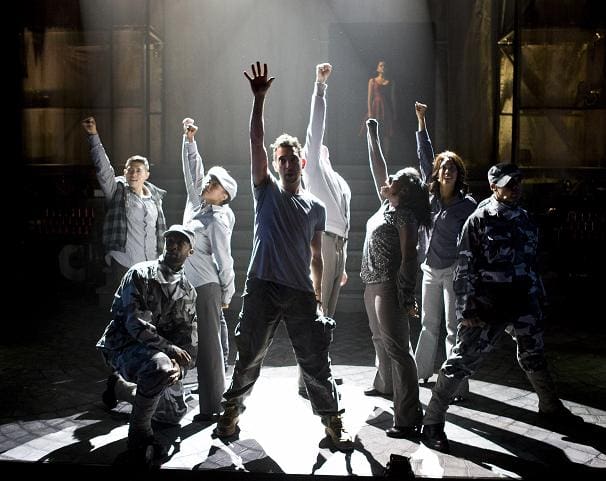
And why, given the energy the dancers are bursting with, does the choreography look a little too much like the dances in early music videos? Like variations on the same monotonous pattern? Choreographer John Caraffa should know better; his partner, Tanisha Scott, should learn.
The design elements are smashing. That is where a good deal of the money has gone. It shows. But, as everyone knows, you can’t leave a theater humming the set! It just makes expenditure look a lot like waste. The disappointing news is that the forty years between Catch My Soul and Venice have not yielded much that is new. The truth is that we should be grateful that we have Verdi’s opera. Oh, yes, and Shakespeare’s play. And the memory of Jerry Lee Lewis banging away at that piano. Now that was an Iago!
photos by Craig Schwartz
Venice
Center Theatre Group
Kirk Douglas Theatre
9820 Washington Blvd. in Culver City
ends on November 14, 2010
for tickets, call 213.628.2772 or visit CTG
