


Areas We Cover
Categories

Chicago Theater Review: THE VORTEX (Dead Writer’s Theater Collective at the Greenhouse Theatre Center)
by Paul Kubicki | July 26, 2012
in Chicago
DEAD WRITER’S PRODUCES DEAD THEATRE
I’ll admit, I was skeptical from the start walking into the Greenhouse Theatre’s production of Noel Coward’s The Vortex, the inaugural production of the Dead Writer’s Theater Collective (DWTC). Why? The newly formed DWTC states that their plays are presented “as we interpret the authors would have intended their works to be staged in the original period and settings.” Now there’s nothing inherently wrong with this, but isn’t part of the point of putting on a production bringing something new to it? Making it relevant to the times? Otherwise it’s an artifact, right?
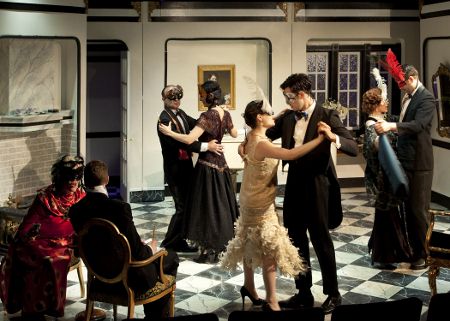
After seeing The Vortex, my suspicions were confirmed. This play feels like a diorama in a museum wing dedicated to the 1920’s. And try as these actors might to shake the dust off, it still smells musty.
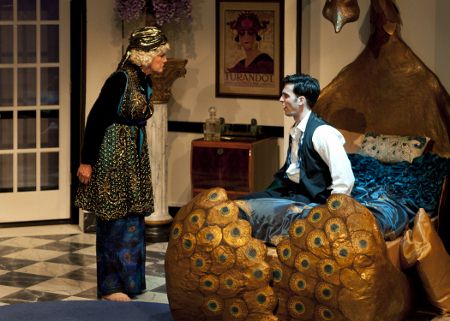
The real shame here is that The Vortex shouldn’t feel as musty as this production; it doesn’t have an awful lot to bridge. The play comments heavily on the “rotten” decadent societal mores of the 1920s. The young, cocaine-addicted snob, Nick Lancaster, blames his uselessness entirely on the manner in which his mother raised him. Florence, Nick’s ungracefully aging mother, believes her problem is that she is fundamentally misunderstood, but her real problem is that she is soul-killingly selfish. “You never love anyone, you only love them loving you,” Nick tells her. While Vortex is certainly not Coward’s best or most complex play, the younger characters are a vivid reflection of those children who grew up during our decadent 90’s boom cycle, making Coward’s concerns once again pointedly relevant.
DWTC doesn’t do anything to bridge this minor gap. It doesn’t give us a sense of what a moral infraction Florence is making when she has an affair with a younger man’”but the play’s drama is built from this central point. We’re not a 1920s audience. We’ve seen Demi and Ashton. It’s no longer shocking. The play could certainly still work if we were shown what a scandalous departure from societal norms her act constituted, rather than just expecting us to be surprised by an act that we’ve all seen before.

But at the same time, while DWTC tries to be true to Coward’s original vision, there seem to be some fundamental misunderstandings of Coward’s work (or, at least, if they did understand, it didn’t translate). Actors play one-liners only for laughs instead of revealing the wit of Coward’s high-society characters as their last measly defense from the truth’”that truth being that they’re utterly useless. Their clever gossip protects them from the realization that they are despicable, worthless, and narcissistic. Nick has this realization at the end of the play, guided by his mother’s friend Helen. The audience, however, should come to find their banter somewhat gruesome and come to realize how internally rotten all of these characters are much sooner. The cast seems to maintain a clear divide between the serious and the funny moments’”but it’s the funny moments that are the ugliest.
But before I go too far with that criticism, I won’t generalize it to everyone in the cast. As Helen, the snarky, high-society gossip who is friends with the Lancaster family, Teri Schnaubelt brings insightful heart to her role. Even when Helen is being disingenuous, Schnaubelt brings something genuine to a stage filled with characters who feel utterly false, even in their falseness. Betsy Pennington is also deliciously rotten as the narcissistic opera singer Clara Hibbert, however inconsequential the role.
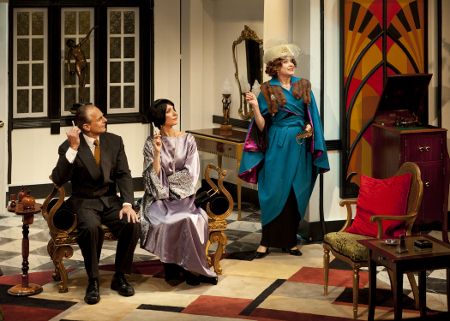
The entire cast is clearly somewhat talented, but it’s obvious that this isn’t any of their best work; they are all capable of playing these roles well, and yet, they all feel mechanical. There are moments where it seems like actors are waiting to speak their next line, or waiting for a line to cue them to move’”much like that museum diorama. Director Jim Schneider doesn’t cultivate anything organic out of his cast. It feels dreadfully over-directed, as if we can hear him telling them when and where to move across the stage.
That stage, by the way, is adorned with a beautifully complex set conceived by Edward Matthew Walter. It is exceptionally complex, but presents a realistic image of each of the three settings of the play, the most notable of which is Florence Lancaster’s lavish bedroom with a giant bed with a peacock head sticking out of it. The set is over the top and tacky, but so are the Lancasters, and Walter gives us a real sense of that the minute the lights go up.
This really is the show that could-have-been. A beautiful set, a decent play that could be relevant, a talented cast that could be great. And yet, DWTC fails to resuscitate any spark this play had, but instead leaves us with a bland retelling’”an artless artifact’”of what was.
photos by Peter Bosy
The Vortex
The Dead Writer’s Theatre Collective
The Greenhouse Theatre Center
ends on August 26, 2012
for tickets, call 773.404.7336 or visit Greenhouse
for more shows, visit Theatre in Chicago
