


Areas We Cover
Categories

Theater Obituary: RICHARD GREENBERG (1958-2025)
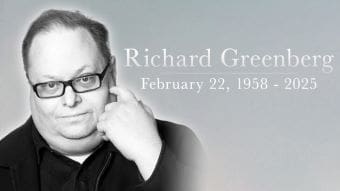
by Michael M. Landman-Karny | July 23, 2025
in Chicago, New York, Theater
A CHRONICLER OF
PRIVILEGED ANXIETY
In the peculiar ecosystem of American theatre—where earnestness often trumps elegance and message supersedes craft—Richard Greenberg, who passed on July 4, 2025 at 67, occupied a singular niche. His characters were the sort of people who attended the right universities, read the correct books, and still found themselves paralyzed by their own sophistication. They spoke in sentences that coiled back upon themselves, searching for meanings that remained tantalizingly out of reach.
Greenberg’s theatrical world was one of beautiful futility. His protagonists were educated into a kind of emotional impotence, trapped by their cultural literacy and psychological insight. They knew too much about art to be moved by it, too much about love to fall into it cleanly, too much about themselves to act decisively. This was territory that few American playwrights dared to explore with such unsentimental precision.
Born in East Meadow, New York, in 1958, Greenberg grew up in the comfortable middle classes of Long Island. His father worked as an executive for a cinema chain; his mother was a homemaker. The family moved in circles where culture was both currency and burden. At Princeton University, he studied under Joyce Carol Oates and wrote a senior thesis that ran to 438 pages. Graduate work at Harvard proved less compelling than the playwriting program at Yale, where he discovered his gift for theatrical dialogue.
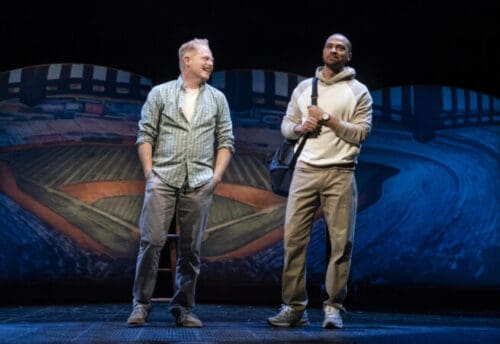
Jesse Tyler Ferguson and Jesse Williams in Take Me Out on Broadway in 2023 (Joan Marcus)
His big breakthrough came with Take Me Out, which won the Tony Award for Best Play in 2003. The drama followed a mixed-race baseball player who announces his homosexuality to the press, then observes the ripples of his decision through his team and the sport itself. Critics praised the play’s exploration of masculinity and race, though some noted that its popularity owed as much to extended nudity as to its insights about American identity. Greenberg seemed untroubled by such observations. Theatre, after all, traffics in bodies as much as ideas.
The play’s success established Greenberg as a distinctive voice in American drama, but it also revealed the contradictions that would define his career. His work was literary yet theatrical, cerebral yet visceral, progressive yet suspicious of easy answers. He wrote about gay characters without making sexuality the central issue; he examined race without offering comfortable resolutions; he portrayed privilege without either celebrating or condemning it.
Greenberg’s unusual career was sustained by an equally unusual institutional relationship. South Coast Repertory in Costa Mesa, California, became his primary theatrical home, producing more than a dozen of his works over three decades. Such sustained support is rare in American theatre, where playwrights often struggle to find consistent venues for their work. The arrangement allowed Greenberg to develop his voice without the pressure of immediate commercial success.
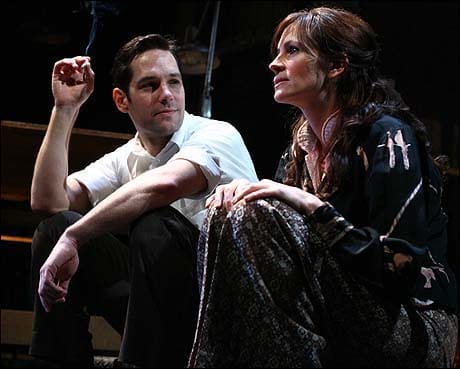
Paul Rudd and Julia Roberts in Three Days of Rain on Broadway in 2006 (Joan Marcus)
His plays often felt like novels compressed into dramatic form. Three Days of Rain, which premiered at South Coast Rep in 1997, became a Pulitzer Prize finalist and eventually reached Broadway in 2006 with Julia Roberts, Bradley Cooper, and Paul Rudd. The production was more notable for its stars than its reviews, but it introduced Greenberg’s work to a broader audience. The Dazzle dramatized the lives of the Collyer brothers, Manhattan hermits who died buried under their own possessions. The Violet Hour explored the relationship between a publisher and his authors in 1919 New York.
Time was Greenberg’s obsession. His characters were always trying to make sense of a world that had moved beyond them, or perhaps had never included them in the first place. The past haunted the present with remorseless persistence. Memory became both refuge and prison. His protagonists were archaeologists of their own experiences, sifting through the debris of their lives for clues to their predicament.
Manhattan Theatre Club became his New York home, producing many of his later works including The American Plan, The Assembled Parties, and Our Mother’s Brief Affair. The theatre’s artistic director, Lynne Meadow, championed his work despite its commercial challenges. Greenberg’s plays demanded patience from audiences accustomed to more immediate theatrical pleasures.
His approach could be taxing. Critics sometimes found his characters too articulate, too self-aware, too paralyzed by their own intelligence. But supporters argued that Greenberg captured something essential about contemporary American life: the way education and privilege could become their own form of entrapment. His people were trapped by their sophistication, knowing too much about the world to navigate it successfully.
Greenberg also worked as an adaptor, bringing his literary sensibility to existing texts. His version of Strindberg’s Dance of Death brought Ian McKellen and Helen Mirren to Broadway in 2002. The production succeeded through its psychological complexity and dark humor, though some questioned whether Greenberg’s approach suited Strindberg’s brutal naturalism.
As American theatre moved toward greater political engagement and social activism, Greenberg’s work seemed increasingly out of step. His plays remained concerned with private rather than public dramas, with psychological rather than sociological insights. Younger critics sometimes dismissed his work as irrelevant to contemporary concerns. The theatre was becoming more immediate, more topical, more easily digestible. Greenberg remained interested in questions without easy answers.
His final completed work was a reimagining of Philip Barry’s Holiday, which received a staged reading in 2024 starring Rachel Brosnahan and David Corenswet. The production is scheduled to open at Chicago’s Goodman Theatre in 2026, making it a posthumous premiere.
The openly gay Greenberg maintained a notably private personal life, never discussing the details of his personal life in interviews. He worked slowly, sometimes taking years to complete a play. Each script underwent numerous revisions, with dialogue polished until it achieved a jewel-like precision. He was a meticulous craftsman who believed in the power of language to illuminate the human condition, even when that condition proved uncomfortable or unflattering.

Christiana Clark, Bryce Gangel, Luigi Sottile, Jessie Fisher in Holiday at The Goodman Theatre (Todd Rosenberg)
Where does all this leave us? Perhaps it’s pointless to try to sum up a career that resisted easy categorization. Greenberg wrote for audiences who recognized themselves in his characters’ anxieties and pretensions, who found comfort in knowing that someone understood the particular burden of being overeducated and underwhelmed by modern life.
In an age of increasing cultural polarization, Greenberg’s work offered a different kind of theatre: one more interested in questions than answers, more concerned with character than cause. His commitment to doubt and complexity seems both old-fashioned and strangely prescient. He understood that the most interesting dramatic conflicts occur not between good and evil, but between competing goods, competing truths, competing versions of the self.
The American theatre has lost one of its most distinctive voices, one that spoke for the educated, the privileged, and the perpetually uncertain. In a time when certainty is increasingly prized, Greenberg’s embrace of ambiguity feels like a form of courage. His characters may have been paralyzed by their own intelligence, but they were also ennobled by their refusal to settle for easy answers. That refusal, more than any single play, may prove to be his most lasting contribution to American drama.
