


Areas We Cover
Categories

Theater Obituary: ROBERT WILSON (1941-2025)

by Michael M. Landman-Karny | July 31, 2025
in Art and Museums, International, Theater
VISIONARY OF
STILLNESS AND LIGHT
The line was always the thing. Before speech, before movement, there was line. Line as structure, line as breath, line as the actual measurement of time. In the theatre-world Wilson built and then rebuilt across five decades, a single raised eyebrow might require five full minutes to complete its journey. A footstep could ring out like a cannon or vanish entirely into the void. Silence was not an absence for him. It was a medium. He sculpted it. He arranged it. And in doing so, he taught audiences to listen with their eyes.
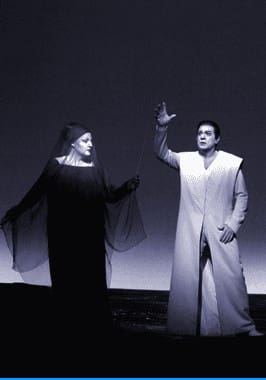
Placido Domingo in Parsifal at LA Opera, 2005 (photo by Robert Millard)
Robert Wilson died on July 25, age 83, after a life spent detouring around opera only to become one of its strangest revolutionaries. Architecture was his first language, then painting, then silence, then light. Speech arrived late, both in life and in art. As a child he had a neurological speech disorder. In adulthood he trained with painters and architects, not singers or conductors. The opera house, when he finally walked into it, must have seemed like a miscast cathedral. He stayed anyway. Not to pay homage. To repurpose the ritual.
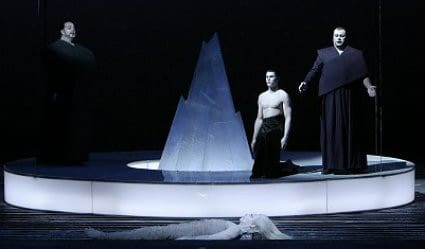
Parsifal at LA Opera, 2005 (photo by Robert Millard)
What he brought was a ruthless geometry. What he chased was a kind of sacred transparency. Movement was slowed until it became sculpture. Light did not merely illuminate the stage. It rewrote it. Color, contrast, timing—each became a compositional tool. The architecture of a gesture could matter more than the psychology behind it. Or rather, psychology was ignored on principle. No melodrama. No Stanislavski. No fluttering hands to signal love or despair. He believed in poses. He believed in rhythms. Emotion was something to be distilled, not enacted.
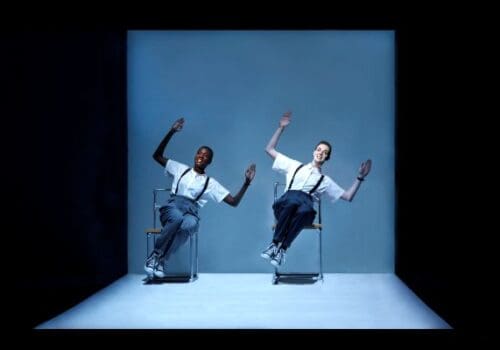
A scene from Einstein on the Beach (photo by Lucien Jansch)
The first of his operas to truly land, or at least to rupture expectations, was Einstein on the Beach. The work was a collaboration with composer Philip Glass. Together they made a four-and-a-half-hour pageant that had no plot, no characters in any traditional sense, and very little singing. Instead it had numbers. It had light. It had slow, repeating motion and dancers who moved like metronomes performing a mass. You watched it like you might observe a lunar eclipse. With awe. With confusion. With patience you didn’t know you had.
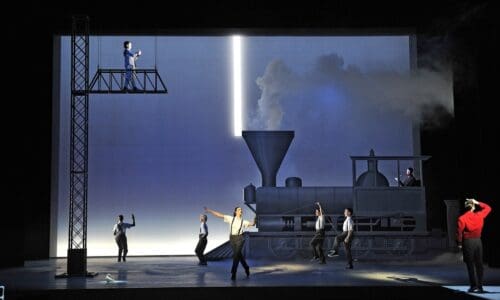
A scene from Einstein on the Beach (photo by Lucien Jansch)
He loathed categories, but his body of work did accrue its milestones. In 1991, he staged Parsifal at the Hamburg State Opera. No blood. No ecstasy. Just robes, perfectly draped, moving like suspended architecture. The Grail itself became a white light, eerily sanitary, hovering in a sterile mysticism. That same year, he created Lohengrin for La Monnaie. The knight did not sail in on a swan. He arrived suspended in light. Elsa moved like a wind-up icon. Every shadow had a musical cue. Every pause felt longer than it should. Or maybe just longer than most directors would dare.
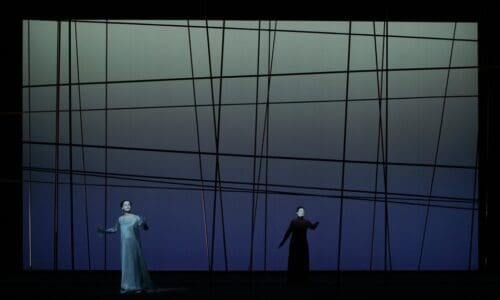
Pelléas et Mélisande (photos by Javier del Real) opened 7 February, 1997 at the Paris National Opera 21 July, 1997 at the Salzburg Festival
His 1997 Pelléas et Mélisande at Salzburg pulled in the opposite direction. Less sculptural. More vaporous. The forest never quite became a forest. Characters looked like they were evaporating under the intensity of the lighting rig. No one cried. No one shouted. Debussy’s orchestration seemed to hover just beneath the surface of Wilson’s aesthetic, like lava beneath snow.
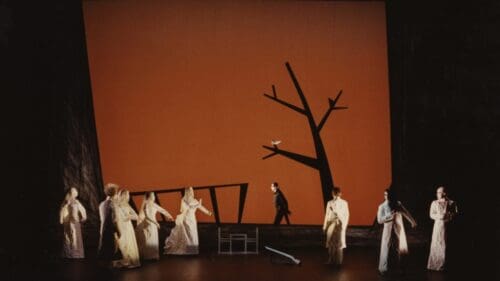
Pelléas et Mélisande (photos by Javier del Real) opened 7 February, 1997 at the Paris National Opera 21 July, 1997 at the Salzburg Festival
There were failures. Or at least misalignments. His Aida for La Scala in 2007 remains a cautionary tale in operatic abstraction. Grand opera needs a pulse, and Wilson all but stopped the heart. What should have been public ritual flared instead into alien procession. Critics split. Some praised the austerity. Others felt shoved outside the experience, unable to connect. Wilson appeared not to care. Compromise bored him. He did not direct for approval. He did not believe in catharsis. His theatre demanded attention, not tears.
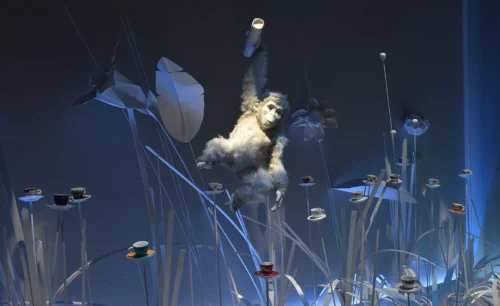
Robert Wilson’s 2017 dreamlike environment to showcase Illycaffé’s artist-designed coffee cups for the 57th Venice Biennale (photo courtesy of Illycaffé)
Perhaps his most uncategorizable creation was The Black Rider, a strange and haunted collaboration with Tom Waits and William S. Burroughs from 1990. Folk horror reassembled as haunted cabaret. Gunpowder lullabies and demon pacts, all filtered through a visual vocabulary that made every limb a question mark. It was theatre as trance. He let music become architecture, let language collapse into sound, let meaning float off entirely.
He drove theatres mad. He was expensive. He replaced lighting rigs wholesale. He required hundreds of rehearsals for a single finger movement. Entire productions hovered on the brink of collapse under the weight of his demands. Yet when it all worked—and sometimes it did—it changed the room. He altered what an opera house could be. He made image and sound equals, not rivals. He reminded musicians that stillness has tempo.
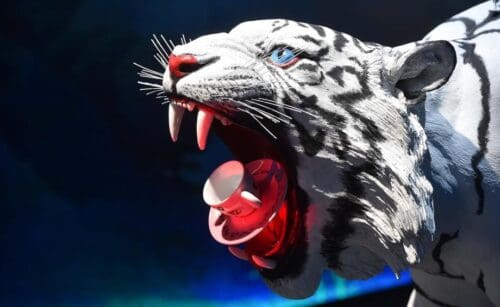
Robert Wilson’s 2017 dreamlike environment to showcase Illycaffé’s artist-designed coffee cups for the 57th Venice Biennale (photo courtesy of Illycaffé)
There are those who say he reinvented opera. That misses the point. He took opera somewhere else entirely. He traced it backward to ritual, to mask, to torchlight and the slow turn of bodies before language existed. He lit the stage in such a way that time itself became the protagonist. He made it impossible to forget the act of watching.
You could not cry at a Robert Wilson production. You could not lose yourself. But you might feel something colder. Something deeper. You might remember what it was to see theatre before theatre had a name. And now that he is gone, the stage feels too fast again. Too loud. Too obvious. Something has gone missing. Something shaped like a line.

This is an excellent and moving commentary on the work of this great genius.