


Areas We Cover
Categories

Theater Review: PARADE (National Tour, CIBC Theatre Chicago)

by C.J. Fernandes | August 7, 2025
in Chicago, Theater, Tours
DON’T LET THIS PARADE PASS YOU BY
In 1913, in Atlanta, Georgia, the body of Mary Phagan, a thirteen-year-old factory laborer, was found in the basement of a pencil factory. On the flimsiest of cases, a Brooklyn transplant, Leo Frank was arrested and charged with the crime. His ensuing trial, conviction, commutation, and grisly lynching is one of many low points in our nation’s history. It led to the formation of the Anti-Defamation League and the rebirth of the Klu Klux Klan and has inspired multiple movies, documentaries, books, a TV mini-series, and oddly enough, a Broadway musical with a Tony-winning book by Alfred Uhry and a Tony-winning score by Jason Robert Brown.
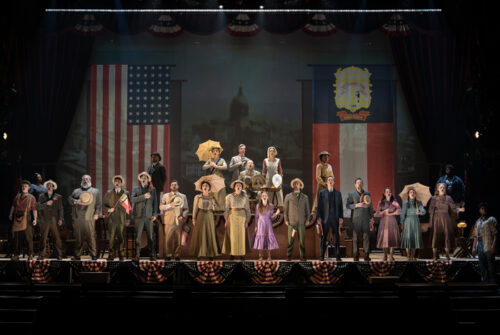 The National Touring Company of PARADE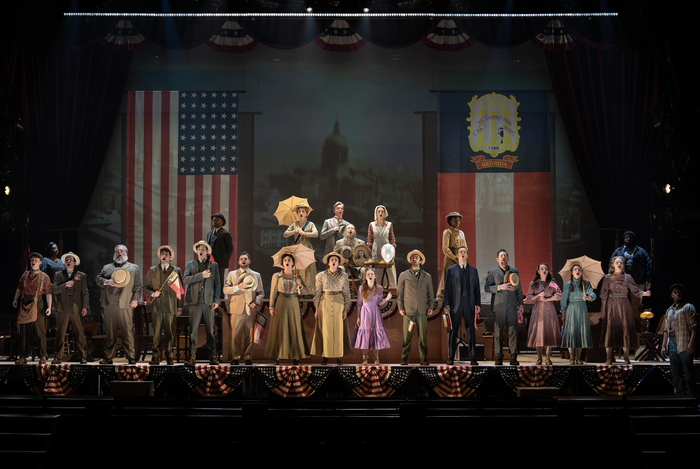
I say “oddly” because one does not expect a deeply upsetting story like this to adapt itself to that most joyous American art form: the musical. The national tour keeps Michael Arden’s direction from the 2023 Broadway revival and with good reason. The show is superbly paced and staged, never letting up for a second. The bravura trial sequence, which comprises the entire second half of the first act, encompassing nine songs and culminating in Leo Frank’s guilty verdict, is about as gripping as anything I’ve seen on a stage. The audience was completely in thrall. A silence so profound that you could hear the rustling of some of the players costumes.
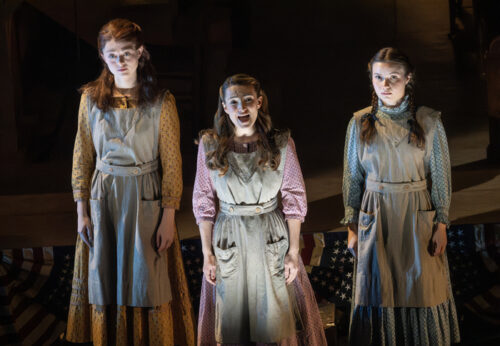 Bailee Endebrock, Sophia Manicone and Emily Rose DeMartino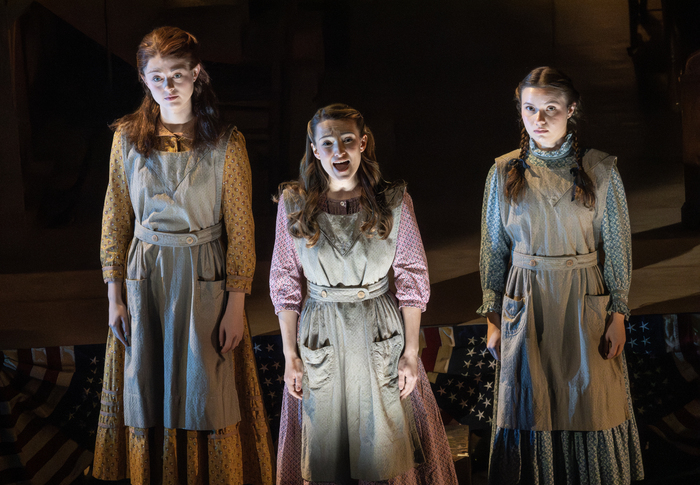
Parade opens on Dane Laffrey‘s stripped-down set. A dais occupies the center of the stage with risers on either side. Most of the action takes place on the dais or on the levels in front of it. It’s a clever decision. Restricting the already small space adds a level of intimacy that would usually be found in a theatre-in-the-round, not on a proscenium in the gloriously posh CIBC theatre in the Chicago Loop. Adding to that intimacy, is Heather Gilbert‘s stellar lighting design that uses the blue spectrum to shade the different scenes to marvelous effect. Her light transitions, especially during the tricky trial scenes, are an immense aid to the cast in general and Leo Frank in particular, allowing them to switch between the competing narratives with a fluidity that’s rarely pulled off on stage.
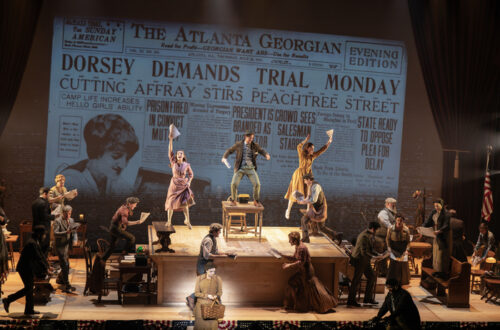 The National Touring Company of PARADE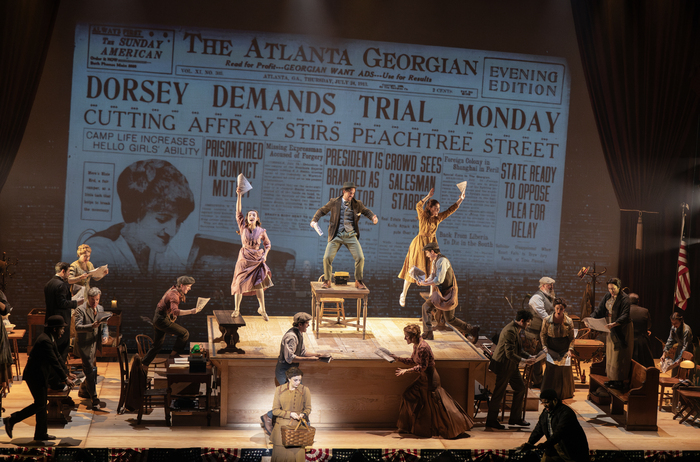
This is not a show that pulls its punches. At the very beginning, indeed, even before the lights in the theatre have dimmed, Sven Ortel‘s projection on the upstage wall shows us a historical marker of the lynching of Frank in Marietta, Georgia, zooming in until the entire backdrop is covered in coldly descriptive text. There will be no surprises. There will be no ignoring history. If I had to pick the production’s one masterstroke that elevates the show beyond any other—and there are several—it is the use of projection. At no point does Parade let us forget that these are real people upon whom grave injustices were perpetrated. As the show moves inexorably towards its horrific conclusion, at each step of the way, photographs of the real people behind the characters are projected onto the backdrop. Headlines from the newspapers of the day (typos and all) accompany the narrative as it twists and turns, the noose slowly tightening around Leo Frank’s neck. This is not a musical that’s afraid of its source material, and more importantly, this is a musical that respects the intelligence of its audience.
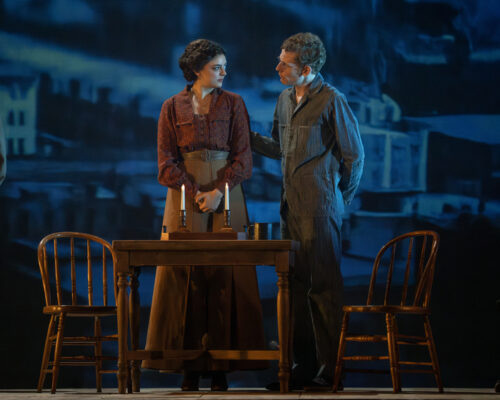 Talia Suskauer and Max Chernin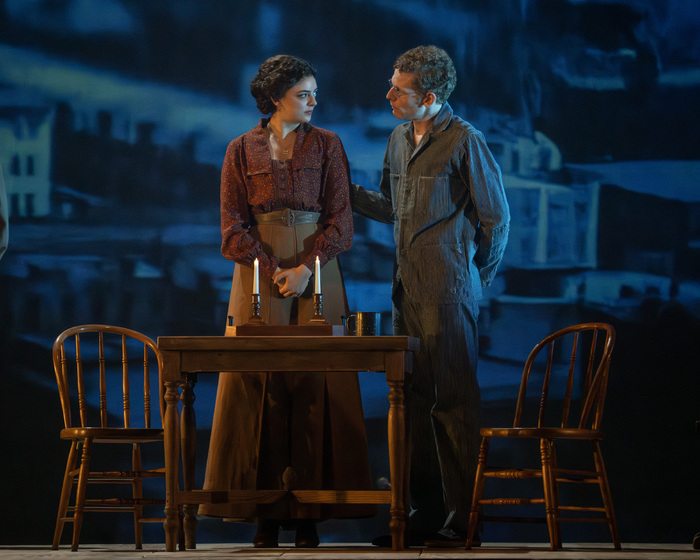
The actors are even more impressive. Max Chernin as the stoic Leo Frank and Talia Suskauer as his steadfast wife Lucille are nominally the leads, but this is a true ensemble piece. And it is to their great credit and generosity as performers (particularly in the first act) that their performances are pitched at the same level as the rest of the cast; it elevates the entire production. It gives me tremendous pleasure to say that I simply cannot pick any actor over their fellow performers. The performances are beautifully synced to each other without a single weak link. Michael Tacconi is a marvel as the gleefully amoral, irrepressible journalist Britt Craig (“Real Big News”); Griffin Binnicker is terrifying as the newspaper owner and propagandist, Tom Watson (“Hammer of Justice”)—every time his sonorous tenor boomed out, a palpable shudder ran through the house; Andrew Samonsky is sleazy perfection as district attorney Hugh Dorsey (“Something Ain’t Right”); and Chris Shyer is heartbreaking as Governor Slaton (“Pretty Music”) whose conscience asserts itself too late for Leo Frank. Really, they’re all wonderful, down to the smallest parts, and all of these pitch-perfect performances are anchored by Chernin and Suskauer.
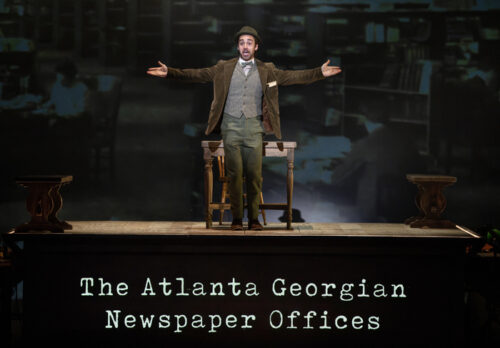 Michael Tacconi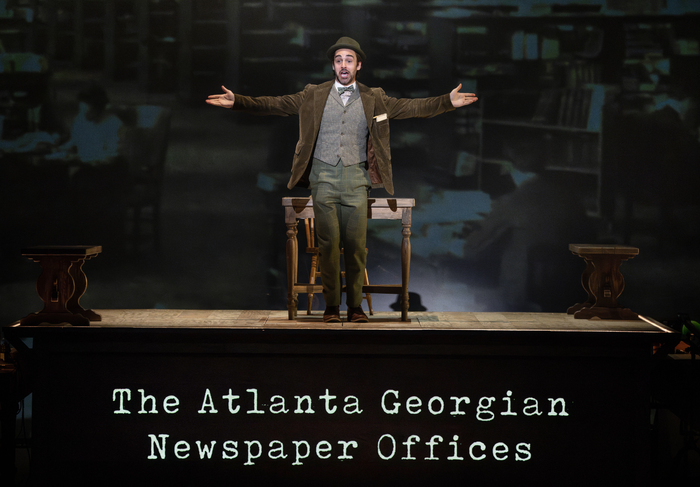
Uhry’s book wobbles on occasion, but never too badly, and there are welcome touches of wit both subtle (a throwaway reference to Dickens’ Fagin brought a wry smile to my face) and overt (“I doubt Jewish money is backing Henry Ford”). He wisely avoids polemics in the dialog, leaving the lyrics to depict the virulent antisemitism and racism of the era. It’s enormously effective because when the slurs are dropped, they hit the audience hard. Witness the collective gasp from the audience when Jenny Hickman as Mary’s grieving mother Mrs. Phagan spits out, “I forgive you, Jew” at Frank during her testimony at the trial.
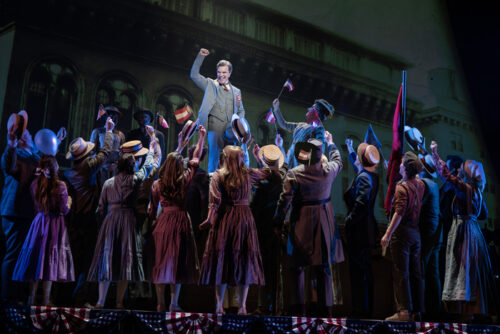 Chris Shyer (center) and company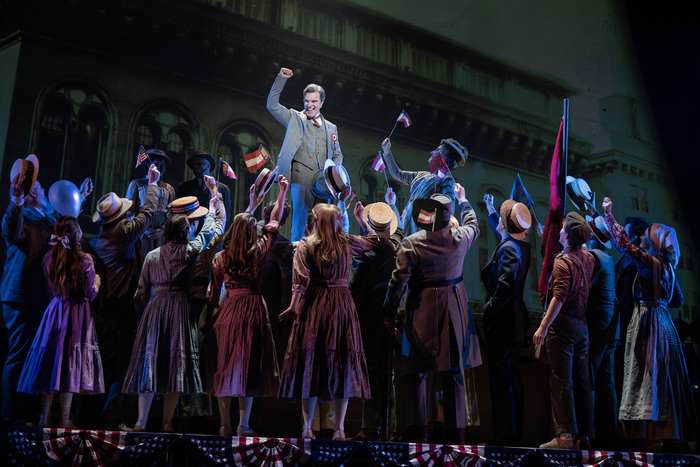
The score was Brown’s first for a Broadway show and it is absolutely glorious, moving from genre to genre and switching tones effortlessly with a confidence that belies his age (he was 27 when he composed and wrote the songs). Quite like the actors, the songs don’t compete with each other but serve the story harmoniously. There isn’t anything here that would become a standard and there shouldn’t be. The influence of Sondheim is everywhere but I was also reminded, particularly with the more vitriolic numbers, of the great Randy Newman—now sadly known more for his Disney soundtracks than his masterful albums in the 1970s and 80s—a Jewish musician raised in Louisiana who created the most incisive, scathing, and witty songs about lowlifes in the Deep South.
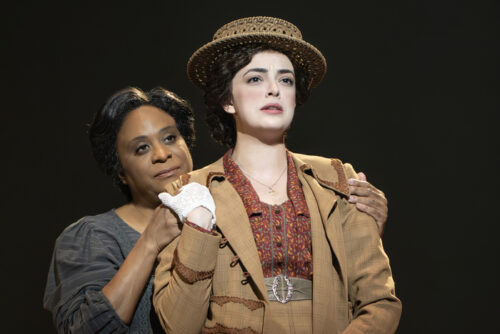 Danielle Lee Greaves and Talia Suskauer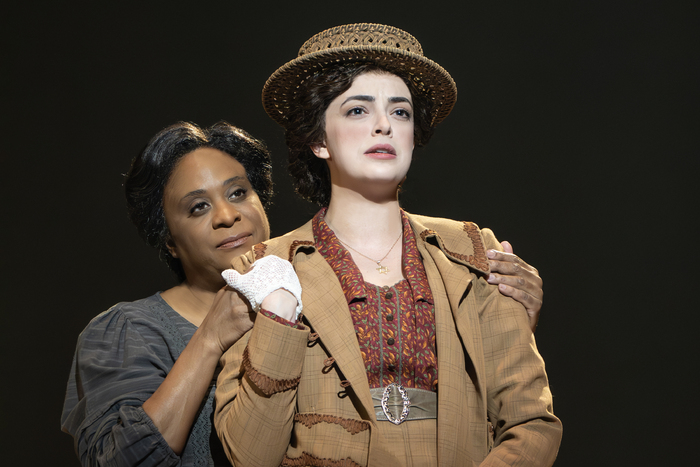
In addition to the aforementioned occasionally wobbly book, the only quibble is that the second act is a bit of a letdown, but it’s hard to imagine how anything could follow that first act and not disappoint (again, shades of Sondheim, particularly Sunday in the Park with George), but I will not rain on this Parade. The staggering ambition of this work is impressive enough. That the cast and production team pull it off so masterfully is a monumental achievement.
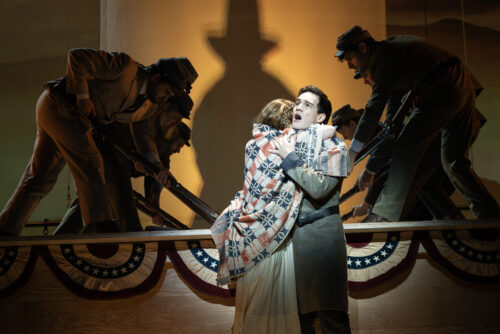 Trevor James and company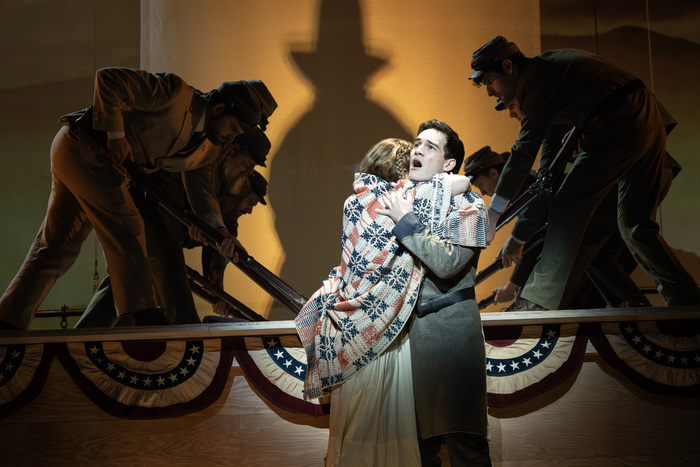
photos by Joan Marcus
Parade
national tour
ends on August 17, 2025, at Chicago’s CIBC Theatre
2 hours, 30 minutes with one intermission
for tickets, visit Broadway in Chicago
tour continues; for cities and dates, visit Parade
for more shows, visit Theatre in Chicago
