


Areas We Cover
Categories

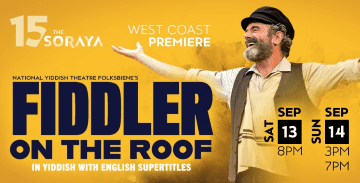
Highly Recommended Theater: FIDDLER ON THE ROOF IN YIDDISH (In Concert at The Soraya)
by Michael M. Landman-Karny | August 14, 2025
in Los Angeles
COMING HOME
When Fiddler on the Roof opened on Broadway in 1964, it collected nine Tony Awards and captured the universality about families weathering change. But backstage, Zero Mostel and director Jerome Robbins were barely speaking. Their feud had roots in politics: Mostel had been blacklisted during the McCarthy era, while Robbins had cooperated with the House Un-American Activities Committee. Meanwhile, some critics complained that the show had been sanitized, stripped of the harsh realities Sholem Aleichem wrote about in his stories of Jewish persecution.
That was fifty-four years ago. On September 13 and 14, 2025, enter The Soraya knowing that you are about to witness something different entirely.
The National Yiddish Theatre Folksbiene’s 2018 production, directed by Joel Grey, didn’t just revive Fiddler. It resurrected it. With Steven Skybell as Tevye and the entire script translated into Yiddish, the show (Fidler Afn Dakh) became what Jesse Green of The New York Times called a revelation: “Even the jokes were making me cry.” Stage and Cinema said, “No matter how many productions of Fiddler on the Roof you’ve sat through, you ain’t seen nothing yet until you’ve seen it in Yiddish, until you’ve heard it in the language in which the shtetl residents of Anatevka spoke.” The pandemic killed their touring plans, but now The Soraya has partnered with National Yiddish Theatre to bring this production West for the first time, in concert form, with the return of the entire original cast, including Skybell, who received a 2024 Tony nomination for his Herr Schultz in Broadway’s Cabaret.
Here’s what makes this event extraordinary: this is North America’s first-ever full, professional production of Fidler Afn Dakh, yet the Yiddish translation isn’t new. Shraga Friedman wrote it in 1966, two years after the Broadway opening. First, a production in Hebrew translated by Dan Almagor was produced in Jaffa by Giora Godik, a Polish-born impresario. Kanar al HaGag played for fifteen months, and a Hebrew-language cast album was produced by Godik. During the run, Godik was inspired by the performance of Vilna-born Shmuel Rodensky as Tevye, which led to the idea of doing the show in Yiddish. That’s when Friedman (working in part from Almagor’s Hebrew version) created Fidler afn Dakh, the version you will hear at The Soraya. It only ran a few weeks in 1966, enough time for Godik to produce a recording in Yiddish. Meanwhile, understudy Chaim Topol took over for an ailing Rodensky in the Hebrew production as the lead, which led to his playing the role in London in 1967 and then on film in 1971, both in English.
Friedman knew what he was doing. A Holocaust survivor from Poland who’d made it to pre-state Israel in 1941, he worked as an actor, playwright, and director. He understood Broadway, sure, but more importantly, he understood what Yiddish could do when you didn’t apologize for it. His translation for Joseph Stein’s libretto and Sheldon Harnick’s lyrics isn’t really translation at all. It’s excavation.
Take “If I Were a Rich Man,” which becomes “Ven Ikh Bin a Rotshild” (“If I were a Rothschild”) in Friedman’s version. The English song is charming, almost whimsical. Tevye dreams of wealth with a kind of innocent yearning. But in Yiddish? The consonants bite. The words carry bitterness alongside the dreaming. This isn’t just about becoming a millionaire. It’s about dignity systematically denied, about a social order that has ground you down for so long that even your fantasies taste of anger.
 Album of Fiddler on the Roof in Hebrew
I grew up hearing Yiddish as a second language, catching fragments of my grandmother’s conversations, understanding the rhythms even when I missed the words. Listening to “Shadkhnte, Shadkhnte” (“Matchmaker, Matchmaker”) on the Yiddish cast recording, I heard something the English version couldn’t capture. When the sisters tease about ending up with a drunk or a brute, it’s not playful anymore. The threat feels real because it was real. Bad marriages in the shtetl meant lifelong suffering, and everyone knew it. Friedman doesn’t explain this. It’s built into the language itself.
 Fiddler on the Roof 1965 Cast Album in Yiddish
This is what Friedman understood about Yiddish: it carries its own history. When Tevye addresses God as “Got” (God) in one moment and “Riboyne shel oylem” (Master of the Universe) in the next, he’s not just choosing synonyms. He’s shifting between intimacy and formality, between complaint and reverence. The language holds centuries of Jewish argument with the divine, and Friedman lets that weight settle into every line.
His Tevye doesn’t deliver Broadway soliloquies. He conducts the kind of debate you’d hear in a study house: part prayer, part legal argument, part comedy routine. It sounds lived in because it is. This is how Jewish men actually talked to God, how they wrestled with questions that had no clean answers.
The historical moment matters here. Friedman was writing twenty years after the Holocaust, for Israeli audiences who often saw Yiddish as the language of victimhood. Hebrew was the language of the new Jewish state; Yiddish belonged to the ghetto, to exile, to defeat. Friedman could have modernized, could have made his translation more palatable. Instead, he leaned into the exile completely.
What a radical choice. By insisting that Yiddish could carry every human emotion, joy and eroticism and philosophical depth alongside the suffering, Friedman rescued the language from its own stereotype. His Fiddler doesn’t mourn the old world. It brings it back to life.
The effect on the musical’s ending is profound. The English version closes with bittersweet acceptance. These things happen; families scatter; life goes on. But in Yiddish, with the weight of what actually came next hanging over every word, the expulsion from Anatevka becomes prophecy. Tevye’s final words carry knowledge the English version can only hint at.
Jerry Bock’s score, written in pseudo-klezmer style, suddenly makes perfect sense. All those moments where English syllables fought against Eastern European melodies disappear. The music was always reaching toward this language. Friedman just helped it arrive.
Choosing to do a concert format at The Soraya feels exactly right. Strip away the staging, costumes and scenery, and you’ll be left with what matters: voices carrying words that have waited decades to be heard properly. No elaborate choreography, no distracting spectacle. Just the text and music in conversation, the way Friedman always intended.
For those of us who understand Yiddish, even imperfectly, this production offers something precious: validation. The language we absorbed from kitchen conversations and bedtime stories, the one we sometimes felt embarrassed about or struggled to claim, can carry great art. It’s not just the dialect of exile and suffering that popular culture makes it out to be. It’s a complete language that once held an entire civilization.
But you don’t need to speak Yiddish to understand what’s happening here. Friedman’s libretto doesn’t charm or entertain in the usual sense. It does something more difficult: it holds up a mirror to a world that existed and was destroyed, then breaks that mirror and lets every shard catch the light.
What Friedman wrote transcends translation. It’s commentary, counterpoint, resistance. It’s eulogy, but also something stubborn and unkillable. Some voices, once silenced, find ways to return. This is one of them, and it’s coming home.

Fiddler on the Roof in Yiddish
National Yiddish Theatre Folksbiene | West Coast Premiere
Younes and Soraya Nazarian Center for the Performing Arts (The Soraya)
18111 Nordhoff Street in Northridge
Sat Sep 13 | 8PM
Sun Sep 14 | 3PM & 7PM
for tickets, call 818.677.3000 or visit The Soraya
