


Areas We Cover
Categories

Concert Review: BOOK OF AYRES (Cécile McLorin Salvant and Sullivan Fortner at The Baker-Baum Concert Hall in La Jolla)
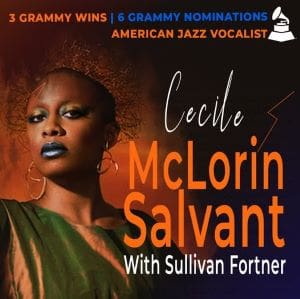
by Michael M. Landman-Karny | August 23, 2025
in Concerts / Events, San Diego
CÉCILE MCLORIN SALVANT
AT THE CROSSROADS OF CENTURIES
The stage offered only a microphone and harpsichord when Cécile McLorin Salvant began Purcell’s Music for a While. No fanfare, no program notes, just her voice leaning into a blues bend as Sullivan Fortner’s continuo pulsed beneath like a rhythm section. In an instant, Purcell’s London was speaking directly to Harlem.
Salvant has made a career of finding such fault lines. Since emerging in the 2010s, the Miami-born, French-trained singer has mined everything from folk ballads to Occitan verse with a scholar’s curiosity and a jazz musician’s instinct. Her classical training in Aix-en-Provence only deepened the link she hears between early music’s directness and the storytelling of blues and jazz. Where most singers fence off repertoires, Salvant walks the land as if it were one terrain.
Purcell, of course, was a synthesizer himself, folding French elegance, Italian drama, and English plainness into his ayres. They were written for intimacy, their sophistication balanced by clarity. Salvant honors this by showing how the same suspensions that create drama in Restoration song also power the “blue” inflections of jazz. Both traditions trust the singer’s freedom over the bar line; both know the truth lies in what happens between the notes.
Her If Music Be the Food of Love proved it. Fortner’s harpsichord set a crisp frame, but Salvant stretched phrases with ballad timing, her breath shaping silences that notation never suggested. She lingered on “excess” until it became hunger itself. You could feel the room lean in. It was neither Baroque nor jazz but the human voice carving meaning out of time.
Fortner’s shifts between harpsichord and piano underlined this dialogue. In Sweeter Than Roses, the harpsichord’s filigree gave way to piano harmonies that might have passed through Bill Evans’s hands. Yet the change felt inevitable, not ornamental—Purcell speaking two dialects at once.
 photo by Sam Zausch
Where Cleo Laine once kept Purcell and jazz in parallel, Salvant collapses the distance. Her Dido’s Lament showed how. She resisted operatic grandeur, almost whispering the line. Each ornament was less display than intake of breath. At “Remember me,” time froze. A woman behind me gasped. This was not interpretation; it was inhabitation.
The second half sharpened her thesis: that “art song” and “popular song” are later inventions. Purcell’s O Solitude slid into a Bessie Smith blues as if they were companions all along. Both treated loneliness with ornament that bent toward truth. Salvant moved between them not as visitor but as native.
The implications ripple outward. Historically informed performance insists on fidelity; jazz insists on reinvention. Salvant suggests both miss the point: Purcell was already an adapter, pulling from court dances, opera, and folk. To approach him with jazz’s freedom is not anachronism but fidelity of another kind. And when a Black American woman sings Purcell as ancestral voice, she does not stake ownership through argument but through artistry so complete the question dissolves.
Fortner matched her throughout, articulating harpsichord lines with studied restraint, then shifting to piano voicings that propelled without intruding. He proved, as she did, that these languages are not opposed but complementary.
The evening ended with Strike the Viol, which became less a Baroque ode than Salvant’s own credo. Every ornament declared that these instruments of the past remain alive for urgent storytelling now.
Leaving the hall, I realized the boundaries I carry as critic—Baroque here, jazz there—are habits of writing, not of sound. Salvant’s Book of Ayres dismantles them. Her Purcell breathes with jazz timing because both traditions understand music’s essence lies not in the notes but in the charged air between them: the pause, the hesitation, the instant where score turns to lived experience.
Most radically, she argues that authenticity is not replication but engagement. Her Purcell felt necessary, not historical. One suspects he would have recognized the honor. He might even have asked to sit in.
Book of Ayres
Cécile McLorin Salvant, voice; Sullivan Fortner, keyboards; Emi Ferguson, flute;
Dušan Balarin, theorbo/lute; Yasushi Nakamura, bass/violone; Keita Ogawa, percussion
presented by La Jolla Music Society
Summerfest at The Baker-Baum Concert Hall
reviewed on Saturday, August 16, 2025
for more info, visit Cécile McLorin Salvant
