


Areas We Cover
Categories

Dance Review: FRANKENSTEIN (San Francisco Ballet at Segerstrom Hall in Costa Mesa)

by Michael M. Landman-Karny | October 3, 2025
in Dance, Regional, Tours
When creation becomes choreography in Frankenstein,
the laboratory turns into a stage of desire
Mary Shelley’s creation continues to haunt not only literature but the stage, where movement and music conspire to make visible the tremors of his unnatural birth. The late choreographer Liam Scarlett’s Frankenstein, brought vividly to life by San Francisco Ballet, joins a long tradition of retellings, yet it asks something riskier of its audience: to see the body as both invention and exile. The ballet moves between awe and unease, reminding us that art, like life, is never finished but always reaching toward recognition.
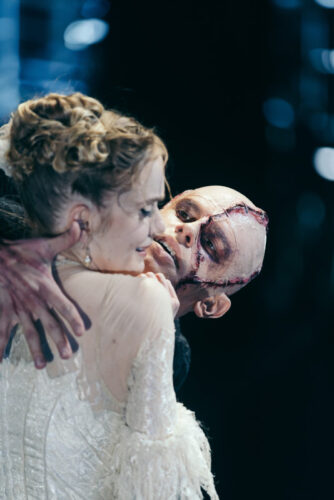

The ballet opens in the Frankenstein household, a world of warmth dimmed by loss. Victor’s mother dies during childbirth, and grief marks him more deeply than science ever will. Scarlett turns the moment inward rather than outward. The choreography folds around Victor’s anguish instead of dramatizing it, showing how pain curls into obsession. Elizabeth, his adopted sister and companion since childhood, becomes a steadying presence. Their duet is tender but edged with something unspeakable, the calm before the storm of invention.


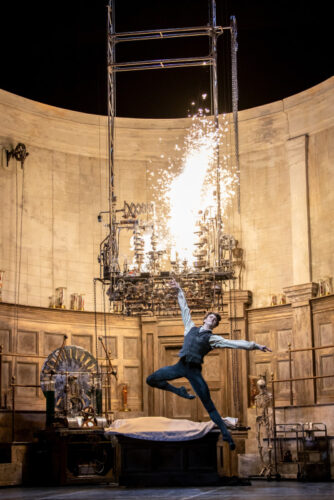
The pulse of the corps shifts time forward, their measured patterns sketching the daily rhythm of village life. Victor’s departure for the university in Ingolstadt feels like a rupture as home dissolves and the stage turns cold. His laboratory rises like a cathedral devoted to forbidden discovery, all metal, glass, and flicker. Here the dance becomes feverish. Victor circles through gestures that could be devotion or delirium, his body wound tight by curiosity. When the Creature he creates awakens, stillness steals the air. His movements grope toward coherence, fragile and uncertain, as if learning to exist were an act of pain. Victor recoils. Their encounter is brief but charged, each one mirroring the other in horror. The first act ends with Victor’s flight and the Creature’s first loneliness, the new-made thing left staring at the light that now refuses him.
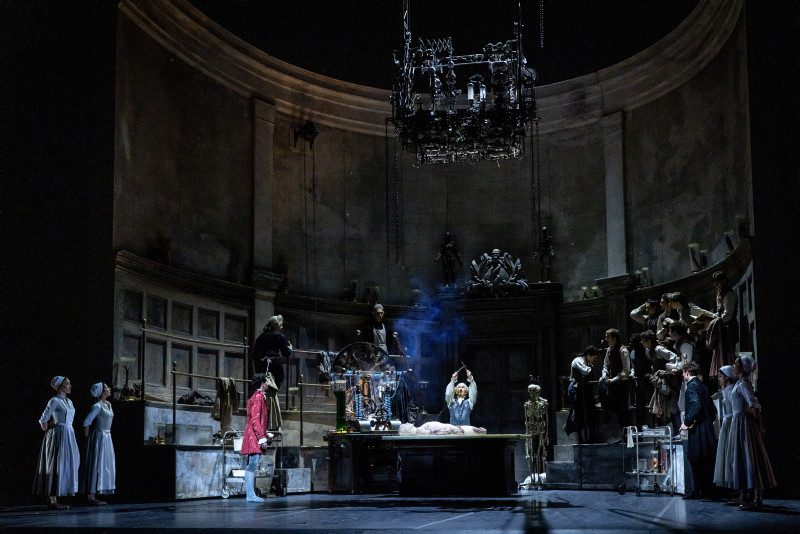
John Macfarlane’s designs build the world from shadow and shimmer. The laboratory gleams with steel and smoke, an altar to ambition. Light slices through the gloom in narrow beams, turning discovery into something hunted. At home, the palette softens, lamplight spilling across wood and fabric, a fragile refuge that feels already lost. The contrast between spaces carries the emotional weight of the story more than words ever could.
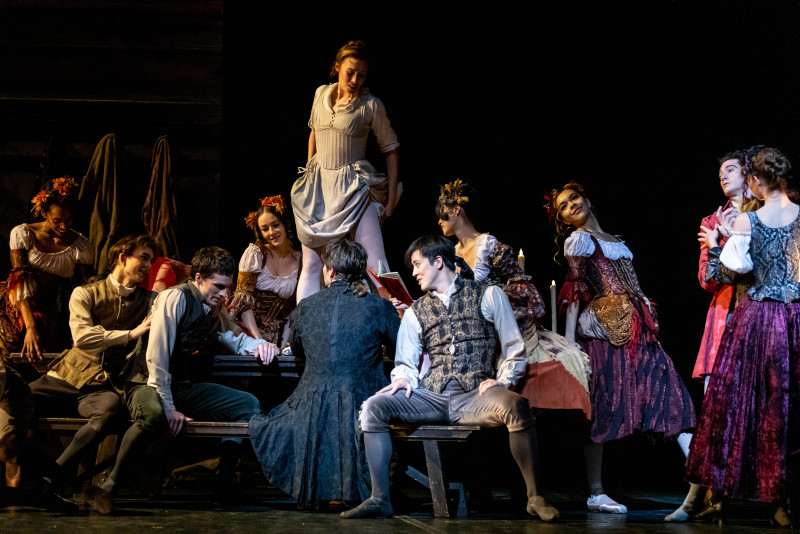
David Finn’s lighting all but speaks. In the beginning, Victor stands inside thin bars of illumination, as if already imprisoned by his own brilliance. Later, during the village festivities, warmth floods the stage; the air glows with gold and rose. The Creature’s entrances shatter that order, a wash of cold silver falling over him, the outsider made visible through color. The balance between light and shadow keeps the ballet in a constant state of moral suspense.

Lowell Liebermann’s score refuses the easy route of Gothic flourish. Instead, it hums with contradiction. In the laboratory, surging strings and pounding percussion seem to echo Victor’s heartbeat. When the Creature stirs, the orchestra hangs on a single trembling chord, searching for stability it never quite finds. Elizabeth’s music, by contrast, opens into long, breathing lines that feel like relief, fleeting but luminous. Liebermann’s orchestration tightens again when society reasserts itself, rhythm driving the corps into rigid unison while brass erupts around the Creature’s dissonant entrances. The music becomes a dialogue between order and rupture, beauty and noise.


The Pacific Symphony played beautifully and tightly under the direction of conductor Martin West, whose control of dynamics lent the performance both muscularity and clarity. The orchestra’s precision amplified the ballet’s emotional pulse, shaping each act with care and restraint.
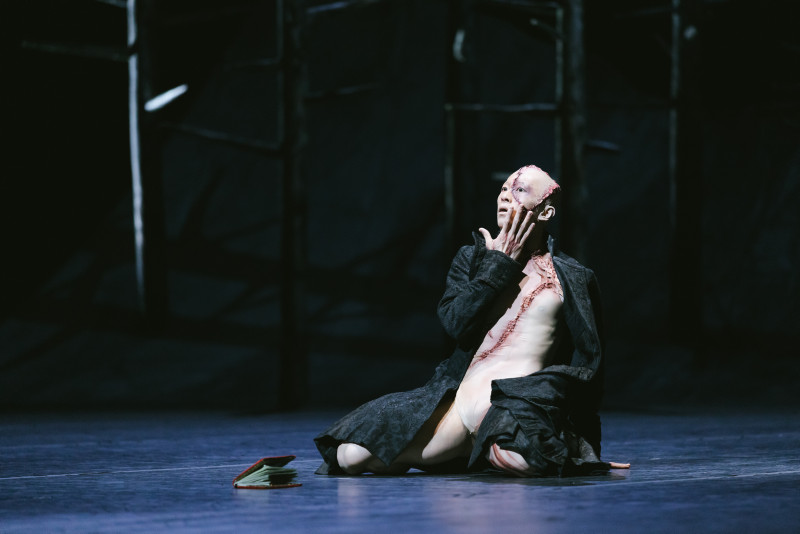
The ballet’s defining moment came toward the end of Act II, Scene 1, when the Creature, performed by Joshua Jack Price, delivered a solo of devastating intensity. His movement oscillated between weight and grace, light and shadow, embodying the contradictions of existence itself. Price’s physical command was astonishing, his sculpted frame heightening the homo-social tensions that ripple beneath the story’s surface. Every gesture spoke of longing and confusion, his phrasing both lyrical and brutal. It was a moment of pure theater that seemed to hold the entire stage in suspension.

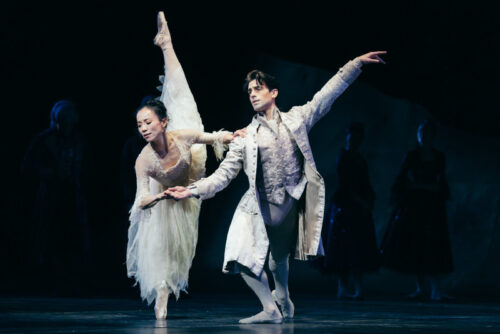
Also deserving of praise were Max Cauthorn as Victor Frankenstein and Sasha De Sola as Elizabeth. Their pas de deux traced the fragile arc of devotion and despair, each movement speaking of love pressed against fate. Cauthorn proved a commanding partner and a soloist of psychological depth, his performance taut with intellect and guilt. De Sola’s phrasing shimmered with sincerity, her dancing luminous even in tragedy. Together they anchored the production’s emotional center, translating Shelley’s words into muscle and breath.
In Act II, Victor and Elizabeth share a duet of near stillness, their movements pared to the edge of silence. The orchestra thins, leaving space for air and pulse. Love feels fragile, not consoling. When the Creature returns, the texture fractures, a low ostinato grinding beneath high, restless strings. The music begins to chase itself, and the stage becomes pursuit.


The third act is both tragic and tender. When the Creature cradles Elizabeth’s lifeless body, the orchestra answers with silence more eloquent than any cry. Each chord that follows feels like breath leaving the room. The final image, his figure dissolving into darkness, refuses closure. The score unravels into uncertainty, as though grief itself is the only music left.
Scarlett’s choreography moves with the music’s volatility. Victor spins through loops of invention and regret. The Creature’s steps are slow, deliberate, burdened by weight and wonder. Elizabeth moves like a human memory, her phrasing spacious and yielding. The corps holds the center, its order a fragile net that keeps chaos at bay. Together, they create a visual fugue on the cost of creation.


When placed beside other dance versions of Frankenstein, Scarlett’s work stands out. The Royal Ballet premiere in London in 2016 was a gamble, and its ambition still feels audacious. Unlike the abstraction of Wayne McGregor’s Woolf Works or the grotesque stylization of early twentieth-century experiments, Scarlett keeps faith with storytelling but filters it through psychological texture. Liebermann’s music and Macfarlane’s design complete the architecture, a nineteenth-century scaffold built to house modern unease. In this realization, clarity and emotional risk coexist with rare balance.

Some imperfections remain. The village scene, while beautifully danced, lingers a little too long. The Creature’s stitched makeup verges on the literal, as if afraid the audience might not see what the body already says. Yet the production’s emotional precision overshadows these quibbles.


By its end, Scarlett’s Frankenstein leaves not terror but ache. It asks what happens when the urge to create outruns the capacity to care. In an age drunk on invention, from genetic editing to artificial intelligence, the ballet feels eerily current. It turns the old Gothic question inside out, wondering if the real monster is not the thing we make but the emptiness we leave in it. That thought lingers, long after the final silence.


photos by Lindsay Thomas
Frankenstein
San Francisco Ballet
Renée and Henry Segerstrom Concert Hall, 600 Town Center Drive in Costa Mesa
ends on October 5, 2025 (reviewed on October 3)
for tickets and *alternating cast info, call 714.556.2787 or visit SCFTA
for more info, visit SF Ballet
