


Areas We Cover
Categories hhhh

Film Review: THE BUSINESS OF FANCYDANCING (Written and Directed by Sherman Alexie; Restored)

by Rob Lester | November 10, 2025
in Film
A TRIBE, A DIATRIBE,
MOVING AWAY & MOVING ON
Say what you will about the ties that bind. If those ties were literally ropes, some of them would stay strong and some would fray or break. Arguably, time does not heal all wounds; some hurts fester and foster resentment for years. Prodigal sons may have some luck being welcomed back home, but others learn that returns and reunions can result in disappointment that things have changed—or regret that some things haven’t. “You can’t go home again,” Thomas Wolfe told us.
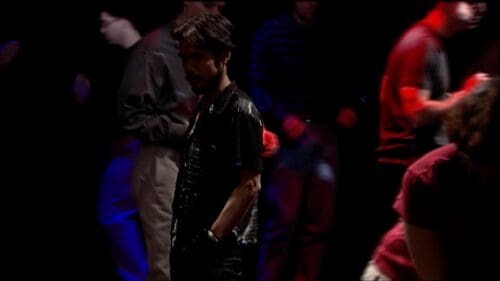
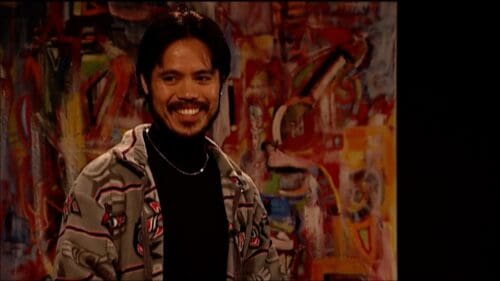
In the often compelling and sometimes confusing The Business of Fancydancing, we meet a writer named Seymour who returns home, after a very long time, to attend the funeral of a friend from his youth. Home is in the state of Washington, on the reservation where he grew up among other American Indians. (Note that, in the dialogue, the characters mostly describe themselves and their neighbors as “Indians,” a term rejected by many in favor of “Native Americans” or “indigenous people.”)
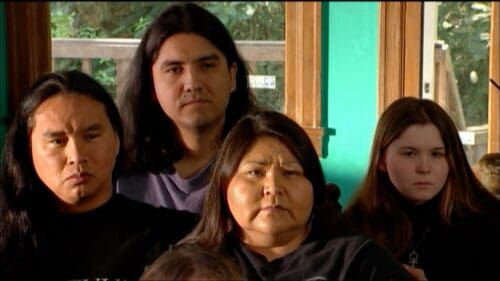
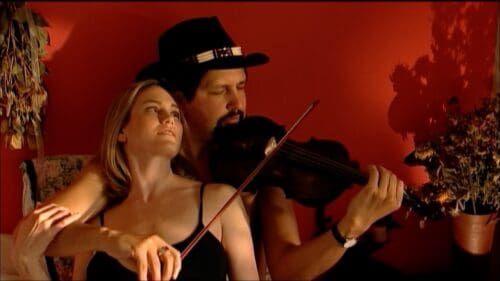
Seymour left the reservation life behind, becoming assimilated in the mixed—but majority-white—population of Seattle. Some brand him an ungrateful opportunist, making money by boldly writing about Indians in an unflattering light—rejecting or mocking that life while accepting the attention and notoriety that come with presenting his own heritage as a kind of spokesman. Some still on the reservation certainly don’t see him as a hometown hero or “local boy makes good.” We see pages of his book ripped and burned. There are burning resentments and the half Indian/half Jewish Agnes, an old flame he met in college, who learned that Seymour wasn’t really burning for her. Why? Because he had realized he was gay.
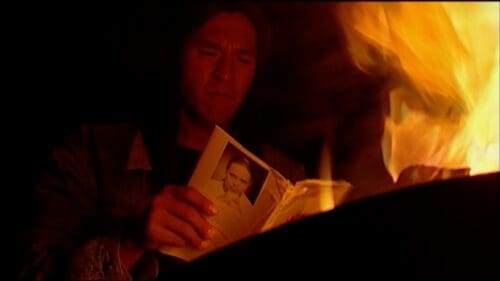

The plot thickens—but not chronologically. The film, edited and photographed by Holly Taylor, bounces around in time, with scenes of the protagonists in the present (around the time of the funeral) and many incidents from the past—college days in the 1980s—plus reflections on their youth, as well as some fantasy-style moments. It may take a while to adjust to the whiplash and figure out where and when we are for the first few seconds of some scenarios, but the kaleidoscopic nature of the mix is effective in dramatizing perspective. Seymour is variously strong, stressed, defensive, determined, elusive, elated, reflective, resentful, kind, and kind of snippy. It’s interesting to know that the character was developed as a mix of the lives and personalities of the actor (the charismatic Evan Adams as Seymour Polatkin) and the writer/director Sherman Alexie. The latter’s own poems are used as examples of poet Seymour’s work.


The movie, quite emotional at times, takes an admirably impressive approach in the way it shows sympathy to numerous characters’ points of view and priorities, plus their decisions. Although Agnes, as played sensitively by Michelle St. John, comes off as calmly mature, noble, thoughtful, and forgiving, others are painted as less angelic and more conflicted, multi-faceted people. Viewers might easily feel drawn to Seymour and his charm, but will wonder about justifying his feelings and motives. In a scene where he’s asked questions by fans while signing books, his answers show a loose connection to the truth. The footage is also sprinkled with excerpts from a TV program where he’s grilled by an interviewer (Rebecca Carroll), and it becomes a battle of wills as she presses him to be honest while he dodges, deflects, and turns passive-aggressive.


There’s tension galore with his onetime B.F.F., the angry loose cannon named Aristotle (Gene Tagaban, whose usually effective M.O. of showing understandable bitterness is overplayed a bit in one in-your-face confrontation). The deceased buddy, Mouse, is portrayed as a somewhat elusive free spirit in flashbacks by Swil Kanim. Some goodwill built up for characters can evaporate when they lash out in an out-of-proportion way; a scene where a stranger—a stranded motorist—is beaten up is chilling. Moods kinetically contrast. So we observe the heartfelt and the heartless; real caring and ambivalence; freewheeling youthful elation and sobering older observations.

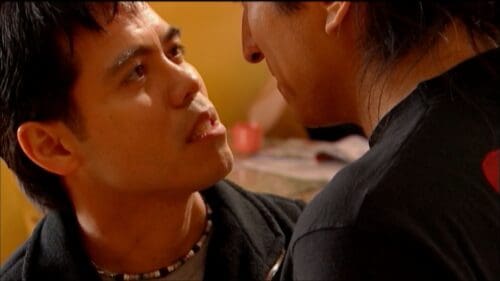
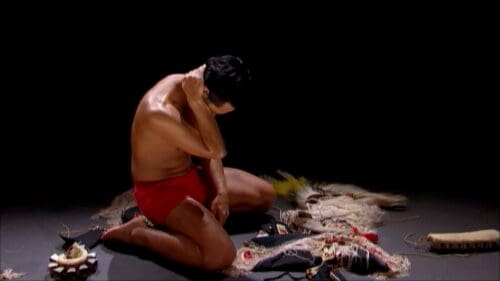
In the same way that its characterizations aren’t all sunny and sweetened, facing real life, The Business of Fancydancing doesn’t dance around the realities of prejudice and the non-cheery aspects of life for Indians on reservations. It doesn’t flinch out of fear of reinforcing stereotypes or overemphasizing certain realities backed up by statistics. As the TV interviewer points out, there is a higher proportion of poverty, addiction, and suicide. The glum and gritty tones are presented, including references to financial inequality, a scene at an Alcoholics Anonymous meeting, and the indication that Mouse took his own life. But there are also lovely examples of community bonding, proud long-lasting traditions, native songs and garb, and the titular terpsichorean twists and turns.
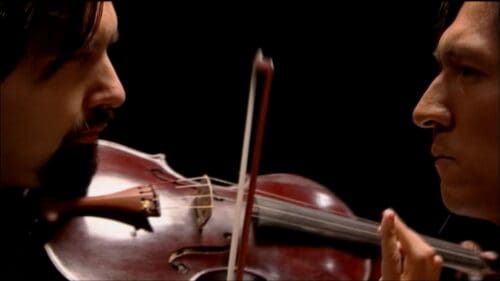

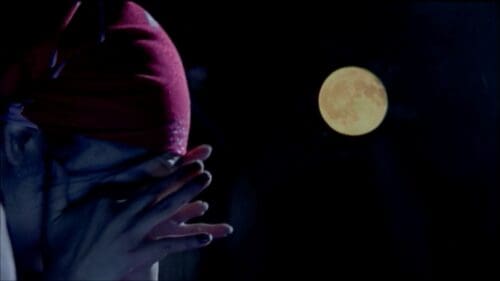
If any of this gives you a cinema-specific sense of déjà vu, it’s because this is not a new motion picture. It was first released back in 2002 and has been restored, coming back with greater resolution and color correction. And, wow!—there are bright colors that really pop. (A scene with Mouse strolling wordlessly through a wooded area for a while is worth it just for the gorgeous greens.)
✦ ✦ ✦ ✦ ✦ ✦ ✦ ✦ ✦ ✦
photos courtesy of Kino Lorber
The Business of Fancydancing
A FallsApart Production
a new restoration presented by Milestone Films
produced by Larry Estes and Scott Rosenfelt
2002 | color | 103 min | United States | English
opens at Quad Cinema in NYC on November 14, 2025
and in limited release nationwide
✦ ✦ ✦ ✦ ✦ ✦ ✦ ✦ ✦ ✦
