


Areas We Cover
Categories

Feature Story: RAYMOND MUNRO (On Adapting Works by Raymond Carver into Story Theatre on Film)
by Emily Brenner | November 13, 2025
in Books, Film, Virtual
Raymond Munro (photo by Stephen DiRado)
TWO RAYS UNITE IN A
JOURNEY OF STORY THEATRE
Theatre, by its nature, is ephemeral. That is part of its allure, and part of what we love about it. It forces us into the here and now- ever changing and ever present. We are also keenly aware of the opposite side of that coin: by design, we cannot preserve this living, breathing art form. Thus, every masterful performance, each fresh directorial concept, all those perfectly timed light cues are quickly lost forever, save perhaps in the memory of the lucky few who were present in those moments.
One might say an antidote to this impermanence can be found in filmed story theatre, where pieces are rehearsed like plays, shot like film, and read like books. The actors rehearse as intensely with a director as if they were preparing to present live theatre. The text of the piece is often a literary work like a story or an article, the characters delivering the omniscient point of view of the story much like a narrator. We may hear the characters speaking amongst themselves underneath or within the reading of the text, which adds to the theatrical feel.
This way of presenting theatre is unique because the actor-as-reader of the text should be as free of “acting” as possible. There is no preconceived interpretation of the lines, no color to the narration. The actor simply lets the lines come through them like a vessel, as opposed to adding any emotion or specificity. This creates a more universal experience for the audience to take in the story and lets the emotion and specificity come from the action and the physicality of the piece.
What is lost from the intimacy of a live performance is gained as the audience is included up-close in the subtext and context through the character’s inner voice. It’s almost like watching a play from the front row and being read to at the same time.
Certain literary works are just screaming to be adapted into filmed story theatre, but not all directors are cut out for the job. The person at the helm must not only have a honed language and facility going deep with actors and a command of storytelling but must also be passionate about literature itself.
Enter the dynamic duo of two Rays: Raymond Carver and Raymond Munro — the former a short story writer, poet, and professor prolific in the 1970s and 80s, the latter a director, actor, and theatre professor working and teaching during that same time. From Carver’s short stories and Munro’s expert creative and directorial hand came some truly innovative story theatre — first live on stage, and then happily on film as well. It feels like fate how these two Rays eventually came to meet, and yet it makes sense considering the trajectory of Munro’s theatre journey.
Ray Munro, inspired by his early acting teacher and director Don Sanders in Chicago and then New York City, was already playing around with the concept and form of dramatizing literary works early on in his career. In his words, he was “drawn to working with non-theatrical material.” To begin, he worked with the Living Newspaper concept (born out of the work of famed Bertolt Brecht) where performers would act out the news, dramatizing current social and economic issues. This provided fertile ground for Munro’s fascination with adapting sources and resources that weren’t necessarily based in theatre.
It helps that Munro is a voracious reader and consumer of art, and passionate about sharing work he finds fascinating. This passion led him to contact Douglass Hofstadter whose book Godel, Escher, Bach (exploring artificial intelligence and the Turing Test) he knew he wanted to adapt into a theatre piece. Hofstadter was happy to grant permission, and Munro adapted some of the dialogues from the book to present onstage. One of them, entitled Coffee House Conversations is a conversation between a physicist, biologist, and philosopher. By this time, Munro was teaching at Clark University in Worcester, MA and had three of his theatre students play the roles. To top it off, he invited a professional physicist, biologist, and philosopher to offer their responses to the text and to engage the audience in dialogue. He presented this piece at the university itself, and in Boston.
Raymond Carver in 1988 (born May 25 1938, died August 2, 1988)
(photo by Marion Ettlinger, Public domain, via Wikimedia Commons)
Clearly, Munro has a taste for inventive theatre, and for finding rich source material in all kinds of places. One such place being the New Yorker magazine, where he next read a Raymond Carver piece in the early 1980s that particularly struck him. This was his first introduction to Carver, and it was love at first read. Hailing from the blue-collar Midwest, Munro immediately related to and appreciated Carver’s blue-collar Pacific Northwest “that’s the way the cookie crumbles” outlook; a sense of no matter what is happening in your life or in the world, you get up and go to work. When Munro moved to the east coast to live and work, he was struck by what he affectionately terms a sort of “pathologized” ideology there, characterized by less grit and more anxiety and fretting. He often felt out of place in the northeast, so Carver’s voice was a welcome comfort for this artistic transplant, who noticed literature in the country being dominated by the more coastal eastern voices at that time. As Munro says, “Ray was not that voice. I was drawn to it and felt that I got him in a particular way that other people wouldn’t. I wanted his work to be known, out there.”
If any director were to adapt the work of Carver, Munro was the perfect fit. Not only did he relate to and see the value in sharing the voice of middle and blue-collar America, he also particularly loved and appreciated Carver’s use of language itself. He likens the author’s work to such geniuses as Samuel Beckett where, in Munro’s words “every phrase had been completely realized.” This kind of economy and succinct perfection had always impressed Munro, who would go on to direct several Beckett works in his career.
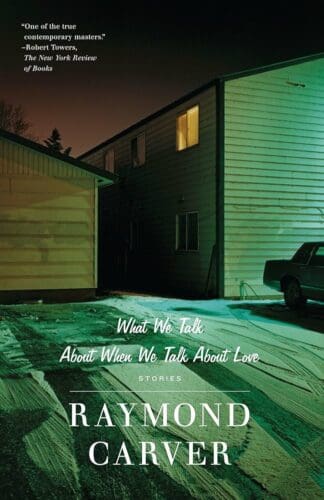
Thus, as is Munro’s wont, he simply wrote a letter to Carver (back in the days before e-mail and the waves of tech and media that made everyone so accessible to each other), stating that he admired Carver’s work and was particularly taken by the recent compilation of short stories from The New Yorker: What We Talk About When We Talk About Love. Munro proposed adapting it for the stage, promising to be loyal to every word of the text. Carver agreed and even accepted Munro’s invitation to come to Clark University to attend the production, bringing his young son along too. The writer had no idea what to expect, as this had never been done with his work before. In fact, Carver’s university students at the time were so trepidatious and protective of their professor and his work that they showed up to the production almost ready for a fight. Luckily, Carver loved the pieces, and the students were rightfully put at ease.
Munro fondly remembers the experience of having Carver there and getting to spend time together after the show. He recalls how the author was in a period of sobriety where it seemed as if he was starting anew on the planet, living with beneficence and wonder and gratitude for life. The two Rays would continue their friendship, corresponding in the few years to come before Carver’s early death.
Back at Clark University, Munro was up for tenure and needed to find a way of presenting a body of his work to the committee. For better or worse, academia values exposure and tangible proof of breadth of oeuvre. As he says, he needed to “publish something that was not locked in the magic land of the theatre.” The answer to this conundrum led Munro to the idea of filming his work with the Carver pieces, in the fashion of story theatre.
By connecting and working with different contacts at the university, local artists, and particularly Walter Henritze at a local media company, he was able to gain some traction. For example, fellow professor Michael Spingler wrote a piece entitled Repondeur that Munro directed and shot with a whole volunteer crew who was in it for the experience of working in film (as opposed to the up-and-coming digital media). Munro and crew then moved on to his adaptation of the Carver pieces Mr. Coffee and Mr. Fixit and Preservation. Technology was evolving rapidly, and by the time it came to film Munro’s adaptation of another New Yorker short story (Hostess written by Donald Mangum), the filming could be done digitally with non-linear editing, which helped to streamline the concept.
Throughout the whole process of converting from stage to film, Munro committed to always working from the perspective of a theatre director first, starting from the first rehearsal. Anyone who has been lucky enough to participate in a Ray Munro production knows well his signature intense approach to rehearsing. The folks who answered his audition calls from local and university publications were happy to get their paychecks in the form of experience working like this.
Gino DiIorio, a student of Munro’s during this time who played one of the two main characters in the Carver piece Preservation, recalls how the rehearsal process emphasized both total presence and synergistic teamwork. He remembers Munro saying: “You’re not a lead singer, you’re a member of the band.” This forces the performer into a certain kind of presence where, as Gino says. “It’s gotta come from you,” as you are playing with the band whose dynamics shift at any given moment, and cannot be manufactured or be anything other than making music together in the here and now.
Munro’s commitment to going beyond simply working on the text to explore concepts like presence and teamwork, combined with his extensive experience in and appreciation for the world of theatre, plus his love of literature and film is obvious in viewing these filmed pieces of story theatre. Thankfully, some of these pieces have gone on to have a more public life. For example, a TV show called Likely Stories hosted by Glenn Close premiered Munro’s adaptation of Carver’s Mr. Coffee and Mr. Fixit both in the states and in Europe, and his Preservation aired on PBS in Chicago.
Today, we are lucky to have sites like Vimeo where work like this can live for the pleasure and insight and education of all. Munro kindly offers the link up for free to anyone interested.
When asked what he would like people to take from this work, Munro is quick to put the focus on Carver, who he describes as “a great writer, a great soul. It was a blessing and privilege to know and work with him.” Instead of pointing to various lessons or morals that could be taken from these pieces, Munro feels that it is not his business to dictate that. If each story is like a piece of art, he wants the work to speak for itself, and to allow people to have the freedom to meet each piece of art in whatever way they are drawn to.
Of directing, Munro says “You find the work that you want to serve. You realize and present the work, and people will meet it in all different ways…You try to do it well and get out of the way.” Anything else, he says, is not his business and not what he’s there for. For example, by stating that a piece is about mental health awareness or depression almost reduces it to only that, which is not what Munro wants at all. His aim, his credo, has always been “to protect and further the work- everybody’s work.” Said like a true director of the theatre, indeed.
To view four of Ray Munro’s short story theatre pieces, Mr. Coffee and Mr. Fixit, Preservation, Repondeur, and Hostess, visit Vimeo.
Stay tuned for one more work to come, born out of the need to create art during the height of the recent pandemic.