


Areas We Cover
Categories

Theater Review: PERIL IN THE ALPS (Austin Playhouse)

by Leo Emerson | November 22, 2025
in Texas, Theater
POIROT TRIES STANDUP —
CAN HE FIND THE LAUGHS?
Hercule Poirot, Belgium’s preeminent detective, makes a bold and comic appearance at Austin Playhouse in Steven Dietz’s Peril in the Alps, a follow-up to his Murder on the Links, both theatrical reimaginings drawn loosely from Poirot Investigates, Agatha Christie’s 1924 collection of short stories, and the book originally titled THE Murder on the Links, the second novel to star Poirot.
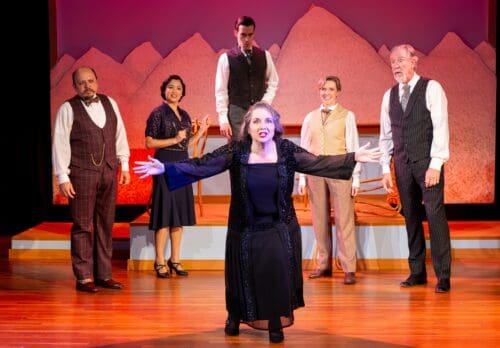
If you’re familiar with Christie adaptations — except Kenneth Branagh’s recent film catastrophes — you know how effortlessly her tales translate to stage and cinema. Dietz’s script, borrowing situations and character types from different Christie sources, plays fast and loose with the source material, and some of his choices, satirizing the Christie style, land closer to caricature than homage. There are plenty of laughs throughout, but the detective story itself proves nakedly uncompelling. The direction seems to agree: A play often teaches you how it wants to be understood, and here there is a subconscious tug-of-war between actors and text. A detective story is most satisfying when we solve the mystery alongside our sleuth — which only works when the characters give the mystery genuine weight. Peril in the Alps wants us to revel in hijinks while also admiring Poirot’s reasoning, and that tonal split never fully reconciles.
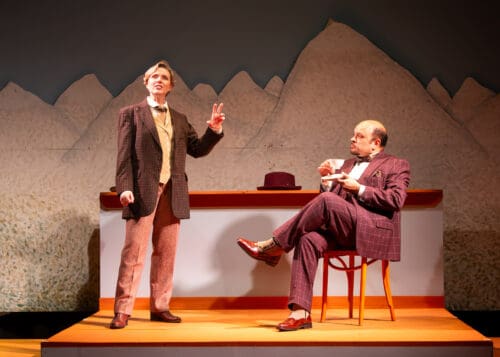
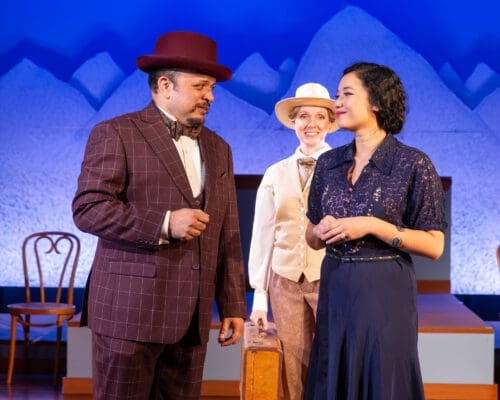
A wife is kidnapped; a husband disappears; Poirot questions the possible connection as we meet all the eventual suspects who might be involved in the disappearances. Poirot is already an inherently humorous creation, but Christie knowingly refrained from letting him tip into parody. Ben Wolfe, an Austin Playhouse regular, plays the famed detective with the expected trappings: the exaggerated bad French accent, a pinstripe suit, precise mustache, and tight and controlled movements. Wolfe is a capable actor who knows how to feed an audience, happily prating about in polished Oxfords and savoring the ends of his sentences. He excels at looks of disgust or disappointment, and always seems perched to give us a knowing glance, but his performance never escapes exaggeration, collapsing the intricate elements of Poirot into something closer to Inspector Jacques Clouseau.
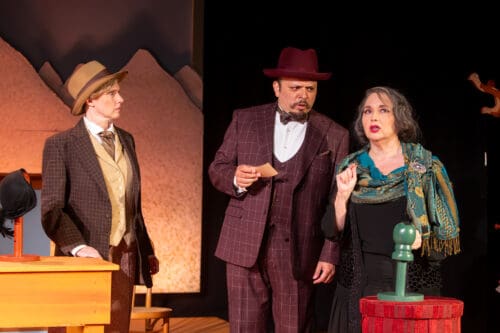
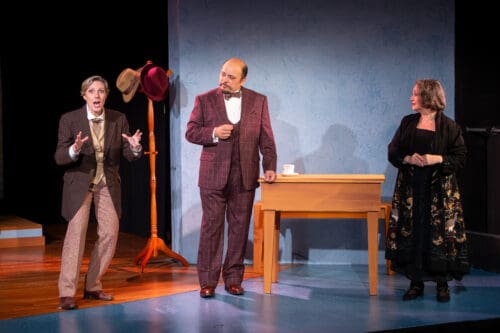
The rest of the ensemble struggles with similar issues, primarily due to the accents. Every character speaks with one. A good accent goes unnoticed, or appreciated later when you realize you’re still in Austin and not London after all. Mildly, the accents are disruptive and seem to cause the actors to overhaul their natural annunciation abilities. As Captain Hastings, Lara Toner — another company regular — battled an indeterminate British accent throughout, often concentrating so hard on sustaining it that her characterization thinned out. The same held true for most of the cast. The lack of command reinforced the cartoonish tone, and the actors seemed quite content to lean into the running gag rather than find a way out of it.
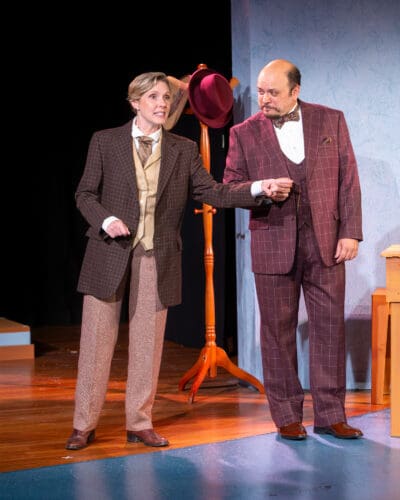
A notable exception is Bailey Ellis, who plays six distinct roles and sharply defines each with different vocal modulations, dialects, and physicalities. For Ellis, accent is an integrated part of character — not a gimmick. It’s a desperately overused adage, but comedy simply is a funny way of being serious, and Ellis allows his characters’ seriousness to generate the humor. In contrast, others approached the material as comedy first, character second.
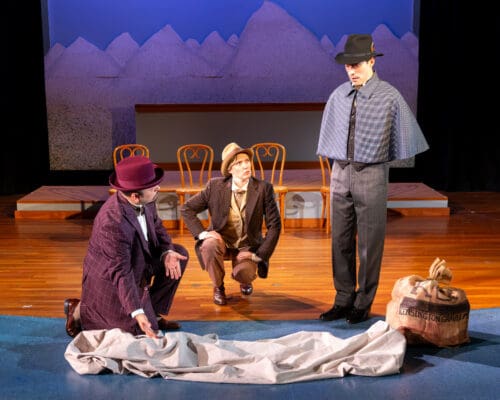
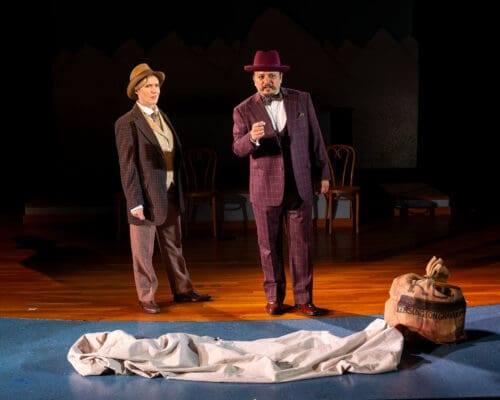
Nonetheless, the show runs a brisk two hours with a fifteen-minute intermission, and under Robert Tolaro’s direction, it never stagnates. Working with six actors covering twenty-six characters, Tolaro embraces his limitations: quick changes of Diana Huckaby‘s costumes abound, Mike Toner‘s set transitions are handled by the ensemble, and Robertson Witmer and Robert S. Fisher sound is also inventive. Mark Novick’s lighting is particularly notable; with actors constantly in motion, he chooses his silhouettes, spots, and color palettes with precision, bringing a graphic-novel sharpness the story otherwise lacks.
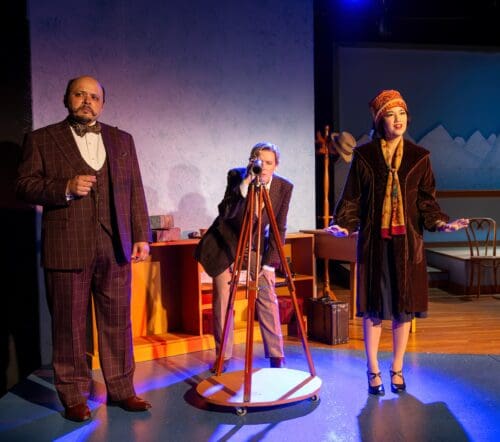
The production’s brightest moment, also one of its best theatrical inventions, comes when Poirot and Hastings deliberate over all the evidence — their recounting is told through puppetry (props by Kiryat Jearim Castillo). The four other actors, lit only to the neck, operate hat stands with assorted hats to represent the suspects. It’s captivating, and despite being pure exposition, it carries a charge and imaginative spark the rest of the play often sorely lacked.
In the end, when Poirot explains it to us all, the solution doesn’t satisfy as it should. Detective stories thrive on that wrap-up thrill we know and love so well (that is why there is always a detective show on TV); it makes us feel smarter than we are, even if we guessed it was the handmaid when it was actually the butler. Peril in the Alps is limited by its own strengths: where it succeeds in making us laugh, it falters in holding our more serious attention.
✦ ✦ ✦ ✦ ✦ ✦ ✦ ✦ ✦ ✦
photos by Steve Rogers Photography
Peril in the Alps
Austin Playhouse (West Campus location), 405 West 22nd St.
Thurs-Sat at 7:30; Sun at 2
ends on December 28, 2025
for tickets, visit Austin Playhouse
✦ ✦ ✦ ✦ ✦ ✦ ✦ ✦ ✦ ✦
