


Areas We Cover
Categories

Theater Review: ALL THE DEVILS ARE HERE: HOW SHAKESPEARE INVENTED THE VILLAIN (Patrick Page at BroadStage)

by Shari Barrett | January 17, 2026
in Los Angeles, Theater, Tours
A MASTER VILLAIN TAKES THE STAGE
Patrick Page turns Shakespeare’s greatest monsters
into a riveting, slyly funny tour through human nature—
one blood-red spotlight at a time.
Dubbed “the villain of Broadway” by Playbill, Patrick Page has never shied away from exploring his dark side. Now, with his tour-de-force solo show All the Devils Are Here: How Shakespeare Invented the Villain, he turns his attention to the twisted motivation—and the hidden humanity—at the heart of Shakespeare’s greatest antagonists. Created and performed by Page, the Octopus Theatricals production is directed by Simon Godwin. Together, they bring Shakespeare to life in a dynamic, contemporary, accessible evening of mesmerizing artistry and powerful storytelling—delivered with rare intimacy.

Moving swiftly through Shakespeare’s canon of villains in chronological order, Page illuminates the playwright’s ever-evolving conception of evil by delving into more than a dozen of his most wicked creations. Thrilling, biting, hilarious, and enlightening, what Page delivers is a masterclass on the most terrifying subject of them all: human nature. Along the way, he shares examples of how each character’s darkness continues to influence villains in film, television, and streaming entertainment.
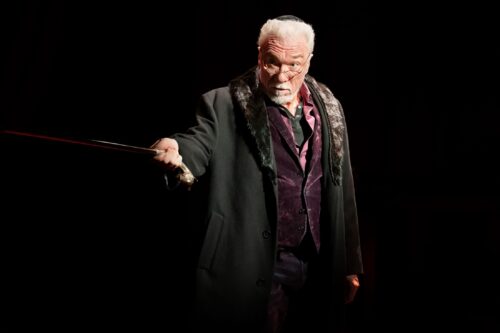
With Stacey Derosier’s lighting design (often blood-red) on three sides of Arnulfo Maldonado’s minimal set, Page begins by tracing where Shakespeare may have gotten the idea of giving even the most monstrous characters a kind of humanity. It begins in 1572, when an eight-year-old Shakespeare reportedly saw a traveling company of morality players. One masked character was known as The Vice, embodying the sins of humanity. Page brings that figure to life with a half-face red mask, accenting his lines with a red tambourine. But like a figure from Greek tragedy, the character has no soul—no humanity—only the embodiment of pure evil, often aimed at the disabled or at racial and religious minorities, people seen as less than human at the time.

Page then compares The Vice to Shakespeare’s first fully realized villain, Richard III—disabled and unbothered by how his actions affect others—perhaps a true sociopath, as many of Shakespeare’s villains can seem. Yet Shakespeare also understood how seductive villainy can be. Page points to Aaron the Moor in Titus Andronicus, then notes that the theater world soon shut down for two years due to the plague. Sound familiar? During that period, Shakespeare’s writing shifted, and Page connects it to the playwright’s fascination with love and desire, including the “dark-haired woman” who may have helped inspire the sonnets. Before then, Page notes, the romantic ideal onstage tended toward lovely blondes—a tradition Shakespeare complicated and upended.

In 1596, Page says, it was time to dig back into the darker corners of the soul with Shylock in The Merchant of Venice. The most interesting question about this infamous figure—demanding a pound of flesh—is what motivates him. Shylock’s brutality forces audiences to confront the reasoning behind his vengeance, and Page makes a case for the character’s humanity: his evil deeds are rooted in the cruelty of the society that surrounds him, and the relentless abuse he endures simply because he is Jewish. Page delivers a monologue that frames Shylock not as a monster, but as someone pleading his case—human, universal, and wounded.

Page then turns to Hamlet, a character who may be the Bard’s best-known troubled soul, and one whose story ends in the bloodbath required to purge the Danish court. Page delivers Claudius’s chapel soliloquy—spoken as the regicidal king wrestles with guilt and the limits of repentance—sharing not only the words but the jumbled thoughts underneath them. The result is a rare look at a villain who isn’t merely plotting, but caught in the trap of his own moral logic.

Measure for Measure examines lust and corruption, which Page traces forward into one of Shakespeare’s most chilling sociopaths: Iago in Othello, proving how evil can hide in plain sight. Page dexterously glides between Othello and Iago, beginning with mutual respect and camaraderie—then showing how Iago’s manipulation convinces the gullible Othello that his pure and beloved wife is cheating on him. Fueled by jealousy and a complete lack of conscience, Iago displays no shame or inner restraint, reminding the audience not only to listen to words but to watch actions. At that point, Page even pulls out a checklist of sociopathic traits, inviting us to consider whether we’ve encountered them in our own lives.

From there, Page moves through King Lear, Macbeth, and Lady Macbeth, with stage fog deepening the atmosphere as the three witches hover over the action. Page also reminds the audience—more than once—not to utter the name of that play inside a theater (it’s “The Scottish Play”), and shares how to counteract whatever theatrical doom might follow. Finally, it’s on to Prospero in The Tempest, the revenge-fueled wizard whose power conjures violent storms to trap his enemies. Darron L. West‘s enveloping sound brings realistic thunder and lightning, and Page’s booming mellifluous voice culminates in a final portrait of Shakespeare’s last villain, complete with a floor-stomping wooden staff. Page’s stage presence is so commanding and so in tune with the many sides of each complicated character that I now wish to see him play every villain in every one of these plays.
Following each performance, make sure to stay for a 20-minute Q&A with Page, offering a deeper look into the world of Shakespeare’s villains, Page’s personal relationship to them, and why he believes these roles only grow richer with age.
✦ ✦ ✦ ✦ ✦ ✦ ✦ ✦ ✦ ✦
photos by Julieta Cervantes
All the Devils Are Here: How Shakespeare Invented the Villain
Octopus Theatricals
BroadStage, 1310 11th St. in Santa Monica, CA (parking is free)
1 hour and 25 minutes with no intermission
ends on January 25, 2026
for tickets (starting at start at $45), call 310.434.3200 or visit BroadStage
tour continues—for dates and cities, visit All the Devils Play
check out Guthrie Theatre’s study guide here
✦ ✦ ✦ ✦ ✦ ✦ ✦ ✦ ✦ ✦
