


Areas We Cover
Categories

Theatre Review: FINDING DOROTHY PARKER (Laurie Beechman Theatre)
by Rob Lester | January 18, 2026
in Cabaret, New York, Theater
SARCASM ON STEROIDS
To say that Dorothy Parker had a way with words would be the understatement of the century—and she spanned two of them, being born in the last decade of the 1800s and hanging on until 1967. Even her own death was subject to one more pithy punchline. In a story with herself as a character regretting attending a party, she mused, “That would be a good thing for them to cut on my tombstone: ‘Wherever she went, including here, it was against her better judgment.’” She also once remarked that a three-word apology might suffice: “Excuse my dust.”
But long before she died—having survived depression, unhappy romances, being blacklisted in the McCarthy era, being widowed, and actual suicide attempts—it was clear that her fame would live on and her quips would remain notable and quotable.
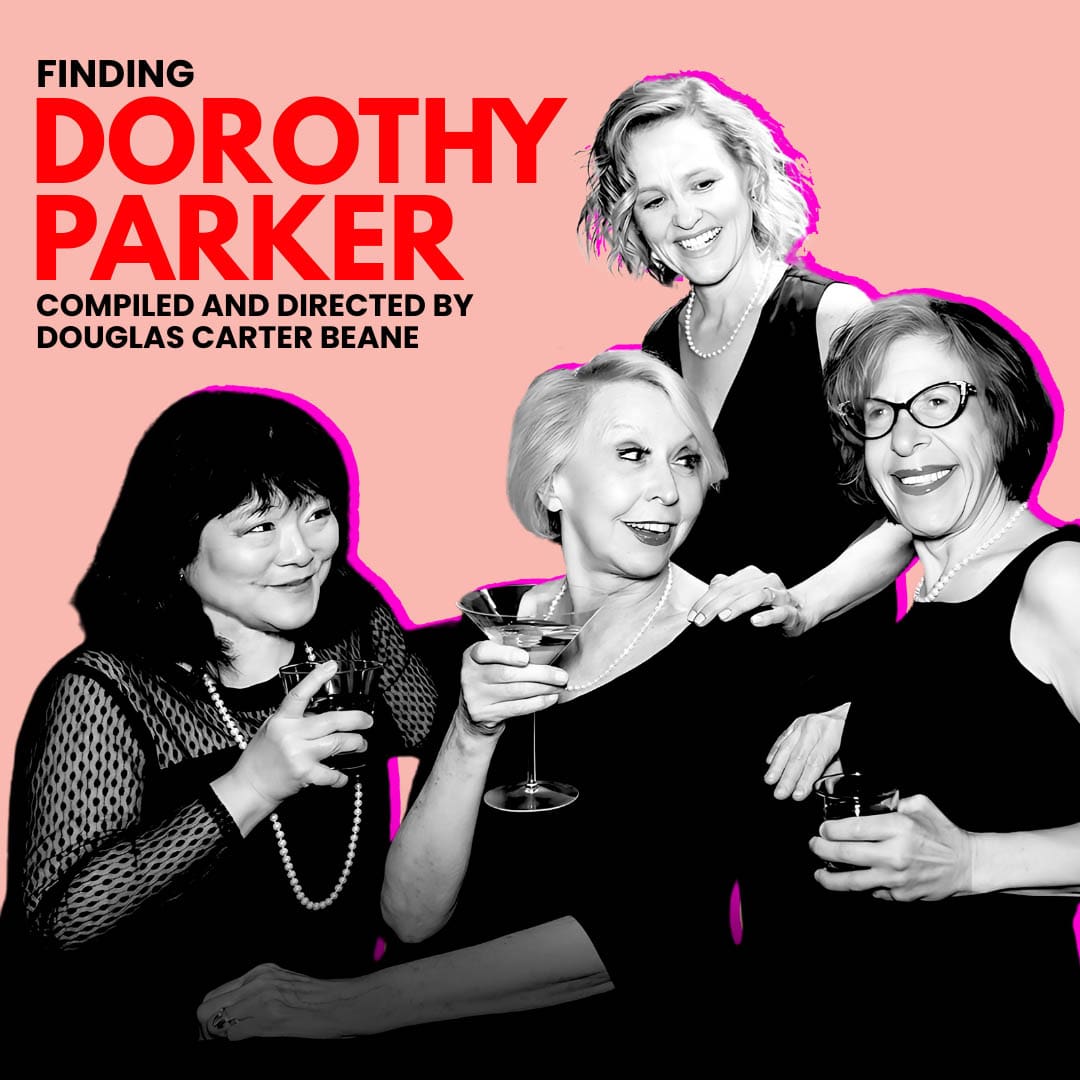
The latest evidence: Finding Dorothy Parker, featuring some of her stories, essays, poems, one-liners, and two song lyrics, performed by four funny women with Broadway credits. They share the stage in a row behind music stands holding script notebooks, commencing the reading (and a little singing). Two of them also deliver longer pieces from spots at the sides of the audience area at the Laurie Beechman Theatre (downstairs from the West Bank Café on West 42nd Street). They’ll be there nightly at 7pm through January 23.
A cornucopia of caustic wit, gripes, snark, and sighing provides laughs—and perhaps the reaction of “How true, how true!” or “Gee, I wish I’d thought of that.” The admiration/jealousy level increases when the zinger is in rhyme. Sometimes, after a chuckle subsides and eyebrows return to their normal height, listeners might wonder what more vulnerable soul might have been under the brittle shell.
One might also wonder how much of the strong, stinging statements are close to truth—or an expression of true feelings—and how much of the intensity is simply artistic license for effect.
This was a lady with opinions who wasn’t reluctant to spout them verbally or in writing, with Parker’s poison-filled pen and her testiness tapped into her typewriter. She once remarked, “The first thing I do in the morning is brush my teeth and sharpen my tongue.” But she also claimed she didn’t take particular pleasure in the process of writing, and, viewing it in the past tense, said, “I like having written.”
ANN HARADA, JULIE HALSTON, ANIKA LARSEN, JACKIE HOFFMAN
Of course, one evening’s worth of readings can only include a fraction of the prolific Parker’s output. In a sly reaction to one of her book collections, The Portable Dorothy Parker, Jackie Hoffman huffs that it’s 640 pages and asks, “Since when is that ‘portable’?” Her comically curmudgeonly persona is a good fit for a Parker saga about a terribly tedious dinner party, seated next to a man whose banal small talk consists of nothing but discussing the food being served (“I like salad. Do you like salad?”).
Julie Halston, who excels at expressing exasperation and exaggeration, has a rant lamenting the state of her fingernails—painted a color she doesn’t like (tangerine)—and then, adding to her agony, “the most horrible thing ever in my life”: one of the nails breaks. With accelerating complaining, she nails the job of portraying a character who treats this minor misery as if it’s a disaster of epic proportions. The speech comes in the form of diary entries about nights on the town, frequently mentioning Hungarian musicians wearing coats of a green color that pleases her far more than her nails ever did.
Ann Harada’s longest solo scenario concerns a woman of relatively patient temperament, smiling while dancing with a man who manages to step on her feet—ouch!—numerous times. And Anika Larsen, affecting an accent, inhabits an upper-class white woman meeting a famous “colored” man and loudly touting her lack of prejudice.
Throughout the evening, the women take turns with a litany of the Parker pet peeves (“I hate _____!!!!!!”). The despised things include an offered glass of Chablis (“Where I come from, we feed this to the pigs”); poems in free verse (so called, says she, because no one would pay for it); and theatre.
Theatre comes in for special hate for the opinion-filled woman whose career included working as a critic. Her displeasures included productions with the word “Yesterday” in their titles; those “downtown plays where metaphors go to die”; shows where “the curtain goes up at 8:00 sharp and comes down at 11:00 dull”; and a description of how Katharine Hepburn played one of her roles—a quote that starts to sound like a compliment, until the second half lands the shiv: her acting “ran the gamut of emotions… from A to B.”
Some sneers might have been tossed off verbally during gatherings with colleagues at the legendary Round Table at the Algonquin Hotel.
Terse to a tee, Parker is remembered for rhymed opinions such as “Theodore Dreiser ought to write nicer” and “Men seldom make passes at girls who wear glasses.” (The bespectacled Miss Hoffman lets out a protesting little cry when that one comes up.)
A barrage of barbs and grousing, even coated with terrific talent and timing, can start to feel like too much similar whining and opining—especially when it becomes too shrill for too long, or notably one-note Parker petulance.
As directed by Douglas Carter Beane, who curated the material and added some narration (including Dorothy Parker being investigated by the FBI and being fired), the show stays in a limited range of energies: funny fussing and fuming. This perhaps compensates for the lack of movement or drama, with performers largely glued to their spots and (somewhat) to their scripts.
When there’s variety, it’s welcome. Ann Harada’s natural sunniness comes through, thank goodness. And when she (and the others) sing, that’s a big plus. She’s radiant and unpretentious as a vocalist. If the rights to a couple of Parker poems set to music over the years could be obtained, that might be considered for a future presentation. (An early album by Barbara Cook was devoted to Parker poems, with melodies composed by Seymour Barab—and others have musicalized the texts, too.)
The songs used here are “I Wished on the Moon” (music by Ralph Rainger) and “How Am I to Know” (music by Jack King). Jackie Hoffman takes a solo on one of these, doing a spot-on impression of a famous singer who covered “I Wished on the Moon” twice.
Some existing recordings by our dear Dorothy herself have an understated, dry, world-weary tone that isn’t always captured in this production. But at the end of the day, the words are the star of the evening—and this gang of four is having a field day.
photo by David Lawrence
Finding Dorothy Parker
The Laurie Beechman Theatre at West Bank Café, 407 West 42 Street
ends on February 6, 2026 EXTENDED to March 8, 2026
$25 food/beverage minimum per guest
for tickets ($45.00 – $55.00), visit The Beechman
