


Areas We Cover
Categories

Theater Review: THE TRAGEDY OF HAMLET (Eddie Izzard; International Tour; Hollywood’s Montalbán)

by Ernest Kearney | January 24, 2026
in International, Los Angeles, Theater, Tours
A SOLO HAMLET BUILT ON
PRECISION AND VELOCITY
Inside the White-Box World of Izzard:
One Performer, Twenty-Two Roles, No Safety Net
Suzy Eddie Izzard—formerly known as Eddie Izzard until 2023 and now using she/her pronouns—is a groundbreaking British comedian known for her gender-defying stage persona. Now Izzard has taken up a new challenge, the actor’s equivalent of the Barkley Marathons: a one-person rendering of The Tragedy of Hamlet, Prince of Denmark—Shakespeare’s longest, most acclaimed work, the inspiration for Disney’s The Lion King, and a major influence on Sigmund Freud’s development of his Oedipus Complex—translated into over 75 languages, including Hebrew, Welsh, Icelandic, and even Klingon, by Nick Nicholas and Andrew Strader.
Izzard is no stranger to legitimate theatre. She portrayed comic Lenny Bruce in a 1999 production of Julian Barry’s Lenny. In 2003, she appeared on Broadway in A Day in the Death of Joe Egg, and in 2010, she replaced James Spader in the Broadway production of David Mamet’s Race.
At 63, Izzard joins the ranks of countless actors who have attacked the role of the bard’s Dane, such as Maurice Evans (of Rosemary’s Baby fame), who played the role over 287 times; Ralph Fiennes, who was the only actor to win a Tony (1995) in the role; and Laurence Olivier, the only actor to win an Oscar (1948) as the melancholy Dane (and Sir Larry was melancholy to the tits). Which reminds me of Sarah Siddons, the British actress who played the Prince at least nine times between 1775–1805. And let us not forget Richard Burbage, the first to chew the scenery as the mad prince. Yes, everyone, from Mel Gibson to Popeye the Sailor has played Hamlet—so now let Ms. Izzard take a swing at it.
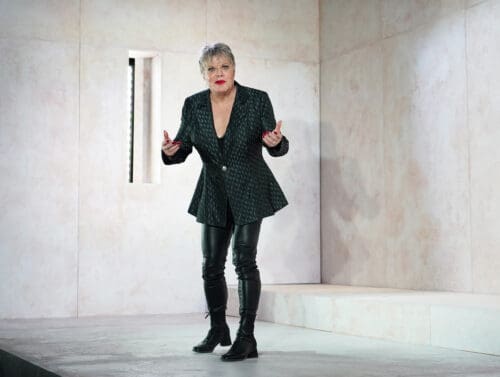
Needless to say, an exceptional Hamlet requires an exceptional concept, and this is achieved in The Tragedy of Hamlet, as adapted from the original by the star’s brother Mark Izzard and directed by Selina Cadell.
In his adaptation, Mark Izzard has reduced the play’s 30 to 40 dramatis personae (depending on how many Lords, Ladies, and other Attendants are called for) down to 22 characters, all of which, in addition to the titular role of the “down in the dumps Danskere,” are played by Izzard herself.
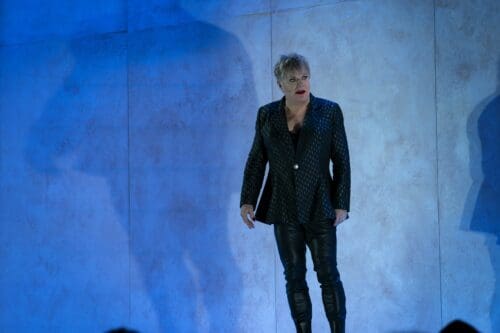
In choosing the Ricardo Montalbán Theatre for Izzard’s Hamlet, an international touring production, producers Arnold Engelman, Mick Perrin, and John Gore have selected one of the city’s most historic venues. Originally a showcase for acts travelling the vaudeville circuit known as Wilkes’ Vine Street Theatre, in 1927, it was the site that initiated Los Angeles’ legitimate theatre scene with the first staging of a hit from New York, An American Tragedy, adapted from Theodore Dreiser’s novel by playwright Patrick Kearney (a great uncle, apparently).
Tom Piper has provided a stunning white-box performing area that occupies half the Montalbán stage. It contains most of the play’s action within its illuminated confines (with brilliant gradation by lighting designer Tyler Elich), while allowing Izzard to break the fourth wall by stepping off into the darkness in an effort to capture the intimacy shared between performer and audience in Elizabethan theatre. Accenting Izzard’s performance and Cadell’s dexterous direction throughout are the melodies of composer Eliza Thompson.
Izzard is in nearly constant motion, assuming one character then another, engaging each in the dialogue of the other. In achieving this, Izzard is astonishingly successful due to an acute clarity of speech and the ability to define characters deftly—the specific skills that made her a comedy legend. There is scarcely a scene where there is any confusion as to who is talking to whom until the climactic conclusion, involving six speaking parts, fencing, poisonings, four death scenes, and an invading army that happens to be in the neighborhood.
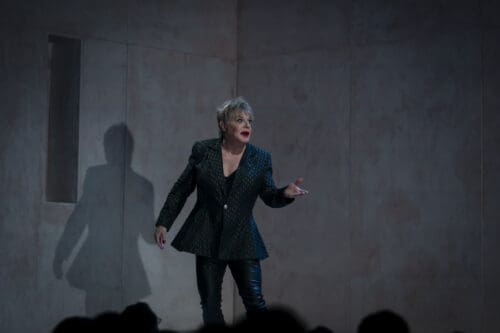
Izzard handles some multiple-character scenes with inventive whimsy, such as Hamlet’s interaction with the duplicitous couriers Rosencrantz and Guildenstern, who are represented merely by Izzard’s “chatting” hands.
Mark Izzard has sliced and diced Hamlet’s 4,167 lines and 29,551 words with the craftsmanship of a Benihana master chef, serving up a taste of every character. The only alteration I caught was replacing “bare bodkin” with “mere dagger.” Otherwise, his faithfulness to the language is impressive—though not as impressive as Izzard’s handling of it.
Of such clarity was Izzard’s delivery that it felt as if some in the audience were hearing the play for the first time. At nearly every familiar passage, the audience rippled with sounds of acknowledgement.
Izzard’s clarity of language and of character, as well as her comedic sensibilities, made this perhaps the most watchable of Hamlets an audience could hope for.
But clarity and character alone do not add up to dramatic impact. This was not a gripping Hamlet, but what stands out about this production is its almost educational quality. Izzard’s performance allowed her audience a means of seeing Shakespeare’s play in a clear, coherent fashion that none of them have ever likely experienced before. I know I haven’t. The marvel of this production, and of Izzard’s extraordinary performance, is the immaculate and pristine perspective it has presented the audience with, which will allow them to look upon this glorious and aged masterwork with a renewed and faultless vision.
✦ ✦ ✦ ✦ ✦ ✦ ✦ ✦ ✦ ✦
photos by Carol Rosegg and Amanda Searle
The Tragedy of Hamlet, Prince of Denmark
Westbeth Entertainment Production
The Montalbán Theatre, 1615 Vine Street, Los Angeles, CA 90028
ends on January 31, 2026
for tickets (starting at $85), visit Ticketmaster
TOUR CONTINUES for dates and cities, visit Izzard Hamlet
✦ ✦ ✦ ✦ ✦ ✦ ✦ ✦ ✦ ✦

We have just seen this in Canberra, Australia and are so very glad we did. She is such an accomplished performer. I have seen a lot of great plays in London, Britain generally, Sydney, but nothing that equals this in its form or magnitude for a single performer. Clever, captivating and moving, I don’t know how she has the capacity to pull it off. But she really owed the room.