


Areas We Cover
Categories

Theater Review: MY SON THE PLAYWRIGHT (Rogue Machine)

by Michael M. Landman-Karny | February 9, 2026
in Los Angeles, Theater
TWO MONOLOGUES
IN SEARCH OF A DIALOGUE
Justin Tanner has spent decades making chaos look easy. Those early Cast Theatre productions like Pot Mom and Zombie Attack trafficked in a particular brand of Los Angeles mayhem — high energy and unruly and knowing. With My Son the Playwright, now receiving its world premiere at Rogue Machine’s Henry Murray Stage, he’s after something harder: the chaos inside a single relationship, the kind that accumulates over years until it calcifies into pattern. This is autobiographical work, and Tanner performs both roles himself. The play is structured as a diptych. Act I presents Douglas, the father, alone in his Salinas apartment; Act II gives us James, the playwright son, alone in Los Angeles. Neither man can reach the other. The architecture insists on the problem.

Douglas drinks gin throughout his monologue, not socially but methodically, like a man with a project to complete. He begins by declaring, with the strained casualness of someone who’s rehearsed the line, that his son is a playwright: “not exactly the field a dad wants his son to go into.” The remark does two things at once, dismisses and discloses. As Douglas continues, the portrait grows increasingly disturbed. He resents James’s spending habits despite serving as his business manager and never addressing the issue directly; he characterizes his ex-wife as a “succubus”; he admits to sexual attraction to men he can’t or won’t acknowledge openly. The drinking loosens his tongue without clarifying his thinking. He circles his grievances like a man trapped in a hedge maze, always returning to the same dead ends.

Tanner understands that self-awareness offers no immunity against repetition. Douglas knows exactly what he’s doing and saying. The tragedy is his inability to imagine doing or saying anything else. When he confesses to inappropriately touching James’s boyfriend, the moment lands with real discomfort precisely because Tanner refuses to let us retreat into easy condemnation. This isn’t villainy but something worse: the slow accretion of small failures, each one justified at the time, that eventually constitute a life.

Act II reconfigures the same material from James’s vantage. He tears through his apartment hunting for marijuana before the dreaded drive to Salinas, excavating his history in the process. Childhood trauma, compulsive sexuality, creative anxiety, the psychological architecture his parents built inside him. Tanner’s performance shifts dramatically between acts. Under Lisa James‘ direction, his work as James has a different texture, more flamboyant and overtly damaged, still carrying the same inability to escape established patterns. He catalogs his sexual partners (an eleven-page list, he mentions), his substance use, his fantasy of firing a shotgun at party guests. Where Douglas spirals inward, James explodes outward. The fundamental problem remains identical. Both men stay trapped in monologues they can’t stop delivering.

The songs embedded in the show (Cat Stevens, Dionne Warwick, original compositions from “James’s boyfriend”) work as emotional counterpoint rather than reinforcement. When James performs “Something New is Born,” with its quasi-apocalyptic lyrics about endings and beginnings, the depression gets illuminated obliquely. The music refracts rather than explains.

This kind of durational performance is rare: two extended monologues, each requiring the actor to maintain engagement and chart a precise emotional trajectory without scene partners or major physical action. For Tanner, performing his own autobiography in this way adds another layer of complexity. The writing provides strong material. His ear for how people actually speak, how they repeat themselves and contradict themselves and justify themselves, is acute. The execution demands more than competence. Both roles require an actor who understands that drunk or anxious are conditions, not performances, and that these characters’ awareness of their own patterns is what makes them tragic rather than merely pathetic. Tanner manages this difficult balance, embodying both father and son without collapsing into caricature or therapy.

The play has the same weakness its characters have: a tendency to circle the same ground until circling becomes the point. Douglas and James spiral through their grievances multiple times. This reflects how trauma actually functions, looping endlessly and resisting resolution, though it occasionally tests theatrical patience. The repetition is clearly intentional, commentary rather than oversight. Still, intention doesn’t always equal impact. Tighter editing might strengthen the cumulative effect, though Tanner could reasonably argue that exhaustion is part of what he’s after.
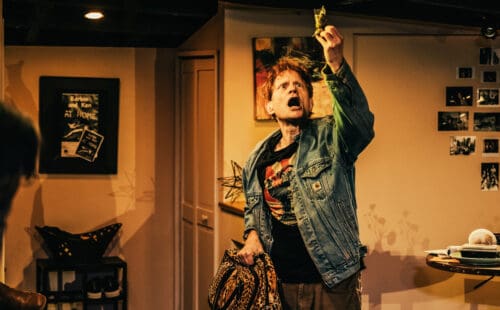
Mark Mendelson‘s set and lighting design, along with Megan Trapani-Diven‘s props, create lived-in spaces that feel specific without being overly determined. These apartments could belong to these particular people. The environments don’t overwhelm the language, appropriate for a play that lives almost entirely in what its characters say and fail to say.

My Son the Playwright succeeds because it’s willing to be uncomfortable, not sensationalist discomfort but the slow, grinding kind that comes from watching people who understand their problems but can’t imagine solving them. Tanner has written something too messy and specific for easy consumption. The play offers no catharsis or redemption. Both men will likely continue their dysfunctional dance indefinitely. What Tanner offers instead is an honest accounting of how families create the very isolation they’re desperate to escape. For audiences willing to sit with that discomfort, this is accomplished work that earns its duration.
✦ ✦ ✦ ✦ ✦ ✦ ✦ ✦ ✦ ✦
photos by Jeff Lorch
My Son the Playwright
Rogue Machine
Henry Murray Stage, 7657 Melrose Ave.
Fri and Mon at 8; Sat & Sun at 5
ends on March 1, 2026 EXTENDED to March 16, 2026
for tickets, visit Rogue Machine
✦ ✦ ✦ ✦ ✦ ✦ ✦ ✦ ✦ ✦
