


Areas We Cover
Categories

Theater Review: MI CASA ES SU TEATRO (Mishpocha Woods Artist Compound in Austin)
by Leo Emerson | February 14, 2026
in Texas, Theater
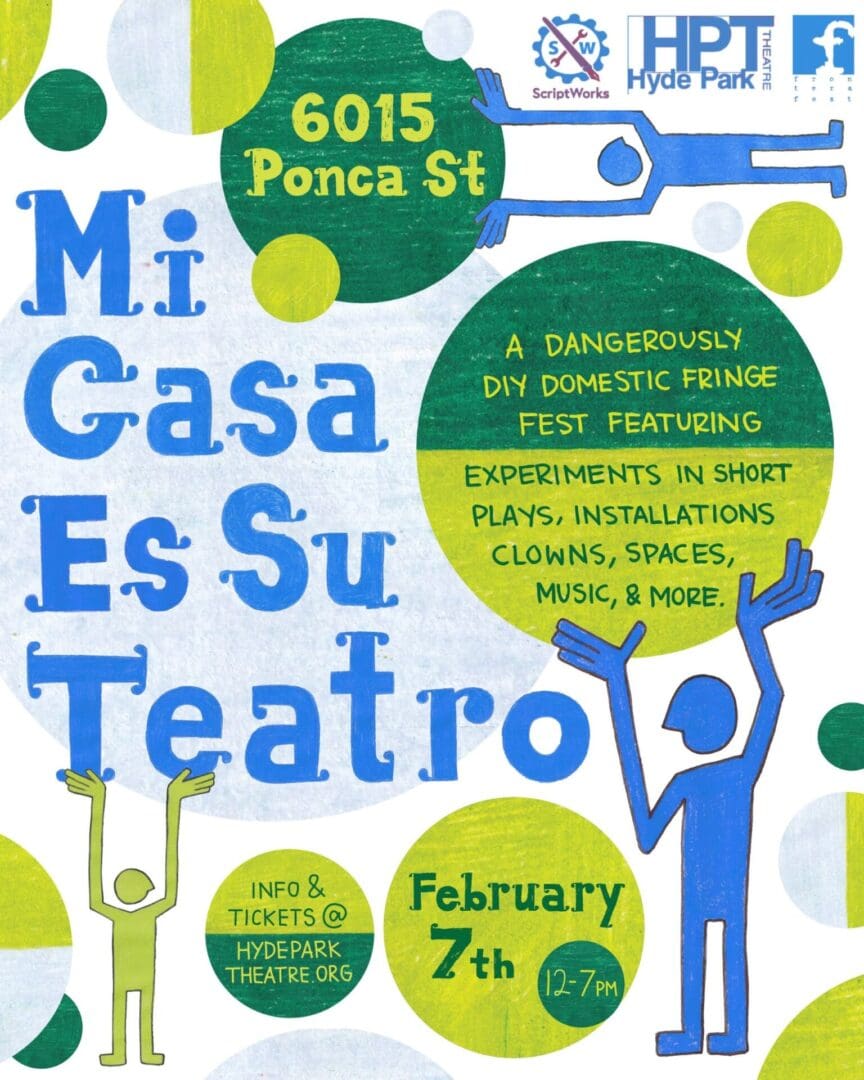
The success of Hyde Park Theatre’s Mi Casa Es Su Teatro (A dangerously domestic DIY fringe fest) — lies in its ability to showcase the symbiotic relationship between art and community. The works presented this year — ranging from the polished dramaturgy of Bradley Michalakis to the improvisational spirit of Drew and Vivian’s Recommended For You — demonstrate a local scene that is restless, inventive, and deeply personal.
Part of FronteraFest 2026, there were 20 performances and 6 installations on February 7, and I was able to cover a few (see below). Each performance felt like an invitation into the artist’s inner sanctum. One doesn’t just watch plays, but inhabits the spaces where these ideas are born. Under the production of Grant Gilker (a fantastic artist in their own right, and one you should keep an eye out for) and Malena Pennycock (whose Emily was a relevant escapade into our future with AI), the festival continues its role as an incubator for experimental storytelling. In the end, I left the Mishpoca compound and a blue shipping container not just a critic, but as a witness to the enduring power of the Austin creative community.
✦ ✦ ✦ ✦ ✦ ✦ ✦ ✦ ✦ ✦
Sometimes you find yourself crammed into a blue shipping container with eight strangers, wondering if the scattered dumbbells are part of the set. They aren’t. You later learn that the container usually houses gym equipment and bikes, but today, it is the stage of Vincent R. and his last performance.
Written by Bradley Michalakis, The Last Performance of Vincent R. is a one-man, one-act monologue detailing the rise and fall of the “greatest actor alive.” Initially, I was wary of Michalakis’s approach. He was overtly deferential, explaining the academic research behind the work—citing a reclusive “Society for the Advancement of Psychic Sciences” and the enigmatic actress Vera Heroney. As he passed around photos of Heroney, I feared I was in for a dry research lecture rather than “theatre.”
But when the performance truly begins, Michalakis transforms. A heavy red quilt is illuminated by the sharp click of a lamp, casting Vincent in a meditative silhouette. Vincent is performative in both speech and mannerism, lending an NPR style gravity to his life story. Michalakis’s skills as a storyteller bloom as Vincent recounts his fall from grace. In his performance, there is an undertone of insecurity and tragedy that satisfies the self-seriousness of Vincent’s history. Even the frequent humorous moments are underpinned by a growing momentum toward an inevitable collapse.
The heart of the narrative is Vincent’s obsession with Vera Heroney. While Vincent is a work of fiction, Heroney’s history was presented as fact. By intertwining them, Michalakis disarms our sense of reality, making Vincent feel as “real” as the historical figures cited. My initial concerns about the “academic” intro were clearly intentional—a mechanism to disrupt the audience’s subjectivity. Thus, the performance doesn’t begin with Vincent, but with my entrance into the shipping container. Michalakis frame works as a layer to dissect the performance itself—with questions of how an audience’s relationship with fact and fiction can determine how we judge a piece’s merit. The Last Performance of Vincent R. is a meditation on art that never feels burdened by its own philosophy. There is a reward for those who play greater attention, without detracting from the piece’s overall entertainment
You can see more of Bradley Michalakis’s work at the Alley Theatre, where he heads their Dramaturgy department.
✦ ✦ ✦ ✦ ✦ ✦ ✦ ✦ ✦ ✦
Despite its brief eleven-minute runtime, Charlie Sharpe’s Furry Play provides a satirical yet sincere portrayal of a frequently misunderstood community. Furries are often reduced to “kinky” stereotypes, a presumption Sharpe addresses immediately as Christfox (Kira Small), Torture (Carly Geary), and Allen (Jake Aigner) meet in a hotel room during a convention.
The plot is driven by Christfox, whose innocence draws both intrigue and ire. While the others embrace the more typical, often sexualized elements of the subculture, Christfox views her “fursona” as an escape from the agonies of being human, sex included. Torture remarks condescendingly, “Are you still a virgin?” Christfox attempts to explain, but it seems their identity is too complex to explain simply. In the play’s most intimate moment, Christfox and Torture don their suits and play together like animals. For a moment, they connect. However, the resolution is bittersweet: Torture leaves (for a contrived reason), and Christfox asks rhetorically, “Is something wrong with me?”
Ms. Small is exceptional. She throws herself into the role with a grounded sincerity that elevates the play from mere satire to a deeper exploration of self-discovery. While Geary and Aigner perform admirably, Small’s performance is the anchor.
What makes Furry Play resonate is that the furry subculture is ultimately incidental to its core message. Sharpe uses the characters’ exaggerated eccentricities to draw laughs, yet those same quirks skillfully betray their deeper insecurities and vulnerabilities. Ultimately, the work is not easily dismissed as a niche production for just the furry community, but a universal story available to any audience.
Charlie Sharpe is a writer in the Austin area.
✦ ✦ ✦ ✦ ✦ ✦ ✦ ✦ ✦ ✦
Zach Fine’s Dead Dog Bridge tells the story of Crab, a depressed dog coming to terms with his life. The name is a nod to the miserable hound in Shakespeare’s Two Gentlemen of Verona, and Fine’s version is just as prickly.
The piece begins with a trainer attempting to “teach an old dog new tricks” in the hopes of making Crab adoptable. Mr. Fine, dressed in furry shorts and a matching shirt, begins with silent clowning and miming before eventually finding his voice (with the help of treats and a chipotle burrito).
The performance felt lightly rehearsed, leading to self-aware improvisations that steadied the show but occasionally undercut the drama. At times, it felt more like “depressed stand-up” than theatre. Fine seemed almost too comfortable in his sadness, his confidence contradicting the character’s supposed brokenness. However, the script contains genuine nuggets of introspection, particularly regarding how the quest for an audience’s admiration can become a destructive force.
Zach Fine is an actor, director, playwright, and teacher at the University of Texas at Austin Department of Theatre and Dance.
✦ ✦ ✦ ✦ ✦ ✦ ✦ ✦ ✦ ✦
While every piece at Mi Casa projected a part of the artist, Robin Chotzinoff’s Project Time had the most heart. Performed inside Chotzinoff’s home in the Mishpoca compound, the “stage” was simply a section of her living room. I watched from a sinking green couch as the house filled with people — sitting on the floor, leaning against the kitchen counter, and peering down from the second-floor mezzanine.
I usually struggle with non-traditional theatre spaces. I value the craft required to turn a “black box” into a dark forest or a high castle. But sitting in Chotzinoff’s home, I sensed a beauty beyond an artist’s control.
Project Time is an unfinished musical Chotzinoff has worked on for years. The writing is ridiculous, playful, and inspiringly original. Aided by the magnificent Pattie Boo Rae, who plays every character, the piece reveals itself as a story less about “arts and crafts” and more about motherhood. In a larger venue, Chotzinoff’s soft singing and quite voice might have been lost. In her home, it was perfect. As the story comes to an end, Chotzinoff grieves at her daughter having grown-up. In her eyes was an immense longing for times gone by, and I couldn’t help but look around for the face of her daughter as if she might appear to take up the toys and songs that Chotzinoff had laid out for her. I hope that Chotzinoff continues to refine and build on what is already a beautiful story.
✦ ✦ ✦ ✦ ✦ ✦ ✦ ✦ ✦ ✦
Mi Casa Es Su Teatro
Hyde Park Theatre; part of FronteraFest 2026
Mishpocha Woods Artist Compound, 6015 Ponca St. in Austin
reviewed on February 7, 2026
for more info, visit Hyde Park Theatre
✦ ✦ ✦ ✦ ✦ ✦ ✦ ✦ ✦ ✦

This is exactly what our 💎 community needed at this moment